

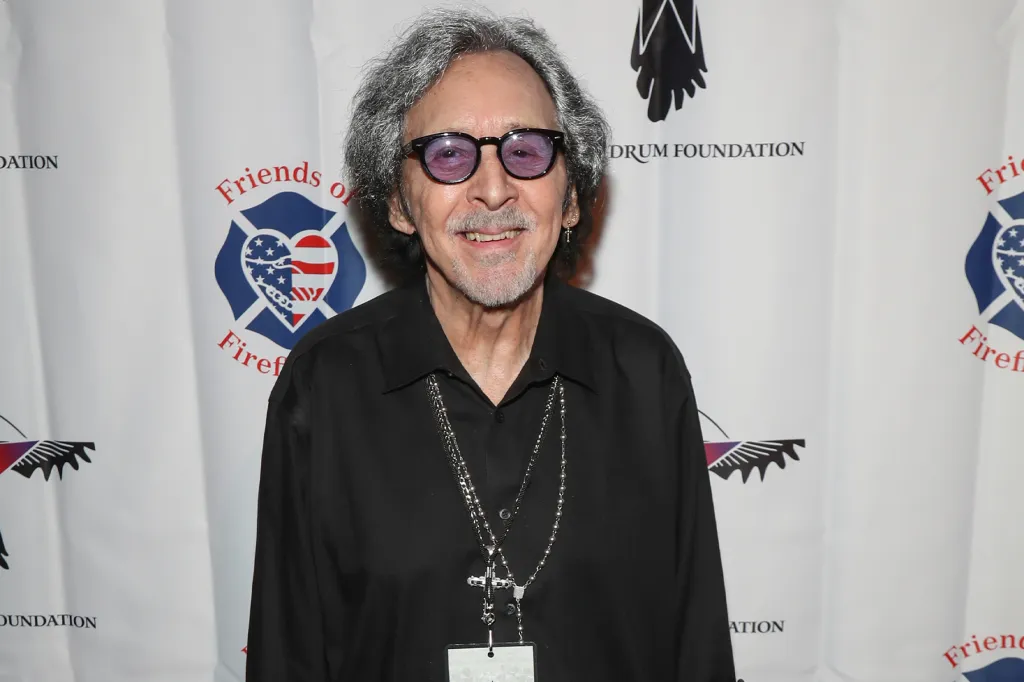
Peter Criss is countering KISS bandmate Gene Simmons’ recent claim that the Catman “had nothing to do” with the group’s 1976 hit, “Beth.”
Criss co-wrote — along with the late Stan Penridge and producer Bob Ezrin — and sang the group’s atypical ballad. It was initially released as the B-side to “Detroit Rock City,” but after garnering airplay on its own, became KISS’ biggest hit, peaking at No. 7 on the Billboard Hot 100. It was certified gold by the RIAA and won the People’s Choice Award for favorite song in 1977. “Beth” appears on KISS’ fourth studio album, Destroyer, its first to achieve platinum status.
Simmons told YouTube’s Professor of Rock that Criss’ role in the song has been overstated: “Peter had nothing to do with that song. He sang it…The mythology of ‘Beth’ is exactly that: mythology. The real story is Peter was lucky enough to be in the same place at the same time as a guy who wrote a song called ‘Beth.’” Contacted by Billboard, Criss — who last month released his self-titled first new solo album in 18 years — says in no uncertain terms that Simmons’ description of the “Beth” creative process is “not correct.”
“Gene wouldn’t know how the song was originally written because Gene wasn’t there from the conception of the song in the late ‘60s and he wasn’t there for the completion of the song with Bob Ezrin. Gene’s statements are ridiculous and very uncalled for; he talks about things that he doesn’t know about,” Criss tells Billboard.
“What Gene’s getting wrong is that as the singing songwriter, I wrote the melody and creating the phrasing for the song that’s on the original demo ‘Beck’ with Stan Penridge [his late bandmate from the pre-KISS Chelsea]. Out of Stan’s little black book what remained on the reworked version of ‘Beth’ is Stan’s original verse and chorus, and my core melody remains on the reworked composition. The core melody was expanded with Bob’s orchestration symphony and musical genius. Bob and I sat at the piano at the Record Plant studio working out the song. Bob Ezrin changed the tempo and made it slower, and I worked on changing some of the second verse and the phrasing with the slower tempo.”
Criss adds that, “Bob Ezrin changed the title from ‘Beck’ to ‘Beth’ — not Gene or anybody else. It was Bob Ezrin; He asked me, ‘Peter, do you mind if we change the title?’ I said, ‘Absolutely not. Beth is much better.’ Bob took the song home and fixed the rest of the lyrics and the structure of the song. He added piano, some time changes and the incredible orchestra composition which elevated the song beyond my wildest my dreams. It was mind-blowing.
“The day the New York Philharmonic came in and recorded its part was one of the most beautiful days of my life. Stan’s input, my input, my voice and mostly Bob’s absolute musical genius is responsible for the success of ‘Beth.’ Without Bob Ezrin’s input and orchestral composition the song would not be what it is today, and I am so grateful to Bob.”
Ezrin, meanwhile, tells Billboard that Simmons’ account is “not exactly how I remember it. I believe from what I was told that the original song was written by Criss and Penridge and was called ‘Beck.’ It was a bit rockier and more macho. I felt it had potential, so I asked to take it home and play with it a bit. I did slow it down, as Gene says, and I created that piano part but also (made it) more vulnerable and sensitive…. It became more of a tragedy where both their hearts were broken. The section in the middle of ‘Great Expectations,’ another song on the same album, was public domain, but the middle of ‘Beth’ is my composition.”
Criss, 80, recalls that, “Gene and Paul (Stanley) hated the song because it was a ballad and they did not want a ballad. It was Bob Ezrin who suggested the band needed a ballad because we had no girls in our audience.” The band’s manager, Bill Aucoin, agreed and supported Bob’s idea.
“No one knew ‘Beth’ was going to be a big hit. My name was credited to that song before it was a hit. I would not put my name on a song I had nothing to do with. That is not who I am. I would not do that.”
Criss also took offense at Simmons’ contention on Professor of Rock that, “Peter does not write songs. He doesn’t play a musical instrument. Drums are not a musical instrument, by definition. They’re called a percussive instrument. Really important, sometimes extremely important in a band. It was for us. But you cannot play a drum fill that could be (copyrighted). But you can come up with a riff that you can own, and a melody and a lyric. Those can be (copyrighted). But nothing you do on drums will prevent anybody else from directly copying whatever you did and applying it to another song.”
Criss counters that, “I do play an instrument. I play drums within the percussion family and drums are one of the oldest groups of musical instruments and a fundamental part of music. Acting as the rhythmic heartbeat that provides structure, tempo and energy, uniting other instruments and guiding the groove in most genres. Drums are critical for timekeeping, creating the foundation that allows other musicians to synchronize, making them essential for cohesive and popular music like rock, pop and jazz. By definition.”
The Brooklyn-born Criss, who now resides in New Jersey, served three tenures with KISS, beginning with its founding in 1973 through 1980, then from 1996-2000 and 2002-2004. There’s been a great deal of acrimony with Simmons and Stanley over the years, with the two calling Criss (and the late Ace Frehley) out over substance abuses. (Criss has been sober since the early ‘80s.) The three nevertheless accepted the band’s Kennedy Center Honor during December in Washington, D.C., a week before the release of the new Peter Criss album.
Criss is planning some personal appearances to promote the album this year and isn’t ruling out the possibility of some concert dates. He’s planning to start working on a follow-up album soon.





Leave a comment