

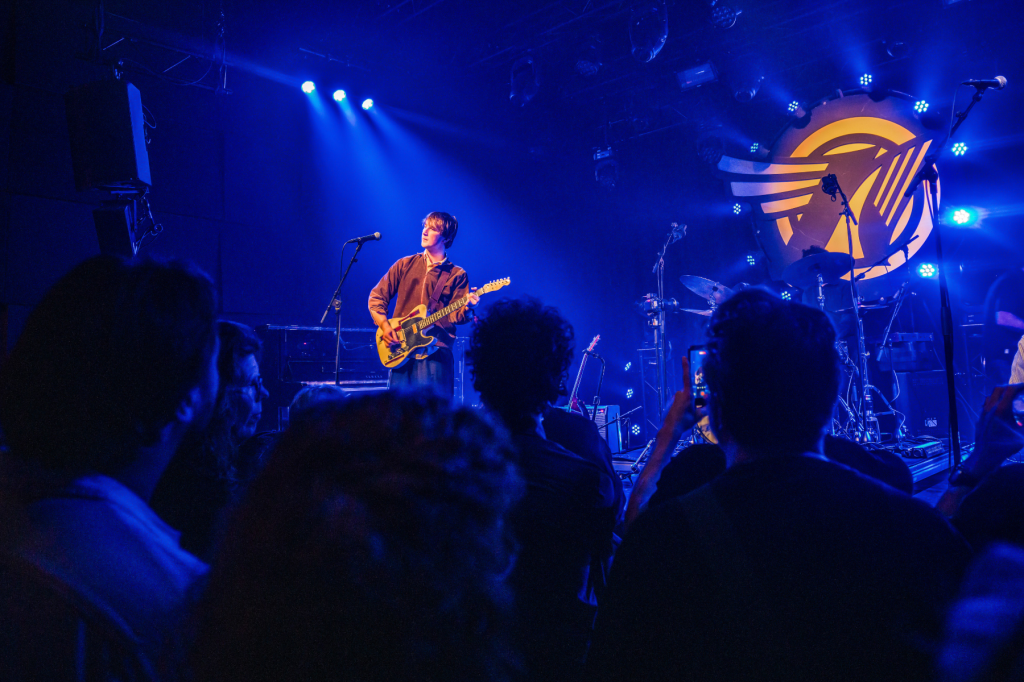
Featuring performances by over 300 emerging acts from 39 countries taking place, there was no shortage of fresh discoveries to be made at ESNS 2026. Now in its 40th year, the festival serves as a showcase event and a crucial meeting point for leading bookers, agents, and promoters, all in the name of introducing soon-to-be stars to the market.
With its tiny, sweltering venues and obligatory backdrop of icy January winds, ESNS annually turns the student city of Groningen into a living, breathing map of new European talent, a place where new sounds can cross borders and genres are freely bent out of shape. This year’s edition kicked off in earnest with a staggering performance from folk wunderkind Dove Ellis – for which the Dutch Queen Máxima was in attendance – at De Oosterport, showing punters and industry folk just what he’s made of.
Under the overarching theme of Europe Calling, ESNS 2026 reflected the full scope of the continent’s thriving music scene, while many a disappointed reveller was turned away from the most hotly-tipped shows. An impossibly long queue formed ahead of Florence Road’s breakout set, while shows from Irish six-piece Madra Salach and Hania Derej, a 20-year-old virtuoso pianist based in Kraków, Poland, saw young acts take musical risks in full view.
This fearless artistic spirit was also celebrated on Thursday (Jan. 15), at The Music Moves Europe Awards, which champions musicians from across Europe whose work reflects innovation and a growing international reach. This year’s MME Award recipients were Camille Yembe (Belgium), Carpetman (Ukraine), Della (Cyprus), Sarah Julia (Netherlands) and Sofie Royer (Austria), while the Jury Grand Prize was awarded to Lia Kali (Spain), who also received the MME Public Choice Award, voted for by fans and ESNS attendees.
Away from all the noise, meanwhile, the ESNS conference played host to important discussions surrounding the live sector, tech, mental health, AI and more, while also facilitating networking between musicians and industry figures. An hour-long keynote discussion with trailblazing agent Emma Banks, co-head of global touring at Creative Artists Agency (CAA), unpacked the headlines behind a booming market for stadium shows across Europe, while representatives from Sziget, Reeperbahn, Superbloom and Sunny Hill were in attendance to discuss an ever-changing festival landscape.
Here are the key stories and talking points from this year’s ESNS festival and conference.


-
Dove Ellis Takes Flight
As his stunning debut LP Blizzard continues to garner praise across music outlets and forums, Ireland’s Dove Ellis entered ESNS 2026 as one of this edition’s hottest tickets – and delivered with ease. For those lucky enough to find a spot inside a packed-out Oosterport Binnenzaal, walking into the dimly lit room to his intense, brooding sound was transportive: goodbye bustling Groningen, hello darkness.
An undercurrent of theatricality bubbled away through 22-year-old’s blend of folk and baroque, not least during “Heaven Has No Wings,” when deliberate pause for breath from Ellis only heightened the song’s soaring final chorus. It’s easy to see why everyone’s so excited about his early, but still quite raw, promise; by the end of the summer festival season, you suspect his star will fully be on the rise. – SOPHIE WILLIAMS
-
Local Ecosystems Need to Be Linked
European co-operation proved the leading topic across the week as the market – the second largest in the world behind North America – looks to hold its place amidst challenges from Latin America, Southeast Asia and India. A number of panels got into the nitty gritty of policy changes and initiatives that can benefit local regions, embolden creativity, and ensure new stars have a chance to succeed outside of major capitals.
Paul Callaghan, from Sunderland Music City, was among the speakers show how local initiatives and collaboration with stakeholders in the English city can benefit all: “Culture is the soul of the city,” he said alongside representatives from host city Groningen and as far away as Sicily, Italy. Linking up ideas, data, funds and stakeholders across regions, they say, will benefit all local music scenes moving forward. – THOMAS SMITH
-
Emma Banks Gives a Unique Insight
In Thursday’s keynote address, CAA’s Emma Banks spoke on the evolving nature of the live industry and an artist’s approaches when booking shows on the circuit. Banks works with stadium headliners such as Muse, Red Hot Chili Peppers and more, but stressed that a one-size fits-all approach is not how she approaches talent bookings.
Lily Allen’s acclaimed LP West End Girl, for example, will be first heard live in a theatre setting due to the record’s narrative structure and intimate approach. The success of that upcoming run and scaling up to arenas was a “reactive” moment because “we didn’t know what [West End Girl] was going to do.” With a sold-out U.S. run and Allen’s biggest-ever U.K. arena tour set to take place in 2026, the agent’s role in shaping how an audience first experiences music (and managing and responding to demand) remains crucial. – T.S.
-
Collaboration Doesn’t Come Easily
Although the theme of European co-operation was on the agenda, having all nations and organisations pulling in the same direction is not a given. At Friday’s panel titled Will Rosalía’s LUX Ignite Europe’s Return as the World’s No. 2 Music Power?, the conflicting approaches and philosophies to how best promote the region’s music were examined in an in-depth, if occasionally testy, conversation between key players from the IFPI and other local associations throughout the continent.
Comments by a high-ranking European Commissioner (the primary executive branch of the European Union) the day prior that music can be a “culture or an industry” and not both, rankled participants as they sought help from the biggest institutions to build the commercial opportunities within the region. The success of Rosalía’s LUX campaign felt like something of an after-thought in the discussion, but the passion and knowledge shown for the wider scene was clear to see. – T.S.
-
Future Utopia’s Disco Inferno
There was a time, towards the tail end of the 2010s, where Fraser T. Smith’s influence on British pop, grime and rap felt inescapable. Between 2018 to 2020 alone, the songwriter and super-producer had credits on records by Dave, RAYE and Stormzy; prior to that, he’d worked on Adele’s record-smashing 21 LP. In recent years, however, Smith has focused on developing his own project Future Utopia, which nods to the various strands of disco, house and electronica.
On stage at Simplon, Smith’s assured and instinctual performance – for which he was joined by drummer Anthony ‘Sweetstix’ Lewis and vocalist Molly J – was sublime enough even without the trippy projections, driven by the looseness of the trio’s groove. It felt almost impossible not to shake something or other while watching them shine. – S.W.





Leave a comment