

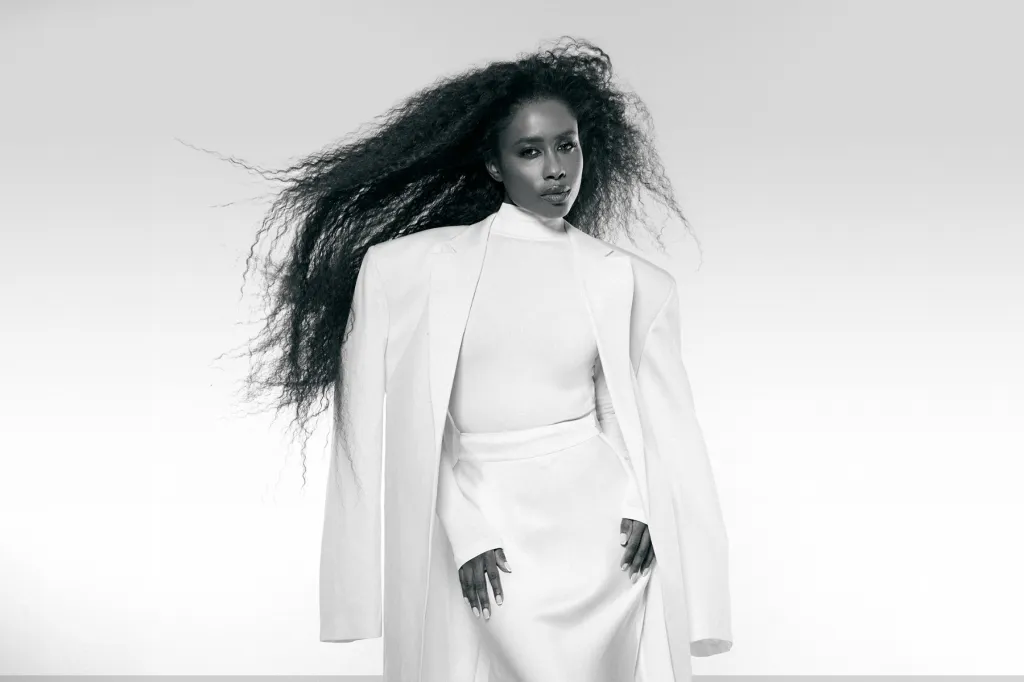
Dalia Mubarak didn’t arrive at the Billboard Arabia March cover shoot as just another cover star. She arrived as a woman carrying her entire life with her.
With her two daughters, Lily and Jazz, by her side, the set felt less like a production and more like a natural extension of her reality, where motherhood, work and creativity coexist.
Explore

See latest videos, charts and news
There’s an immediate familiarity to Dalia. At first, she comes across as effortlessly unpretentious, someone who doesn’t perform for the room. But as the moment unfolds, a clearer picture emerges: a woman deliberately shaping her life on her own terms, and a voice that moves with conviction.
Moving between takes, checking in on her daughters, and keeping an eye on the shoot, Dalia carried herself with warmth and generosity, never too busy to offer a smile, even in the most hectic moments.
Watching this, the cover lines began to write themselves. But the image was too layered to reduce to a single angle: there is Dalia the mother, the woman, and the artist, one of Saudi Arabia’s most distinctive voices carving her own path. Above all, she is a creator finding her way at a time of profound transformation across the Arab world.
That’s precisely why her presence on the March cover feels so fitting.
In a month where International Women’s Day meets Mother’s Day, the choice carries added resonance, especially as Dalia enters a pivotal moment in her career: a new album on the horizon and a highly anticipated role as a coach on The Voice Kids. More than ever, she seems more in sync with herself than ever.
Since 2014, Dalia has built her career with a quiet sense of purpose. She experiments, produces and moves fluidly between dialects, treating production and visuals not as decoration, but as extensions of her sound.
Her relationship with music began early, shaped in part by her mother, whose voice, Dalia insists, is sometimes even more beautiful than her own. From early attempts in talent show auditions to eventually sitting on the judging panel herself, her true breakthrough came in her early twenties. From the start, it was clear she was pushing Saudi music toward bolder territory, whether through lyrical choices or her ability to reframe Gulf poetry and feminine expression within a contemporary sonic landscape.
She has continuously expanded her musical boundaries, drawing from diverse rhythms and influences so that each release feels like a new challenge across voice, language, and performance. From the contemporary pop energy of “Mara ‘Aan Million” (One in a Million Woman), to the traditional Gulf spirit of “Yareitni Rajal” (I Wish I Were a Man), and more recently, her Iraqi dialect experiment “Arja’ La’en” (Come Back, Because…), Dalia resists settling into a single sound.
As she puts it, boredom has been her greatest enemy since childhood, and it doesn’t seem likely to catch up with her anytime soon.
Her trajectory includes milestones that arrived earlier than expected: becoming one of the youngest Saudi artists to join The Voice Kids as a coach, and gaining early recognition in global Billboard headlines following her signing with Warner Music, one of the first moves of its kind for a Saudi artist at that level.
When reminded of these achievements, her reaction was one of genuine surprise, as if hearing them for the first time. Off camera, she said, almost questioning rather than celebrating, “I never really reflected on that before… should I have? Maybe.”
That same honesty carried into the interview itself.
From the outset, it was clear Dalia doesn’t have much patience for overly polished conversations.
Whenever the discussion drifted toward the kind of rehearsed territory typical of artist interviews, she instinctively pulled it back to something more real, more human.
No matter the angle, honesty remained the anchor. Because with Dalia, the conversation doesn’t stop at the music, her personality is inseparable from her work. Which raises another way of looking at her: what if we read Dalia through her songs?
From “Qimmat Tumoohi” (Top of My Ambition) to “Ya Hasidi,” (Those Who Envy Me) from “Enta Koni” (You’re My Universe) to “Tamanni ‘Alaik,” (Let Me Check in on You), these titles feel like fragments of a personal narrative, each opening a window into a different layer of her identity: ambition, defiance, vulnerability, anger, heartbreak and a constant pull to reclaim control.
As the conversation deepened, those layers became more visible.
The woman who appeared so radiant and spontaneous also carried the weight of difficult chapters: two marriages, personal disappointments, clashes within the industry and moments where stepping away seemed easier than continuing.
And yet, alongside those challenges, her career has been marked by significant successes. The latest chapter: her role on The Voice Kids, which she described as a “divine sign” to keep going, at a time when she was genuinely close to walking away from music altogether.
There’s a quiet irony here.
Dalia, who speaks about motherhood with deep intensity, and openly admits she doesn’t want to go through the experience again due to the overwhelming love, emotional exhaustion and constant worry it entails, found her way back to herself, through children.
During our conversation, she recalled a moment with one of the young contestants on the show, a brief encounter that felt powerful enough to ground her again, or perhaps return her to her earliest beginnings, when the dream was simpler and less burdened.
Holding back tears, she said, “I had lost my passion. The energy I got from the kids reminded me of my dream, why I’m here, why I’m sitting in that chair.” She continued: “When I sat on The Voice panel and saw the kids, it felt like rescue. I was taking energy from them, and I told myself, ‘Dalia, you’re here because one day, you were there.’”
With that spark, the idea of retirement faded.
Now, she steps into a new phase, arguably her most energized yet, with her upcoming album promising even greater diversity in dialects and musical directions. Iraqi joins the mix, alongside Egyptian, a dialect she has mastered over the years, bringing her closer to a wider Arab audience.
Which raises the question: is this the most liberated version of Dalia we’ve seen yet?
Whatever impression she leaves on those who meet her, or those who follow her, it’s likely they’ll see an artist more daring than ever. But Dalia herself resists being reduced to any single identity: not just an artist, not just a mother, not even a woman with an “inspirational story” in the conventional sense.
What lingers after the interview is something rarer: A woman who has reclaimed the center of her life, who has finally stopped trying to become what others expect, and simply started being herself. And perhaps that is exactly why this cover feels so fitting.
This in an English translation of an article that originally appeared on Billboard Arabia.
Billboard Arabia





Leave a comment