

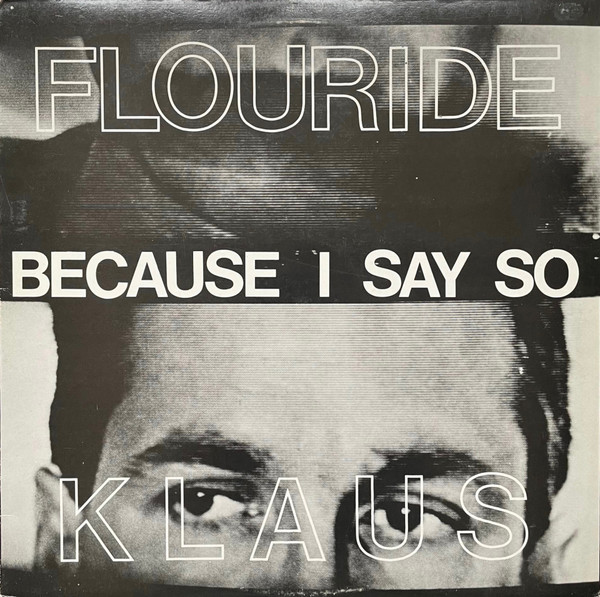
Martin Gray takes a journey back to 1988 and revisits the debut full length solo album Because I Say So by influential Dead Kennedys bassist Klaus Flouride, and finds himself still enthralled by the off kilter and unconventional mix of sinister electronica and genre-defying sounds featured within.

The sub-culture of weird and uncategoriseable was pretty much alive and well throughout much of the 1980s – a decade that has since become unfairly maligned in more ways than one but nevertheless bequeathed us so much fascinating and intriguing music. If one dug a little deeper and chanced a peek beyond some of the more noted proponents of this defiantly uncompromising scene (e.g. pretty much all of the US underground acts like Minutemen, The Residents, Oingo Boingo, Butthole Surfers, to name a few, as well as an emerging UK scene centered on genre-bending experimental post-punk/noise acts on labels such as Play Hard and Ron Johnson), they might come across one particular oddity that emerged toward the end of the decade with very little fanfare.
Said oddity was the first full length album from former Dead Kennedys bassist Klaus Flouride (born Geoffrey Lyall in Detroit, Michigan). Titled Because I Say So, it is a complete anomaly that stands defiantly alone among all of the records that were released that year, 1988. It also happens to be one of the most intriguing and fascinatingly bizarre records of its time, its contents transcending a variety of genres – but on closer examination also appearing to openly crib and satirise them.
After the Dead Kennedys disbanded in January 1986, amid disillusionment with elements of their own fanbase and the sanctimonious attitudes shown by the record industry regarding censorship in general, the various members went about their own solo endeavours but nevertheless reconvened in summer to record their final studio album Bedtime For Democracy which was eventually released in November that year. From that point onward, there was no more new DK material and Klaus Flouride set about further work on his first solo dabblings that initially emerged in 1985 on a mini-LP/maxi-EP entitled Cha Cha Cha With Mr Flouride – issued whilst the Kennedys were still very much active and touring the Frankenchrist album which was released the same year.
Klaus Flouride’s modus operandi was straightforward: to make a record with nary any nod to commerciality or concessions to mass public acceptance. Dabbling with a variety of different styles and approaches, he settled on the two main branches of his interests which were to create atmospheric instrumental pieces that could serve as soundtrack material, and to indulge in bizarre off-kilter musical sketches that adopted a variety of styles that either tipped their hat to – or more likely lampooned – genres such as blues, pop, country, punk rock and various points in between.
Because I Say So is a consciously – I would say gloriously – chaotic, unfocused and unwieldy beast that, in the space of its 56 minute running time and 19 tracks (CD version), delights in doing the job of wrong-footing and baffling the listener at almost every turn as each track sets a scene and either sticks to it or veers off at tangents and in so doing confronts the listener with moments of either unexpected suspense and terror or occasionally calm and tranquility.
You even get the impression that Klaus is probably secretly laughing at the sheer absurdity of how everything is so meticulously contrived as to cause the maximum unease and dread, only to then come out with some totally flippant and innocuous sing-along numbers to lighten the mood before whacking you over the head once again with more deliberately jarring atonal synthesised menace.
The album pulls no punches with its ominous opener: Door Slammer, which is basically a repeated doomy electronic keyboard drone comprised of just two sea-sawing notes that sounds so apocalyptic and foreboding it’s like the gates of Hades opening (together with a leaden percussive noise like the slow-motion flapping of giant demonic bat wings), ushering you into its infernal maw, before it quickly subsides and track two Eclipse (Blue/White) fades in with the ambient sounds of rain or waves, and distant foghorns backing a slow insistent acoustic guitar figure, which then changes to an electric guitar playing the same riff across two full octaves.
It’s a pleasant enough contrast from what has just gone before, but even here the constant hum of drones and hissing dissonance hints at some further tension in the air, so any respite is duly broken by the start of the third track Feeding Time In Hell – a creepy piano-and-double-bass motif with a suspended final chord that promptly gives way to skin-crawling groans (created either by treated saxophones or sampled human voices) that conjure up visions of undead entities calling from deep below and trying to reach up to grab you by the ankles and drag you down to join them. It’s perfectly nightmarish and unsettling and you find yourself looking nervously over your shoulder just in case some unseen presence has come into the room.
Elsewhere the distinctly uneasy listening vibes continue with the distorted synthesised cacophony of Born Again Dentistry, its overloaded droning synths sounding like a swarm of angry hornets amplified tenfold (face it, who doesn’t enjoy a trip to the orthodontic surgeon with this teeth-grating cacophony playing as background music, huh?), whilst the ghostly Desert Ships appears to be comprised of sampled funnel belches (some of them eerily pitch-bent) from the eponymous vessels overlaid with lacerating electronic whiplash effects.
Most disquieting of all however, is Pretty Flowers half way through the second side. Taking a lot of its harsh tune-free cue from the likes of Throbbing Gristle, it’s a funeral-paced piece of electronic sludge with a heavily treated (and pitch-lowered) voice admonishing an unseen victim (‘how could you? how could you be so worthless?’) and as it progresses a scree of ear-bleeding scraping noise starts emerging from the churning maelstrom like a train’s brake wheels squealing on the tracks, and gets ever louder in the mix until towards the five minute mark it becomes so piercing it’s unbearable. It’s truly unpleasant and deliciously obnoxious aural torture.
By way of contrast, however, there are also moments are genuine beauty to be found: Akiko is a lovely airy instrumental led by guitar and keyboard synth that lacks the brooding claustrophobia of other numbers on the album, even when its dramatic climax arrives at the end where the guitars start fuzzing out. A second rendition of Eclipse – this time parenthesised with (Blue/Green) – is much brisker in tempo and is briefly strummed out on a single acoustic guitar before it abruptly rings to an end.
Listen to the whole of Because I Say So via this You Tube video:
Where the mood and tone lightens on the album courtesy of the few actual songs on here we’re treated to a couple of throwaway cover versions: the first, Charlies Friends, is a straight countrified take on the 1975 song by US folk singer and prose artist Joel Zoss whilst the second, Dominating Baby, is a playful retro-blues gallop through the 1969 track by Norman Greenbaum with Dr. West’s Medicine Show and Junk Band.
However, these two are countered by a couple of further self-penned numbers, one of which is the decidedly boisterous punk-cum-rockabilly thrash of Bus Thru The Barrier – a consciously dumb and repetitive 3.44 minutes consisting solely of one lyric ‘We’ll take the bus thru the barrier / bus thru the barrier / take the bus thru the barrier / all the way home thru the barrier’ repeated over and over again and initially sung through vocoder. Gradually becoming more riotous, it might finally run out of steam and yield to the lengthy, sparse and dank instrumental interlude The Drowning Cowboy (sounding for all the world like it was recorded in an underground concrete storm drain) but just when you thought you’d heard enough of that repetitive ‘bus’ refrain, back it comes, fading in again four tracks later for a 25-second reprise before it abruptly shuts the fuck up and cuts off (something nagging suggests to me that the original full unedited version must have lasted in excess of twenty minutes!).
Two tracks later comes the album’s centrepiece Keep On Walking – a sprawling six-and-a-half minute pastiche of the Beatles’ Let It Be AND Hey Jude which, due to its reverential and almost straight faced and earnest delivery, coupled with an atypical lyric built on positivity and hope, makes this track the sole red herring on an album filled with many weird and peculiar moments. It begins with a quiet piano and voice combo – with Klaus doing his best Macca-meets-Neil Young vocal – before the song starts to build with a chorus featuring backing vocalists chanting the naggingly catchy refrain: ‘How you gonna keep your head off the ground? Keep on walkin’, keep on walkin”. After the second verse this is how the song gradually climaxes, with this chorus/refrain repeated endlessly to fade, just like with the four minute wordless chanting ‘na na na na..’ coda that was Hey Jude’s famous slow fade. It’s completely uncharacteristic of the album and sticks out like a sore thumb, but nevertheless provides the sole pleasantly conventional moment on here.
A revisit of an earlier song (from his debut 1985 EP) So It Goes appears here in a remix and with words added to the original skeletal electronic backing: now resembling something by The Residents. The lyrics are dryly amusing: ‘In this day and age, good cha-cha records are hard to find / When one finds one, it’s sure to give peace of mind…..Cha-cha music must have a good lyric I suppose / Try as I might I just can’t come up with one, so it goes’. And then things get even more hilariously self-reverential with the final stanza: ‘Mr. Flouride is fighting with Mr. Tooth Decay / He is flossing and he is brushing, thrice a day…..One, two, cha-cha-cha (repeat 25 times)’. It’s pretty much a triplet of non-sequiturs set to music. Who says Klaus doesn’t possess a surreal self-mocking sense of humour?
Of the final pair of closing tracks, El Sid (The Credit Song) does exactly what it says on the tin – a full list of contributor credits read out in Klaus’ electronically-distorted voice, whilst The Final Word is another brooding disquieting synth drone-dominated instrumental outro with piercing keyboard stabs to keep up the tension right to the very end. But just when you think that’s the album finally done with, we’re given yet another alternative ending … fading back in is the refrain to Keep On Walking, this time as a 54 second reprise – and here the track finally ends with Klaus shouting ‘a round of applause!!’ to rapturous cheers and laughter from the massed singers in the studio.
There are a few words on the inlay which state that this album ‘includes music from the Phil Tippit film ‘Mad God”, which I found intriguing because no matter how much I searched and asked around at the time, I drew nothing but blanks. It’s not even known or confirmed if indeed such a film ever existed. This remains a bit of a conundrum. Equally cryptic are four further words which immediately follow: ‘You CAN tuna fish’. Make of that what you will!
Since I first came across this album in 1989 thanks to a couple of reviews in the then inkies (Melody Maker and NME) which made me intrigued enough to investigate, I have played this so many times I have actually lost count. It’s a really addictive listen to which I keep returning time and time again. Rather like how Barry Adamson released a series of fascinating solo albums which were soundtracks for films that actually didn’t exist (starting with Moss Side Story – also released in 1989), Klaus Flouride here provided – for me at least – an ideal soundtrack accompaniment to the darker and more twisted recesses of the imagination. Music that is in turns variously ambient and soothing as well as sinister, foreboding and jarring, but then also throwaway, frivolous and even spiritual.
Because I Say So, even after almost 36 years having slipped under the radar, continues to be addictive ear candy for this writer. It’s a truly fascinating piece of work whose very low key existence may ultimately have been detrimental to its chances of being heard or appreciated by a wider audience (even many DK fans) such that it’s well worth revisiting.
Re-appraisal written by Martin Gray
Further pieces in this series and other reviews and articles can be found on Martin’s profile
Please note: Klaus Flouride does not have or maintain an active social media page, but there may be pages set up by fans such as this one on Instagram
You can, however, still access his parent band the Dead Kennedys on their main web page here
A Plea From Louder Than War
Louder Than War is run by a small but dedicated independent team, and we rely on the small amount of money we generate to keep the site running smoothly. Any money we do get is not lining the pockets of oligarchs or mad-cap billionaires dictating what our journalists are allowed to think and write, or hungry shareholders. We know times are tough, and we want to continue bringing you news on the most interesting releases, the latest gigs and anything else that tickles our fancy. We are not driven by profit, just pure enthusiasm for a scene that each and every one of us is passionate about.
To us, music and culture are eveything, without them, our very souls shrivel and die. We do not charge artists for the exposure we give them and to many, what we do is absolutely vital. Subscribing to one of our paid tiers takes just a minute, and each sign-up makes a huge impact, helping to keep the flame of independent music burning! Please click the button below to help.
John Robb – Editor in Chief
PLEASE SUBSCRIBE TO LTW





Leave a comment