
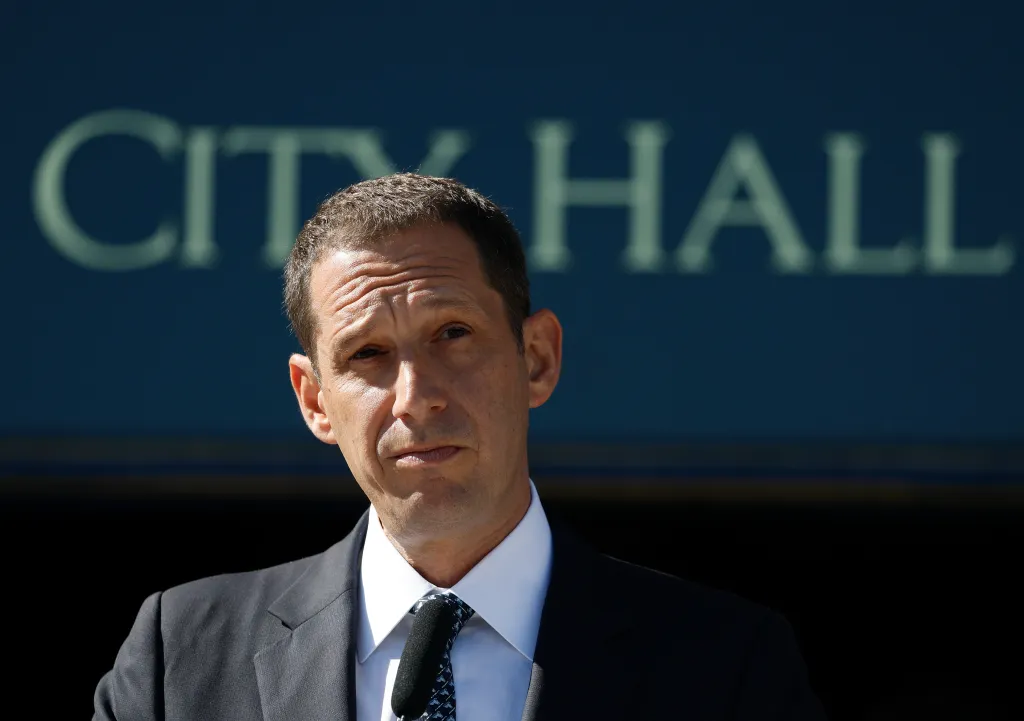
San Francisco Mayor Daniel Lurie arrived in Seoul with a recovery argument: for a post-pandemic city working to bring people back downtown, music is not nightlife at the margins. It is civic infrastructure.
From April 21 to 23, Lurie spent three days in Seoul marking the 50th anniversary of the San Francisco–Seoul sister-city relationship, on what local coverage described as his first official overseas trip since taking office. Traveling with him was a delegation of arts, culture and business leaders, including EMPIRE founder and CEO Ghazi Shami, whose San Francisco-headquartered independent music company has been expanding its Asia strategy since appointing Jeffrey Yoo as senior vp of East Asia in October 2024.
Related

For Lurie and Shami, Seoul functioned as more than a diplomatic stop. The visit clarified a broader alignment between culture, business and city-building: San Francisco is using live music and public programming as part of its recovery strategy, while EMPIRE is expanding Asia as a major axis of its global operation. Seoul offered a natural meeting point for both.
“Our philosophy at City Hall is to create the conditions so that culture leaders can do what they do best,” Lurie told Billboard Korea. “And that starts with public safety. You don’t get that right, nothing else works.”
Lurie, who founded the anti-poverty nonprofit Tipping Point Community before becoming San Francisco’s 46th mayor in January 2025, has built his administration around the visible repair of a city whose downtown struggled sharply through the pandemic years. In his telling, the work is not only about policing or office vacancy. It is about rebuilding the conditions that make people choose a city again.
That means public safety. It means permitting reform. And increasingly, it means programming the city through concerts, festivals and cultural events at a scale large enough to change behavior.
In summer 2025, during Lurie’s first year in office, San Francisco hosted a three-weekend run of major music events in Golden Gate Park: Dead & Company’s three-night stand marking the Grateful Dead’s 60th anniversary, the long-running Outside Lands festival, and a Zach Bryan concert at the Polo Field. According to the mayor’s office, the block was projected to generate $150 million in local economic activity and drew more than 450,000 attendees.
Related

“We had three weekends of music that brought in close to half a million people,” Lurie said. “Music, arts, culture brings people together. It brings people to our city to come see shows.”
What turns that programming into policy is San Francisco’s entertainment-zone and permitting overhaul. In May 2025, Lurie signed legislation creating five new Entertainment Zones across the city — designated areas where, under California state legislation championed by State Sen. Scott Wiener, open-container alcohol consumption is permitted on closed streets during sanctioned events. With those additions, San Francisco had 21 entertainment zones adopted or pending, according to the mayor’s office.
The model is designed to reduce the cost and friction of outdoor events by making it easier for neighborhoods, restaurants, bars, artists and promoters to turn streets into programmed cultural space. For visiting artists, labels and cultural partners, the framework could offer a more flexible layer of activation beyond the traditional ticketed concert: outdoor showcases, fan-facing pop-ups and neighborhood-scale events that can sit alongside a larger tour or release campaign.
PermitSF, Lurie’s regulatory-reform package, is the other half of the strategy. The mayor described it as a broad attempt to make San Francisco easier to build in, operate in and reimagine.
“We have done 20 pieces of legislation to make it easier to have concerts, to build housing, to start a small business, or to take over a huge new building and reimagine it from the ground up,” he said. “Our job is to create the conditions for San Francisco’s comeback.”
Related

Lurie returned often to the relationship between City Hall and small business, describing entrepreneurs and cultural businesses as partners in the city’s recovery.
“We look at our small-business community as a partner,” he said. “With Ghazi, it’s about creativity, but it’s also about the city — and how his company gives back to the community. I believe it has to be a partnership.”
Lurie also cited a shift in local sentiment, referencing San Francisco Chamber of Commerce CityBeat polling: two years ago, 22% of San Franciscans felt the city was heading in the right direction. Today, he said, that figure is about 65%.
“A new chapter of San Francisco is being written,” Lurie said.
Seoul offered a useful counterpoint. South Korea has increasingly turned music and popular culture into tourism experiences and cultural strategy, not only through concerts but through adjacent programming: dance classes, broadcast-studio tours, K-pop-themed experiences and festival-linked tourism programs.
That model is visible in both public policy and visitor behavior. In 2026, South Korea’s Ministry of Culture, Sports and Tourism said it would intensively foster “Global Festivals” as part of a broader goal to attract 30 million inbound tourists, while recent local coverage has pointed to K-pop and K-culture experiences as a growing part of foreign visitors’ itineraries. BTS-related tourism has also shown how a major music event can move fans through multiple districts and cultural sites, but the broader point is not limited to one act: in Korea, music increasingly operates beyond the venue, as a route into tourism, local business, public space and city identity.
Related

EMPIRE is a visible music-industry example in San Francisco’s version of that chapter. Founded in San Francisco in 2010 by Shami, the independent label, distributor and publisher has built its reputation on artist-friendly, non-exclusive structures and a technology-driven back end outside the major-label system. Its roster includes Shaboozey, whose country-pop breakout “A Bar Song (Tipsy)” spent 19 non-consecutive weeks at No. 1 on the Billboard Hot 100, tying the all-time record set by Lil Nas X’s “Old Town Road” in 2019.
In January 2025, EMPIRE acquired the historic One Montgomery Street building in San Francisco’s Financial District as its new global headquarters, with a planned rooftop concert venue later submitted for city review. The move anchored Shami’s company more visibly in downtown San Francisco at a moment when the city was looking to reconnect business, culture and public life.
For Lurie, that matters.
“Entrepreneurs and business leaders like Ghazi, who have gone through the ups and downs of our city, born and raised in our city — it means everything,” Lurie said. “The global nature of his work is synonymous with what San Francisco is: a global city.”
For Shami, EMPIRE’s San Francisco identity is not a branding layer. It is part of the company’s operating system.
“EMPIRE is really a reflection of what San Francisco is,” Shami told Billboard Korea. “Incredibly like-minded people. Independent entrepreneurship.”
That operating system is now extending further into Asia. In October 2024, EMPIRE appointed Jeffrey Yoo — the executive who previously worked with Korean R&B artist DEAN and helped develop Jackson Wang’s international career — as senior vp of East Asia. The first signing under Yoo was G-Dragon, in partnership with the artist’s Korean agency Galaxy Corporation.
G-Dragon’s third studio album, Übermensch, was released February 25, 2025 via Galaxy Corporation and EMPIRE. The album ranked No. 10 on IFPI’s Global Album Sales Chart for 2025, while its title track, “TOO BAD,” featured Anderson .Paak.
EMPIRE has since signed a deal with Cambodian music company Baramey Production and, in April 2026 — the same month as Lurie’s Seoul visit — announced a strategic global partnership with Bollywood powerhouse Zee Music Company.
Asked what EMPIRE offers in 2026 that the major-label system does not, Shami pointed less to genre or geography than to internal architecture.
Related

“In San Francisco, my CFO is Korean. My head of FP&A is Korean. I have Koreans in marketing and royalty processing, in many departments,” he said. “Because if we’re going to build a footprint here in Seoul and in greater Korea, you have to have that triangulation — where you’re triangulating culture but also business.”
That idea — triangulating culture and business — also described Lurie’s Seoul delegation. Lurie said the broader group included leaders from San Francisco’s arts and cultural institutions, including SFMOMA, the San Francisco Ballet, San Francisco Opera, the California Academy of Sciences and the Exploratorium. He also pointed to Korean-rooted leadership inside San Francisco’s cultural establishment, including San Francisco Opera music director Eun Sun Kim and Asian Art Museum director Dr. Soyoung Lee, as evidence that the connection between the two cities is already embedded inside institutional life.
“We have leaders of many of our arts and cultural institutions traveling with us,” Lurie said. “Those two leaders are representative of the Korean leadership in our city.”
The three-day itinerary included a stone-donation ceremony at the Garden of Gratitude memorial site at Gwanghwamun Square, a ceremonial first pitch at Gocheok Sky Dome, a Myeong-dong walk-through and meetings with Seoul Mayor Oh Se-hoon.
The trip ultimately positioned the San Francisco–Seoul relationship as more than a ceremonial anniversary. San Francisco is using cultural activity as part of its recovery strategy. EMPIRE is expanding Asia as a major axis of its global operation. Seoul, with its concentration of music, technology, fandom and cultural-export infrastructure, showed where those two movements could overlap.
“My first time to Seoul,” Lurie said. “It’s lived up to the reputation of being the center of arts, culture, K-pop and some incredible food. We look forward to deepening the connections between our two cities.”
Asked about the next phase, he framed the visit as groundwork for a relationship that is already moving beyond ceremony.
“Obviously, we have 50 years of sister-city relations,” Lurie said. “But what’s really exciting is how we can connect our cities even more deeply.”
Mayor Daniel Lurie and EMPIRE founder and CEO Ghazi Shami were interviewed by Jae Kim of Billboard Korea during Lurie’s April 2026 visit to Seoul.





Leave a comment