

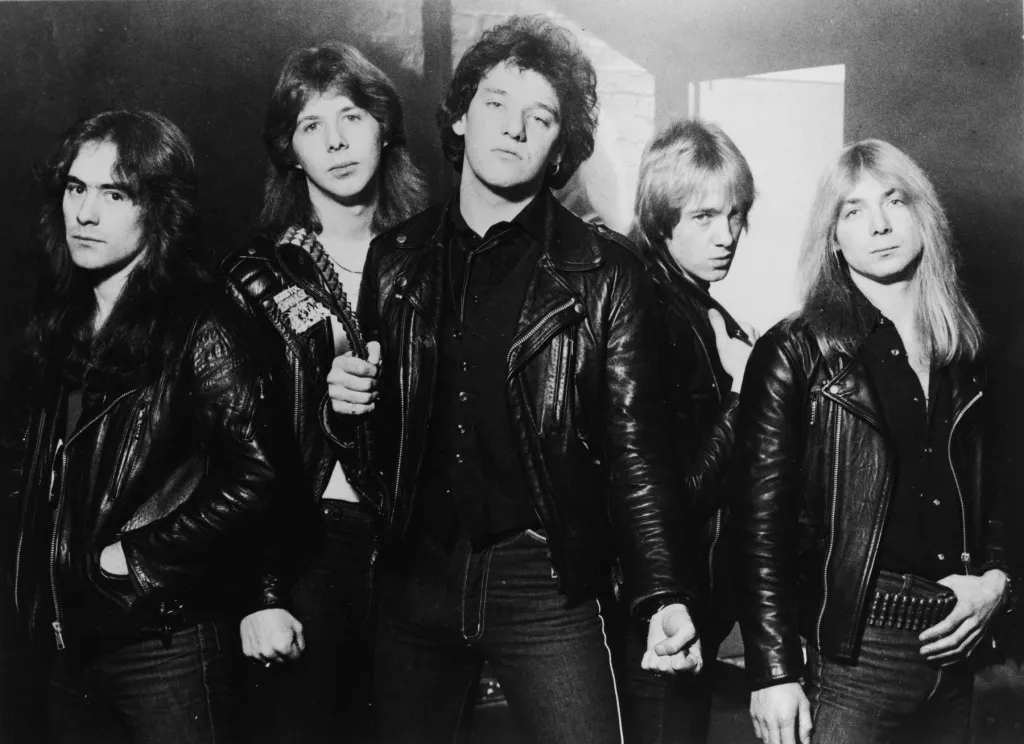
As a rock ‘n’ roll frontman, Paul Di’Anno left no stone unturned. However, after his passing in 2024, at the age of 66, the original Iron Maiden singer is surely one of the great “what ifs” in the heavier end of music.
Explore

See latest videos, charts and news
Di’Anno’s life, career and brutal health battles are the subject of a new feature-length documentary, Di’Anno – Iron Maiden’s Lost Singer, the work of filmmaker Wes Orshoski (Lemmy, The Damned: Don’t You Wish That We Were Dead).
The film screens in North American cinemas from June 9, through Cleopatra Entertainment, and features appearances by James Hetfield (Metallica), Gene Simmons (Kiss) Maiden’s Steve Harris and members of Exodus, Slayer, Megadeth, Overkill and Sepultura.
In it, Orshoski unearths footage of Di’Anno in his pomp, a pioneer who bent metal into punk and led from the front on the first two Maiden album. Poor lifestyle choices led to poor health, and Di’Anno’s final years, as we observe in the film, are anything but a heavy metal miracle. By the mid-2010s, Di’Anno was wheelchair-bound due to crippling knee injuries, a grim situation that contributed to anxiety and depression, all of which the late rocker discusses in the film.
Still, his voice remained mighty when his body failed him, and Di’Anno was always planning, hoping to hit the road again. In one touching moment, caught on film, Di’Anno learned that his old Maiden bandmates would step in to cover his extensive medical bills.
“My film largely centers on their efforts to help Paul get back on his feet, professionally, emotionally and literally,” explains Orshoski. Through the extensive process, the setbacks, and the hope, “I grew a lot from working with Paul,” he admits.
Di’Anno was the frontman with Maiden from 1978 to 1981, leading from the front for the British band’s self-titled album from 1980 and its followup from 1981, Killers. He split with the group before their 1982 commercial breakthrough with The Number of the Beast, which introduced new vocalist Bruce Dickinson, the band’s frontman to this day.
“Those first two albums are so special to me,” says Metallica’s Hetfield at the top of the doc. “Paul had kinda like the ultimate metal voice for me.”
In his post-Maiden career, Di’Anno worked recorded and toured as a solo artist and as a member of such groups as Gogmagog, Di’Anno’s Battlezone, Killers, Rockfellas, and Warhorse.
Billboard caught up with Orshoski to discuss the film, almost 10 years in the making. And, of course, its tragic subject.
Billboard: It feels like the planets aligned this year for Iron Maiden, with Rock Hall induction, the band doing some of their biggest shows, and two documentaries. How did your film come about?
Wes Orshoski: I’m thrilled to see Maiden voted in this year. I grew up in the Cleveland area and the Rock Hall means a lot to me. There are a lot of acts that have been criminally ignored, like INXS, the Smiths and Joy Division, but Maiden to me is the biggest wrong that needed to be righted with this year’s vote.
My film has been a long time coming. I started work on it in 2017, not long after Matt Green at Cleopatra Records and his longtime friend and former Di’Anno bandmate Cliff Evans reached out to me and pitched me on it. I was intrigued and said “yes” immediately. I grew up a fan of Bruce Dickinson (Di’Anno’s replacement) and never really knew that much about Paul, but I knew that his legend still loomed large.
So, I knew there was going to be an incredible story to tell. But I can’t believe how things really came together for in the end.
Documentaries are a labor of love. Can you give me a sense of the challenges you were faced with in the making this film?
Well, before I ever even met Paul, he misled me on the phone about his physical condition. He made it seem like he would be on his feet in a month or so, after a minor medical procedure and a month after that I would be filming him on tour in Brazil. The first time I ever met him was at the front entrance to his local hospital in Salisbury, England. He was going for a doctor’s appointment before that “minor procedure” and I was there to film it.
Immediately, I realized he wouldn’t be walking any time soon. The doctor there explained that he was in need of two complete knee replacements, one extremely involved. Paul nearly flipped at one point when the doctor explained to him that there was a chance he could both lose one of his legs and potentially even die during the operation. I originally signed on to make the film over a 12-month period, and it became obvious that that was not going to happen.
After that, Paul began missing appointments, which I’ve learned is a major no-no within the British national healthcare system. He was waiting longer and longer for care, while his health was getting worse and worse. So there were tons of delays because of his health, and then Covid happened. And it was in the middle of Covid that two fans stepped in, launched a crowdfunding campaign and convinced him to seek treatment in Croatia.
They were both Paul’s guardian angels, and they gave me a film!!!
My film largely centers on their efforts to help Paul get back on his feet, professionally, emotionally and literally.
You spent time in close quarters with Paul. What can you tell us about him, and that personal time you shared?
I filmed with him on and off from 2017 to 2023. Paul could be an absolute sweetheart, a lovely man, and he could be an absolute demon. I tried to show both sides in the film. I enjoyed being around the easy-joking funny guy quite a lot. When he was in a great mood, he could be super fun and a blast. Zero ego. But when the Mr. Hyde side of him reared its head, it could be ugly for everyone within earshot. And he was sort of unapologetic about that nastiness. That said, several times I would see him blow up and then I would notice that he would almost immediately feel awful about it.
You have to understand, I was filming him during some of the worst times in his life. I mean, imagine where your mental health would be if stuck in a wheelchair going on almost a decade, and desperately trying to put your life back together and you have a camera on you. I know I for one could not endure that. So I try to keep that in mind when thinking back on the darker moments.
To be honest with you, I grew a lot from working with Paul. After the film had dragged on for a few years, I remember filming him in his care center in Croatia, and on this particular day we really got into it with the camera rolling, just yelling at each other. I watched it a few years later with a different sort of perspective and realized he was absolutely right about everything he was barking at me about. I called him up to apologize.
He was in Mexico at the time, and he couldn’t have cared less. He was more interested in what sort of tacos he was going to order for lunch. So as much as he was rightly known as The Beast, there was a certain amount of grace there, too.
Did Paul get to see an edit of the film before he passed?
He did not, no. The film was finished when he passed, but, no, he never had a chance to see it.
Were you in touch with the Iron Maiden camp during the process?
The very first thing I did after signing a contract with Cleopatra was call Iron Maiden management. Maiden manager Rod Smallwood was very kind, but immediately told me that neither he or any of the current band members would be participating.
Obviously, it was a massive bummer, but not unexpected. In the end, though, I’m very happy to say that Steve Harris and the rest of the guys do appear in the film.
Who should go see this film?
This is the first film I made for a specific audience — Maiden fans and metal fans in general. The outside world has no idea who Paul Di’Anno, nor do they care. So I didn’t really make a film that’s trying to straddle the line between appeasing metalheads and everybody else. That said, I’ve gotten some wonderful feedback from folks who’ve seen it who had no knowledge of Paul or Maiden before the film started. Ya know, girlfriends of guys with Eddie on their chest (laughs).
A special Q&A session with Orshoski will immediately follow the North American theatrical premiere on June 9 at Lumiere Music Hall Theater in Beverly Hills, CA. The film will release that day on both the digital VOD and Home Entertainment DVD/Blu-ray formats.
Visit MusicFilmNetwork for and Cleopatra Entertainment for more.




Leave a comment