

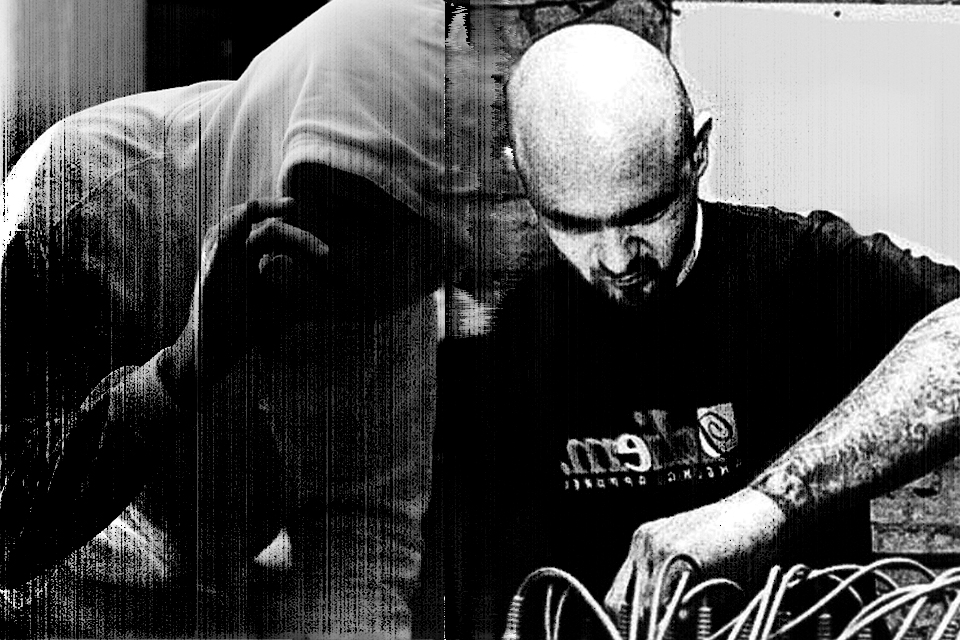
 JK FLESH/MONRELLA: SHOUTING THE ODDS
(GIVE/TAKE | Avalanche)
DL | LP | CD
Out Now – Order HERE
Louder Than War talks to Justin Broadrick and Mick Harris about their new album, SHOUTING THE ODDS. A demonstration of what each artist’s arsenal is bursting with as a distinctly split release, yet a collaborative concentration of overlapping histories where everything is eaten and flattened as techno is stretched on a splintered rack. By Ryan-Lewis Walker.
It’s difficult to quantify what happens when JK FLESH (Justin Broadrick – Godflesh, Jesu, Final, Techno Animal) and MONRELLA (Mick Harris – Scorn, Lull, Painkiller, Napalm Death) release an album together. The various species of electronic brutality teeming at various sub-levels within their second split release (following 2021’s SEE RED), routinely dial into the palpable idiosyncrasies of each artist (Broadrick’s wizardry with hard techno that turns the vertebral column into a spike-studded vibrator, Mick’s masterly command of brutalist dub that could upturn patches of tarmac with the ease of shaking fleas out of an old rug), whilst also reinforcing this work as a shared axis of balance and complete obliteration. This is their life.
Hardly strangers to the domain of doing things according to no other rule other than their own self-scripted methods, as comrades on the outskirts through thick and thin, so much more is at stake here to term it as just ‘techno’. But to term it anything more is adding unnecessary baggage to something that doesn’t need inflating any further. It’s business as usual. Another day at the office. Another puzzle on the pile. Without which, the riches of our lives would disintegrate into shit quicker before we could convince ourselves of the illusion of gold in our palms.
Both highly prolific artists who seem to be oozing music from a bottomless reserve of ideas, new and old, the constant, reverential investment from fan bases and forums far and wide into the contemporary works of Broadrick and Harris is quite unlike any other devoted arms of audience. With Godflesh on its final year, Broadrick’s Opiate EP release as Jesu, or RISE ABOVE by JK FLESH, both originally released on separate labels, and now powerfully remastered and projected into the death zone of the current moment via his own AVALANCHE imprint – Broadrick remains an enigma animated by nothing apart from his music.
A recent Instagram post features Broadrick bound to a hospital bed after undergoing emergency surgery to remove a large hernia; the procedure (not keyhole, bearing in mind), required a six-inch incision on his groin. Despite surgery, the show must go on. With JK Flesh shows, new projects and releases lined up almost immediately. If this doesn’t demonstrate his dedication to the cause and his almost animalistic instinct to create as a method of survival, then what the hell does?
Meanwhile, Harris’ experiments with murky, water barge atmospherics, house-on-the-hill electronics and post-apocalyptic terror bite as Blare Weight Unit (his first gig in three years will be in Middlesbrough for Industrial Coast on July 3rd as part of series of shows for the city’s Sonic Arts Week) or CULVERT DUB SESSIONS inhabit a similar space. Someone on the fringes of society, yet so intrinsic to the integrity of the specific section of the underground he, along with Broadrick, were the architects of.
These works are things finished and incomplete, differing times and states of mind, temporarily archived and newly revived, brand-new off the belt and resurrected from the earth to shake all foundations and penetrate all pigskin leather facades.
In this way, SHOUTING THE ODDS is not just techno music. Rather, this is a significant release, as much as any release in Broadrick and Harris’ unstoppable, ever-mounting catalogue, as the defiant sound of outsiders wreaking havoc on the bleeding rings of reality. Churning from their huts, pagan pylons of body-unknotting grind, their body-strewn shores, their splintered workbenches, their towering fortresses of existential mania, arrives an exhilarating fist-shaped laser of light. The light fills the mouth and empties the eyes.
From my side, it was an instant yes when Justin – who I do consider a friend – said, “Mick, let’s do a full-length, our style – techno release, this time with physical copies.” Justin had previously released via his Avalanche Recordings Bandcamp, a digital-only back in 2022, which was well received.
“The pair of us go way back and pretty much share the same thoughts about old techno,” says Harris. “Justin has been very supportive of me and very transparent with lots of personal stuff, which for me means a hell of a lot, rather than being brushed under the carpet, or not understood for a lot of it if I’m being honest…negative ways, and how I come across. Justin doesn’t hold anything against me and offers a lot of mental support.”
“Fundamentally,” Broadrick states, “all I do, and all I have ever done, since I was around nine years old, is create music. I don’t function in any conventional or traditional way. Mick and I, of course, go all the way back to the Napalm Death SCUM album, when we were young teenagers. Also, I performed on the very first SCORN album, alongside Nic Bullen, too, the album VAE SOLIS, post-SCUM, same line-up. Our history is long, so any shared release has an extra historical significance. I suggested many titles to Mick for this release; SHOUTING THE ODDS stuck with him most and seemed appropriate.
“Being someone with diagnosed mental health conditions, autism and C-PTSD, and from having a late diagnosis, and then delving deep into researching these conditions, it’s apparent Mick suffers from conditions too, although he’s undiagnosed for personal reasons, but I have a lot of empathy and understanding, and I like to help wherever I can those who suffer. I suffered in silence for the majority of my life, but once diagnosed, I became liberated and finally could begin to comprehend the years of pain I endured. Some don’t wish to acknowledge this stuff, but that’s on them and their reasons or agendas.”
Stimulated by the scent, but unsatisfied by the taste of the catch, Broadrick’s bodybuilder boiling side of things establishes SHOUTING THE ODDS as a skin-stripping rollercoaster of industrial techno power. Nails into marble. Columns topple. Machines heave. Slabs dislodged from their rightful street. Distilled vinegar in the veins. This is nothing new in Broadrick’s world. An ironmonger strikes an anvil, and all hell breaks loose.
CONDITIONAL is a hard-hitting enmeshment of hypnotic, synth-snaking arpeggios, booming kicks and caustic glitch attack rattling throughout the nuclear fallout shelter. It slips, and it spills. Metal melodies glisten and bend.
On TRANSACTIONAL, things are taken into new dimensions of bone-boiling magic. It turns things inside out with an insurmountable surge of whirring sirens and steroid-shot horseshoe beats. It’s delirious and unrelenting. Militant and tight. It ignites a wrath that pulls us through wormholes.
DISAGREEABLE is an acid sauna rush of lung-sucking action. A canvas of gritty, industrial hammers applying immense pressure to grotesque blooms of chrome-coated configurations. As ever, Broadrick conjures forth a critical, hallucinogenic audiovisual setting to these gnarly, snarling tracks – partitioned by drapes of PVC smeared in shit and dirt, a lonesome machine, sputtering sawdust, whistles in the corner of a neighbouring room, barbed wires between the teeth.
A bit of a historic point, the pair both found techno via unique yet similar channels. For Harris, techno sank its fangs into him via early Warp releases by LFO and Sweet Exorcist, eventually getting to Aphex Twin and R&S Records. In ’92, it was Karl O’Connor – who worked at a record shop I started to visit – that told me about a new record coming in under the name of Jeff Mills: Waveform Transmission, Volume 1,” remembers Harris. ”That just hit me full-on, and for me was techno. I’ve never shied away from those early Mills records being a direct influence on my Monrella project.
“I just try to do my thing, and yes, I’m influenced – we all are –, but we put our own take and spanner in the mix. I still enjoy creating techno when the mood seems right…It’s not something I am constantly working on, but when I do get fully involved and still love those big kicks, rolling bass, stabs and hitting the red on my mixing board. Always.”
Similar to Harris, it was in the unit of Underground Resistance via Jeff Mills and Robert Hood that a sense of what was so alluring and odd within post-punk and post-industrial music manifested as a shared helix.
“Like Mick, I immediately connected with it, and we both went to that same record store that Karl O’Connor worked at in Birmingham,” Broadrick says. “Karl went on to become the legendary producer REGIS, alongside his label DOWNWARDS, and it seems like he independently, on different days, played Jeff Mills to both Mick and I. Life-changing music. Like drum and bass or jungle, its impact was deep, and, consequently, lifelong.
It felt like an inevitable modern conclusion,” he adds. ”Back in the early 90’s of industrial music, what industrial music hinted at – Throbbing Gristle and Cabaret Voltaire, etc., is some of my favourite music ever made. They were making techno before it existed.”
The notion of something ”consequently lifelong” cannot be ignored. Even when we are consciously unaware of its influence on us, the past eats into the present and consequently, like techno, or punk, or old industrial music, or drum and bass, or jungle, or Birmingham – it resonates and recedes into the future. Indeed, ‘the Birmingham techno’ sound by way of Peter Sutton, Anthony Child and Karl O’Connor (Female, Surgeon, Regis, British Murder Boys) is still pioneering in its use of disparate influences ranging from debauched no wave to jerky post-punk and industrial depravity. It stank like stale beer. It stung like cheap amphetamines. It was sexy and sociopathic with its brutalist bus shelter poetry poking through the cold. Yet, even things of ”consequently lifelong’’ proportions can be disconnected from the mains.
“I have no idea who came up with the term Birmingham techno, but I’m certainly not part of it, or that,’’ Harris states. ”The Birmingham sound you hear mentioned time and time again, if I’m being honest, was created from influences, so it’s not a unique thing at all. That’s just my honest opinion. Older techno has been a huge influence for me and Monrella. I just try to do my thing with that and create hard, funkier, straight down the line, no-nonsense techno.”
However, from the signals shot from tower blocks where the pull of pirate radio stations was absorbed by thousands to the ceremonial dens of darkened warehouses, Birmingham carries an enduring, symbolic bullet of memory of techno music through an industrial-punk filter. In various ways, these fables morph into ambitions with the music they make as felt on SHOUTING THE ODDS. Birmingham is in the bloodstream. It hangs behind the eyes.
“I’ve been present in the early House of God nights here in Birmingham. The first time, in ‘93, when I was out riding my bike with 2 friends and stumbled upon this flyer that said twisted acid techno HOG. I said, ”Let’s go,” and we did after taking hash cakes. Haha! I’ve never been a dancer, I’m an on-the-side-line listener, taking it in, and just enjoy that immersion of sound in mind and body. I was disappointed with what I heard, including a young Tony Child (DJ Surgeon). Those big thumping kicks and stabs and hats blasting through a big PA system in a dark and dingy room.”
“I skipped a lot in Birmingham and left there in 1994,” Justin adds. “I was more present at the early London things with Jeff Mills and Plastikman, most notably at the LOST nights hosted by Steve Bicknell (also a killer artist with an old school, heavy psychedelic sound). Same with early Aphex Twin live in 1993. Life-changing experiences.”
Furthermore, a thought on space. I attended the Industrial Coast gig in the abandoned B&M unit in the shopping centre in Middlesbrough, along with Andrew Nolan – it felt underground and dystopian and cool. Likewise, as with the well-known attitude towards Detroit or Manchester at various epochal intervals, from the Electric Circus, to Factory through to the Hacienda, and the White Hotel, so too does Birmingham seem to be a fortress-like nexus for dark, crocodile-skin techno music. Everyone approaches it a bit differently, which is important to keep things in motion. Like Broadrick and Harris always do on individual projects and collaboratively. How did your experiences in Birmingham come to define ‘the sound’? Is there even a Birmingham techno sound, and why do you think it feels and sounds this way?
“The shopping centre in Middlesbrough felt both very right and wrong at the same time, haha! Which is arguably appropriate! It’s quite a post-apocalyptic city in some ways, but I find most UK cities like that now. Very uncomfortable, hostile environments. Feral. More than it being Birmingham specifically, I think it may just be a city thing, especially in depressed, bleak UK cities.
When I discovered industrial music as a kid, Throbbing Gristle, Cabaret Voltaire, etc., really captured the council estates, and the brutalism of the architecture, the factories, the sounds and smells, the smog, the greyness. I’m stricken with crippling hypersensitivity. I feel too much of everything – total overload – so music is my direct way of expressing this overload. I was extremely aware of my environment as a kid, but realised upon pointing this out to others that I was quite alone in my perspective. So, it’s environmental too, both the immediate and the imagined. I’ll never get the city out of my system. I’ve spent longer living in rural areas than I have in the city, but my first twenty-four years in Birmingham are indelible, and for mostly negative reasons; I can’t get over them, I’m still expressing that, I’m still reflecting it, and I am sure I always will be.”
A bold title, one that imagines Broadrick and Harris rallying against what is offered by way of Temu-techno in favour, naturally, of something that goes against the grain of what gets in your way as artists with techno as one weapon in an artillery chamber of many. It’s hard. It’s fast. It prizes the jaws apart with its bare hands. It’s ‘black and threatening’.
“Justin came up with the title, and it sits well,” says Harris. “I have always considered myself an outsider, from growing up on an estate and the kids not letting me play with them, to discovering punk music, then John Peel. I was a loner at school and could never keep friends. Instead, staying in my bedroom to listen to music. Especially the John Peel shows/sessions from ‘79-’85, to discovering Napalm Death in July of ‘85 and getting to know Justin and other punks at the Mermaid pub. I guess my first real friends were Justin and Nic Bullen, when I was asked by Justin in November of ‘85 to join Napalm Death.”
“SHOUTING THE ODDS is a loaded term, very British, and somewhat ironic,” adds Broadrick. “Also, isn’t everyone ”shouting the odds” these days?! In terms of what techno is now, neither of us recognises it, it’s not of interest.”
Embodying the tangent that draws on the experience that many people felt dissipated when John Peel’s radio show provided a much-needed voice from under the pillows of isolation, whilst imagining a mental connection to thousands of other isolated individuals scattered across the country, in addition to their key roles in Napalm Death, and possession by industrial music, the wrench in the works is a weapon solely wielded by them, and no other. The existential Excalibur is a butter knife to a well-done steak in the hands of ordinary men. The outsider psyche is what ensures they remain free from the constraints of normalcy. Yet, this comes with its hardships.
As outsiders, whose sole function is to create, how does a track germinate from the seed of an idea into a tune? ”For me,” Justin elaborates, ”most work begins with an idea, a concept, and generally it’s very strict and disciplined. Which, once made real, becomes something else entirely. Everything for me begins in the studio in my imagination, then I have the struggle of translating it. This is what I do every day, with every project – a constant, endless flow of ideas. I dream music. Most of my best ones don’t get made, unfortunately, or I’m just incapable of articulating it satisfactorily, so I release these approximations, hoping they’ll work somehow outside of me.
“I don’t follow the rules with anything I create. I don’t generally understand rules, so I follow my instincts, which are probably ‘wrong’ to others. I feel like that in every context of existence, so that extends to all music I operate within. We both love and have been obsessed with similar techno for most of our lives, so it makes sense to us to have splits with these specific projects since we’re generally on the same page with our interpretations of techno.”
Dream music. Not dream of music. There’s a difference. The former indicates a fully-formed idea, pulsating from within some secret core of an unconscious being, as it happens – a spirit stood on a piece of tape on a stage. It does a striptease with a handgun. It vanishes into vapours of obfuscated abstraction when we stir into wakefulness. The latter dreams of something far more ephemeral – the attached glories, the lore of horrors, the storied myths.
AAYet, in each of Broadrick’s tunes, that notion of almost being able to seize hold of the dream, the frustrating sense of failure that happens when clasping one’s hands together in the hope that we have managed to transfer what we heard in our heads a moment ago, is now a tangible reality, turns and burns through each one of his nail-sharp tracks.
AAWe hear this idea in USED/USER. A song that stands ground while also sliding off the map, and then gets brought back into focus after the third minute. A subtle, but still seismic shifting of the gears that really emphasises that hot, analogue touch, fluttering and floating throughout his contribution here. It feels like it’s sentient and growing and bubbling.
Has Broadrick got a massive amount of gear to fuck with to accomplish capturing this vibe? Or is it a minimal, less-is-more approach to make the most noise that does it? Just how does he know when a track is done?
“I guess I have a bit of equipment, for sure, but less is more for me,” Broadrick states. “I get so easily overwhelmed that I prefer to use as little as possible, especially in terms of source sounds. The treatment of sounds is where it’s all at – saturation, gain levelling, taking things as far as possible, sometimes, is the best way to learn. But I’m never chasing new gear. I’d rather work with minimal equipment and get the most out of it. I’m more of a hi-fi junkie than gear.”
“I’ve always been the same with guitars too – it’s just a tool, it doesn’t really excite me as an instrument. I only have many guitars due to different tunings or strings. 8-string, 7-string, etc. But it’s not an object I obsess over. For me, it’s like cars, which I hate. I find them deeply unattractive and almost illogical. Scary, but unfortunately necessary. Gear is the same, and musical gear is often disappointing, I find; these things never quite do what I imagine they could. Gear is quite disappointing, almost like trophies.”
In Harris’ case, there are various clips of a worktop submerged in pedals, boxes and wires. NIGHT BEFORE RAKE is a concrete jam of ominous, turpentine-textured beats and knife-flicking cougar spats. Corrugated synth melodies poke through after the first minute falls into the next. Soon after, a noxious overcast of murky, nuclear smog seeps into it with scrapes of warehouse-wobbling crashes and swampland shaman hum.
The thud forces its foot through the doors of the castle with SLIGHTLY OVER, a dub-dunked chug of hard-hitting whiplashes and overhead wires crackling across the tracks. Synapses are greeted with searing blasts of heat, caustic hats, and deathly rides, cautionary forces of sonic destruction decapitating all objects that befall the spell of the mongoose sabre. Things dip out. They shimmer and shatter and disappear. Only for the echo to shimmy up the shaft and start the whole workout over again.
The penultimate DOUBLE RED gnaws its way through vats of toxic waste as though it were a stick of spearmint – a combat of magma melodies, disorderly percussive hisses and ravenous synths. Lastly, in SHELF, we feel the darker, rave-ready house influences sneak into focus in dense mushroom clouds of menacing, machine-music dread. Mad patterns of rhythms leak and shake the screws loose from ceilings of corrugated rafters. Melodies bleed until other melodies turn imaginary. The backbone never succumbs to the plea of anything caught in a dream. It dictates. It detonates.
“I guess I have always leaned toward a darker, dirtier sound. Maybe that’s coming from punk…who knows?” ponders Harris. “My style is basic and minimal, and my writing and production is minimal. I have my way of working, which is well documented. I’m a sample person who loves to make beats, bass, etc., from various samples, put those sounds through the mixer using pedals and old spring reverbs, the Tubby clone filter with hands-on live mixing, not using automation inside the software.
“It’s all very hands-on, a lot like the old dub way of mixing, which is huge for me,” he adds. “I may make/mix several versions and then pick one, but I never do any edits, etc. It’s live through the mixer, into two tracks in Logic, then out, top-and-tailed and always backed up on my GDrive. I have tried a few synths over the years, but I end up sampling them and selling them on. I just much prefer samples, and over the years I’ve accumulated many, many, many.”
With so much to do, and so little time, what’s next in store for the pair?
“Endless music expression, until I cannot physically make it anymore,” Broadrick offers. “There isn’t enough time, I have so much to do! I have many projects with more new ones are forthcoming! Some have now finished for many reasons. Godflesh is on its last year, but I have so much more coming.
“I have to balance my music-room time but when I’m in there I try to be fully productive with no distractions and just get my head down,” Harris adds. “I have been doing a lot of music for my Bandcamp page, lots of dub techno under the Culvert Dubs name which has also seen physical releases with session 4 and soon to drop Session 7 on Ron Morelli’s ri who has been fully supportive of me and my music. I have my first 2 live gigs in just over three years coming up with my beat, bass, and drones project Blare Weight Unit, working with visual artist and good, good friend Dereck Stormfield/Scald. Really looking forward to that as I had put gigs on a huge backburner due to my ongoing anxiety issues and travel, so fingers crossed for those.”
Harnessing the collective weight of what both Harris and Broadrick not just interpret, but experienced through their adventures through wormholes of early punk, and whirlpools of old industrial music, with that uncurrent of trauma shredding the psyche to pieces by position meat hooks under the left nostril, a lot has been fought for. Unrelenting. Irrepressible. As long as Broadrick and Harris live and breathe, kick and scream, celebrate and complain, our organs are willingly laden with the smog of a few aching decades.
Justin Broadrick | Bandcamp
Mick Harris | Bandcamp
~
Ryan-Lewis Walker | Louder Than War
A Plea From Louder Than War
Louder Than War is run by a small but dedicated independent team, and we rely on the small amount of money we generate to keep the site running smoothly. Any money we do get is not lining the pockets of oligarchs or mad-cap billionaires dictating what our journalists are allowed to think and write, or hungry shareholders. We know times are tough, and we want to continue bringing you news on the most interesting releases, the latest gigs and anything else that tickles our fancy. We are not driven by profit, just pure enthusiasm for a scene that each and every one of us is passionate about.
To us, music and culture are eveything, without them, our very souls shrivel and die. We do not charge artists for the exposure we give them and to many, what we do is absolutely vital. Subscribing to one of our paid tiers takes just a minute, and each sign-up makes a huge impact, helping to keep the flame of independent music burning! Please click the button below to help.
John Robb – Editor in Chief
PLEASE SUBSCRIBE TO LTW



Leave a comment