

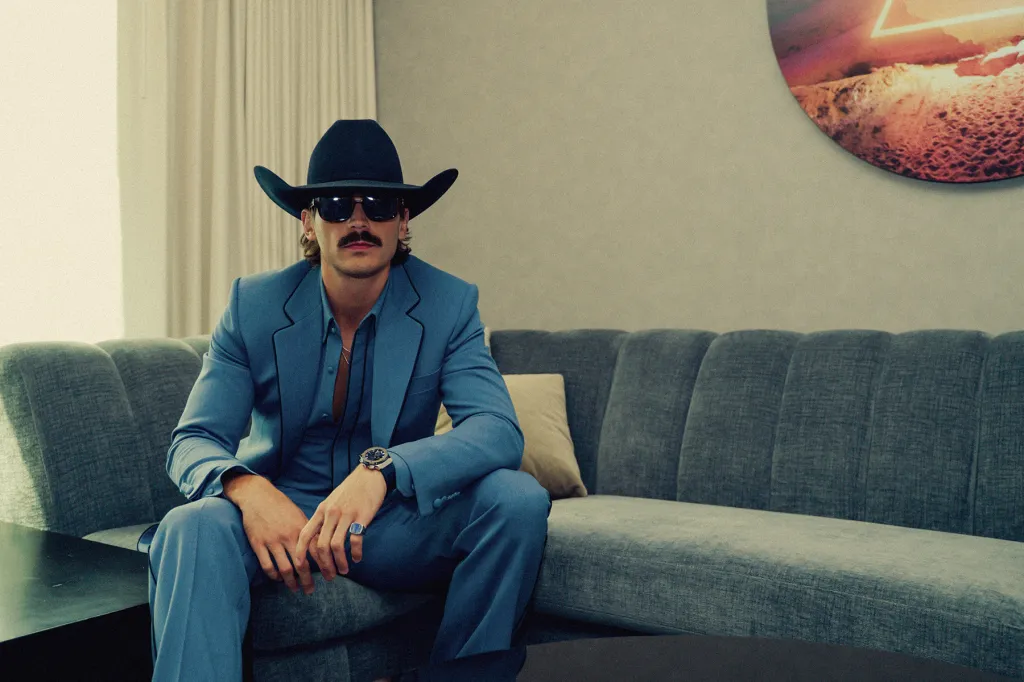
There comes a moment in most Tucker Wetmore shows — between performing lively hits like “Proving Me Right” and “3,2,1” — when the Washington state-born country artist sits down at a piano and leads the crowd through a medley of classics, from Beethoven to Jerry Lee Lewis’ “Great Balls of Fire.”
“I’m an old cat. I’m an old soul,” the 26-year-old says. “I like ’60s, ’70s, ’80s music, early-’90s stuff.” Wetmore grew up listening to the Eagles, Hall & Oates, Queen, Van Morrison, Elton John, Billy Joel and Atlanta Rhythm Section, and at 11 taught himself how to play piano. His path to a life in music didn’t quite start then and there — a college football career intervened, until an injury cut it short — but watching Wetmore on the keys today, his destiny, and, now, chief mission as an artist is clear: to connect and entertain.
“I like the thought of people getting together for one sole reason: for the same love of the music,” he says. “And I personally take responsibility for that. It’s my job to make sure they have a night that they’re going to talk about two, five, 10 years down the road. That’s what I tell my guys before every show … Every night I get onstage, I’m going to give them the best time I possibly can give them.”
Wetmore landed on the country scene in 2024 with his Billboard Hot 100 breakthrough, “Wine Into Whiskey.” His debut album, What Not To (Back Blocks/MCA/Mercury), reached the top 15 on the all-genre Billboard 200 last year and yielded a trio of Country Airplay top three hits: “Wind Up Missin’ You,” “3,2,1” and “Brunette,” a fast-paced, energetic track that Wetmore says he “immediately believed” in — and that just became his first Country Airplay No. 1.
“It was like a week of it being out; I played a show and people went crazy, jumping up and down, waving their hands in the air,” he recalls. “I was like, ‘You can’t really deny that.’ It proved itself live time and time again and it still does.” The song’s rapid-fire lyrics remind him of childhood moments spent riding in the car with Eminem on repeat, trying to keep up with the rapper’s bars. “I feel like ‘Brunette’ is one of those songs where it’s so fast and high-energy, you can’t really help but try to learn all the words.”
Onstage and online, it’s not uncommon to see Wetmore talking candidly to his audience, gyrating and shaking his hips to the music, or unabashedly showing off the results of his workout regimen — usually from the waist up, though a recent shot he posted of his bare backside also made the rounds on social media, to much ribbing from his tourmate Dasha, among others.
“I feel like if you can’t get onstage and be exactly who you are, then you’re not doing you justice,” the self-professed “goofball” says of his antics. “Somebody who I think does a great job of it is Luke Bryan. He will get up there and say whatever crosses his mind and people love it. If you’re just authentically yourself, it’s going to resonate with the majority of the crowd, because they leave there saying, ‘He’s just a normal dude.’ And that’s all I am — I’m a normal dude and I like to make music and shake my little tail feather onstage every night.”

Chase Foster
He might be carefree onstage, but Wetmore is serious about building a global fanbase. His current The Brunette World Tour has already staged legs in the United States, the United Kingdom and Europe and is now back in America for more shows through the fall; he recently carved out some studio time in Switzerland, another step toward his goal of “distill[ing] a worldwide sound in a small-town genre.”
That expansive outlook toward his potential audience has, Wetmore says, been a priority for him since the outset of his career. “I feel like in the past, especially with country, [artists will have] grown so much in the States and then they’re five years into their career, a couple of albums in, and they’re like, ‘All right, let’s go take this thing worldwide,’ ” he says. “They’re kind of playing catch-up, taking steps back [into] smaller venues — which is not wrong, it’s [one] way to do it — but I’ve always said I want to grow as much in the States as I am overseas at the same time.”
It was during a sold-out three-show run in London in late April that his former tourmate (and, now, confidant) Thomas Rhett surprised Wetmore on video with news that he’d won the Academy of Country Music Award for new male artist of the year, while Wetmore’s mother, Sia, presented the accolade to him onstage. It was a fitting moment: Raised in a single-parent household after his father left their family when Wetmore was 11 (a subject he touches on in the poignant “What Not To”), Wetmore forged a tight bond with his mom and sisters. Professionally, too, he’s surrounded himself with strong women, including his manager, Autumn Ledgin.
“I was raised by women. I grew up around women my entire life. I’m just more comfortable around women and feel more creative around women, and I trust women more, honestly,” Wetmore says. “Women are powerhouses … especially the women around me. They set a goal and they’re going to achieve it. And if they can’t, they’re going to find another way.”
Chase Foster
Wetmore is quickly seeing results of that team effort. Next up, at this summer’s CMA Fest in Nashville, he’ll graduate to playing the Nissan Stadium stage.
“When I first played CMA Fest [in 2024], I had no album out. I [just] had a couple of songs that were doing really good things. That first time I ever played at the Hard Rock stage, 8,500 people shut down Broadway to watch me [play] a 25-minute set,” he recalls. “That was two years ago, and now I got my own slot at Nissan on the main stage. I think that’s just a testament of trust in the process; keep doing what you’re doing.”
This story appears in the May 30, 2026, issue of Billboard.





Leave a comment