
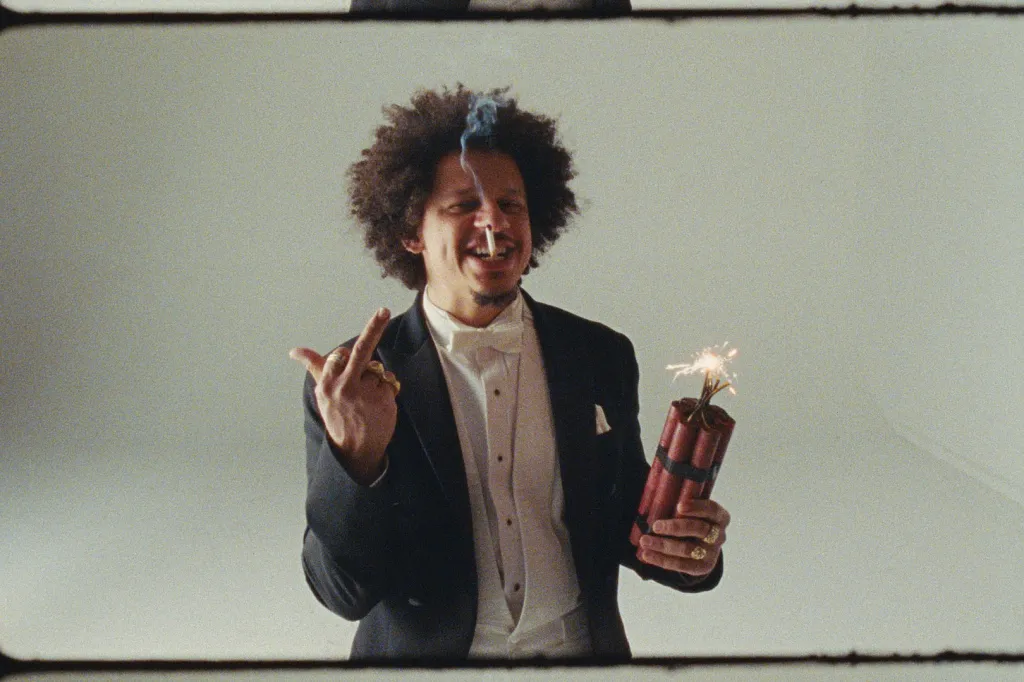
As the boundary-smashing, beyond over-the-top talent behind Adult Swim’s long-running The Eric Andre Show, comedian and actor Eric André has presided over some of the more bizarre, surreal pranks, stunts and hilariously cringe moments to ever be aired on television.
But André’s latest project might just manage to stun his audience even further. Under the not-so-serious name of BLARF, André has just released a surprisingly serious album of classical music, Film Scores for Films That Don’t Exist (out now on Stones Throw Records). A collaboration with composer Prateek Rajagopal, the album features eight pieces for full orchestra, ranging from the silly (“1869 Overture,” essentially a very out-of-tune take on Tchaikovsky’s “1812 Overture”) to the quite beautiful (“Stars Without Light”), which riff on both film score archetypes and the composers who write them.
André is, in fact, no goofy novice: Before he pivoted to comedy, he was a serious upright bass player who attended the prestigious Berklee College of Music (where he also studied conducting — a skill he recently put to use in front of an orchestra at the only concert of this music thus far, at Los Angeles’ Zipper Hall in late April).
“This is like a big wish fulfillment thing for me,” André says of making Film Scores. “I’m just happy that it came together, and I have so much gratitude towards Prateek for pushing it along all the way.” He spoke to Billboard about his conservatory past, conducting an orchestra in Hungary, and what’s next for BLARF.
You told Pitchfork of your first BLARF album, 2019’s Cease and Desist, “I dare you to get through six minutes of it, it’s f—in’ unlistenable.” I wouldn’t say the same of this one!
I think I always wanted to make a completely different album each time. I’ve only made two [BLARF] albums, so you won’t notice that that agenda until, like, I have three, four or five albums. Comedy is a full-time job, so this is just passion project stuff and I don’t have time to crank out that much, but I always wanted to. I started doing comedy when I was 20 years old, like halfway through college, and then I just pivoted to it, but I always wanted to continue to make music, not for any kind of commercial success attempt, more just for my own creative gratification.
How do you know when it’s time to do a new BLARF project?
I’m constantly doing it in the background between gigs — they just take a while to complete, and then I release them upon completion. I’m still making new music now; I’m trying to make new hip-hop loops on Ableton, I’m trying to get into Detroit house and ghetto tech and some more jazz stuff. Prateek, who I made the album with, just scored a Bollywood movie, and I was like, “Whoa!” I was frustrated we didn’t put any Bollywood stuff or Indian instrumentation on the album, and we didn’t put any really jazz stuff on the album. So I’ve already been thinking about jazz composition, and then going back more to electronic stuff, because it’s just way easier to produce than dealing with orchestras. [Laughs]
How did you and Prateek first link up?
So, originally Ludwig Göransson was gonna do the score for [André’s 2021 Netflix film] Bad Trip. Ludwig got very busy because he’s like, on his third Oscar, and his [creative] partner at the time, Joseph Shirley, kind of took over on Bad Trip; then Joseph worked on the Trolls movie, and I worked on the Trolls movie, and he’s a very lovely, very talented guy. And I love film scores; I love Ennio Morricone, film music is very emotional, it’s like a neglected part of the record section. [I told him how] I always get these ideas for compositions, and asked, could he help me? And he’s also incredibly successful and busy and has kids, so he’s like, “I would love to, but I can’t even keep up with the actual work that I need to get done, but I have this like protege Prateek who’s like a musical wizard.”
Prateek was just very young and hungry and incredibly talented and just knows every genre of music so well — there’s no task insurmountable for him, he thrives under pressure and stress and loves a challenge, so he was very invested early on, and very enthusiastic. I wouldn’t have finished the project if it wasn’t for Prateek.
What was your collaboration like?
I started out with voice notes and ideas for compositions, and then I’d go to Prateek’s office and studio, and he would put out like a mini demo version of what I would kind of sing to him through these voice memos, and the suggested orchestration, and then we’d sit in his studio and just figure out where the song wants to go, where it wants to be. Sometimes we were stumped: “What’s For Dinner” ends on this death metal stuff just because we couldn’t figure out an ending to it. So, as a joke, we were like, “I don’t know, let’s do a death metal ending!” And then I found out in real time that Prateek was into metal and in an Indian death metal band. His band is amazing, I had no idea. That kind of metal is very technical. Jazz, classical and metal people are gluttons for punishment.
He wasn’t just a co-composer who helped me flesh out these wisps of ideas that I had, but he was also kind of like a showrunner, a producer, making sure, like, we found an orchestra in Budapest, Hungary. He was constantly pushing everybody to do this the right way, not necessarily the cheap way.

Eric André conducting for the recording of Film Scores For Films That Don’t Exist (Photo credit: James Scott).
Were you stepping up and conducting the orchestra in Hungary?
Most of the orchestra, while we were recording, was conducted by their conductor, but I stepped in a little bit, and then when we did the live show [in Los Angeles], I conducted. Conducting is not as hard as playing upright bass — that was more nerve-wracking for me.
What was that whole dynamic like? What did the orchestra players make of you?
I think it was a combination of intrigue and confusion from the top to bottom of the process. But I love conducting. I love Fantasia, Mickey Mouse and Bugs Bunny were my first, like, conductor idols. I took conducting class in school, and I loved my teacher, Francisco Noya — he was very like, spiritual about his conducting, he was just a total character, a very memorable professor. He’d be very intense when he taught class, but he was actually very soft and sweet.
I love having an orchestra at [my] disposal. I was very high on it. It was like those astronauts that go out into space and they’re in such a trance, like, “When am I ever going to get to do this again?” and they’re just like taking in the glory of the universe. It was a total dream come true.
Did you think of all these pieces as being one big score for a film or more individual things?
No, I thought they each go with their own movie. The first one [“The Final Shootout”] is like a spaghetti Western. “Mercury Dripping Down My Spine” goes over like, an Ari Aster or Panos Cosmatos [horror] movie. The other challenge was like, how do I find comedic value in instrumental music — like without words, how do you achieve a comedic effect?
Some of the pieces do feel outright funny, but the majority start out sounding like they’ll go in one direction and by the end definitely become something more unexpected — for instance on “Piano Concerto No. 0,” it sounds like you’re literally murdering the piano at the end.
I’d get so frustrated practicing piano when I was little that I would throw my piano books on the ground if I would get to like, a Mozart passage that would stump me. When I got older, one of my professors, Whip Browne, would always say, “Practice slow, learn fast; practice fast, learn slow,” and that’s the greatest piece of advice for any temporal art… I have to remind myself of that every day. [But] I used to have these dark fantasies about destroying my instruments all the time, and once you’re playing stringed instruments, the better you get the more expensive they get. So it felt so carthartic just like, taking an axe to a piano and setting it on a fire.
Wait — so you are literally destroying a piano?
Yeah, I really destroyed a piano, a cheap upright we found through like a free curb alert on Craigslist. I love John Cage and how he would tamper with the piano strings, so I wanted to hear how it would sound taking an ax to the strings. There was one time on The Eric Andre Show that I think I stomped on a few cellos, and I remember the art department was like, “Did you feel good doing that? These are works of art!” I was like, I feel great doing it! We got like, cheap Sam Ash cellos. I wasn’t like, stomping on a Stradivarius.
I saw the video of you walking around asking people to listen to the music and say what kind of film they think it’s for. What’s the strangest story anyone’s told you?
I don’t even think most people get that far. People are like, you compose classical music?! At the front door, they’re like, what?! So I have to go into basically everything I’ve been saying to you for the past 45 minutes. They can’t even get past level one [laughs]. You saw the best answers! Closest friends are like, you play music? You compose music? I’m talking not even comedians or people in the public eye, just like drinking buddies who are like, you didn’t bring that up? I dunno, you didn’t ask!
So we’ve established that there’s a lot of film footage that you need to get on, but other than that, what is next for this iteration of BLARF? Do you want to do more concerts?
Yeah, I’d love to do more concerts. We’re going to edit together the concert that we did do and hopefully we can sell it to a streaming service or put it on YouTube. When that comes out, I actually think that the album will almost be supplemental to the special. My Netflix special is a stand-up comedy special, my HBO special is an Eric Andre Show live special, and then this special, whatever platform it’s on, it’s going to be like an orchestral music special, so I like having that evolution of changing the medium for each of my specials. So that’s kind of next up on my musical agenda.




Leave a comment