
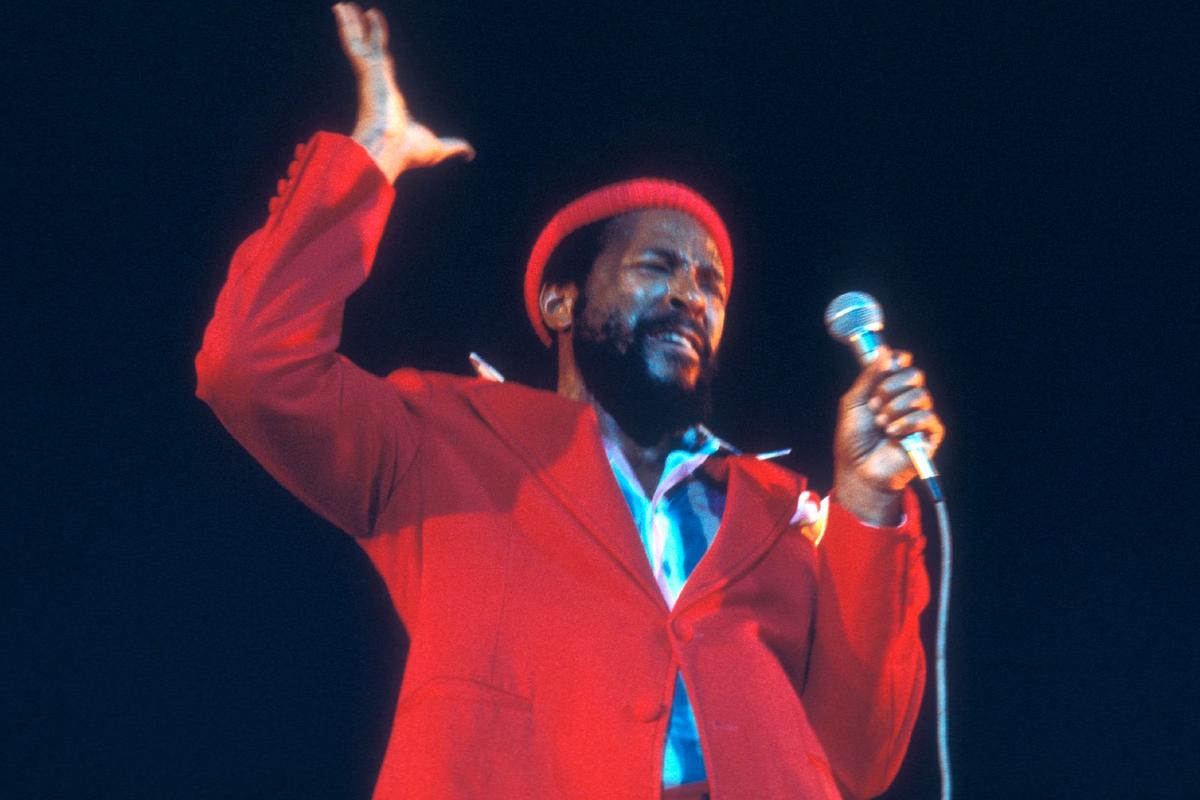
Marvin Gaye was still in a pretty good place, personally and professionally, in early 1976 as he was prepping the release of his 14th album, I Want You.
His previous two albums — 1971’s What’s Going On and 1973’s Let’s Get It On — were critical and commercial hits, with the latter LP’s title track going all the way to No. 1. In between those two records, he wrote and produced the soundtrack for Trouble Man. A truly solo achievement, Trouble Man served as consolation after What’s Going On‘s sequel, You’re the Man, was shelved because of its political leanings.
Gaye also embarked on a successful tour and recorded the last of his popular duet albums, this one with Diana Ross, around this time. Within two years, it would all come tumbling down, as a messy divorce, drug abuse, another canceled record and dwindling sales piled up. But in 1976, all was still relatively good.
READ MORE: The Top 40 Albums of 1976
Back in 1970, while working on the songs and ideas that would become What’s Going On, Gaye was spearheading a new artist-driven movement at Motown that gradually and cautiously began to loosen its control over some of its stars. Gaye — who’d been around from nearly the start of the company, singing on his own hits as well as penning songs for others — wasn’t given total control of his music until Trouble Man, but for the most part, he was trusted with his vision.
What Inspired Marvin Gaye’s I Want You’?
Thing is, Gaye didn’t always trust that vision himself. In some ways, that led to You’re the Man remaining unreleased at the time (it finally got an official release in 2019). And when he was putting together music for his next album in 1975, he sought help from producer Leon Ware, a Motown staffer who’d recently scored solo hits for Michael Jackson and the Smokey Robinson-less Miracles. He ended up playing a big part in shaping what eventually became I Want You.
marvin gaye i want you cover
But the album’s core — like Let’s Get It On, the songs were about sex — was all Gaye. His marriage to the sister of his Motown boss Berry Gordy was going through its final stages as his relationship with Janis Hunter, whom he met during the Let’s Get It On sessions when she was 17, was heating up. Tracks like “Feel All My Love Inside” and “Soon I’ll Be Loving You Again” (which included the line “I’m gonna give you some head“) reflected his intentions.
Listen to Marvin Gaye’s ‘I Want You’
Gaye and Ware holed up in the artist’s newly opened Marvin’s Room studio in Los Angeles, where they, along with Motown’s Funk Brothers session musicians, spent chunks of 1975 and early 1976 working on the album. Like he’d been doing on his previous records, Gaye multi-tracked himself singing different parts.
When Marvin Gaye Started Experimenting With Synths
He also began experimenting with a synthesizer, which complemented the new musical direction Ware started steering toward. More expansive and sweeping than much of Gaye’s previous work, many of the songs on I Want You took a slow-burn approach to their melding of soul, funk and disco. (The opening title track, for example, is a third over before Gaye starts singing.) Elements of jazz and doo-wop also found their way into the material, bridging Gaye’s ’60s and early ’70s music with a new future.
Listen to Marvin Gaye’s ‘Since I Had You’
This all added up to a slightly disjointed but mostly captivating album that seemed like another turning point for the artist, even upon its release on March 16, 1976. The three-year break since his last LP certainly had some effect here, but the musical leap had almost as much to do with Gaye and Ware’s combined vision.
There weren’t a whole lot of albums that sounded like I Want You at the time, but in the decades since, the album’s “quiet storm” sound has inspired a genre and an entire movement of neo-soul artists in the ’90s and beyond. The deep bass, spacey soundscapes and groove-based beats, in a way, were just a step or two ahead of the burgeoning disco scene, but the overall picture seems much wider now.
Was Marvin Gaye’s ‘I Want You’ Successful?
Not that the album was appreciated as much back then. It hit No. 1 on Billboard‘s Soul chart and No. 4 on the LP chart (as they were called at the time) and did manage to sell a million copies. Someone of Gaye’s stature almost always charted well after a previous success, and the album’s first single, the title track, reached No. 1 and No. 15 on the soul and pop charts, which also helped stir interest.
Listen to Marvin Gaye’s ‘After the Dance’
But I Want You didn’t click with fans the way What’s Going On and Let’s Get It On did. Those controversial lyrics certainly didn’t help spread the word on the radio or connect with more conservative-minded listeners. And despite the No. 1 studio single “Got to Give It Up” from the otherwise Live at the London Palladium album in 1977, the next year’s Here, My Dear and 1981’s In My Lifetime continued a downward turn in Gaye’s career that eventually picked up with 1982’s Midnight Love and especially the “Sexual Healing” single before his 1984 death.
What’s the Legacy of Marvin Gaye’s ‘I Want You’?
It wasn’t long, though, before I Want You and, even more notably, Here, My Dear became cornerstone records in Gaye’s late career. The latter was an intentionally uncommercial double record designed to fulfill a divorce settlement agreement. I Want You, at times, can sound like a similar commercial kiss-off, but it came from an opposite spot in Gaye’s life, when he was in a much better place. It’s difficult, it’s horny and it’s definitely not for everyone. But it’s also on the verge of something really exciting at times.
From Marvin Gaye to Stevie Wonder: The Top 25 Soul Albums of the ’70s
There’s more to the decade than Marvin Gaye and Stevie Wonder, but those legends are well represented.
Gallery Credit: Michael Gallucci






Leave a comment