
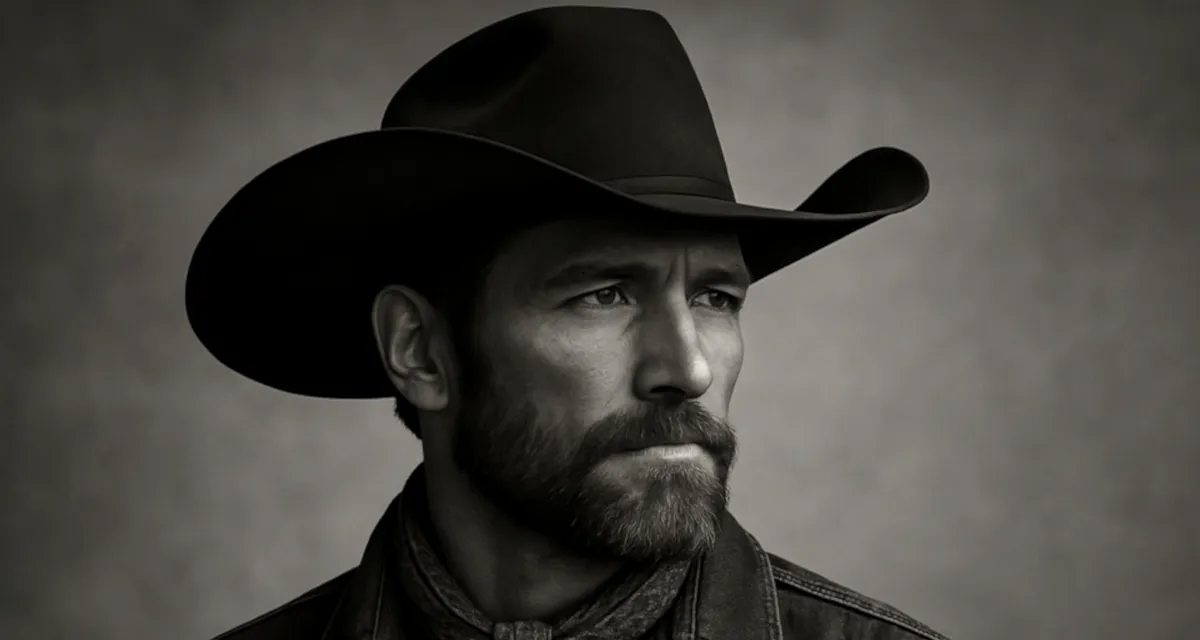

One of the images used to represent Breaking Rust.
Did Breaking Rust “steal and borrow” from a human creator to pump out “Walk My Walk”? Artist Blanco Brown believes so, and he’s fired back by releasing a cover of the (relative) AI hit.
Atlanta-born Brown took aim at the alleged infringement in an Instagram post late last month, purportedly after receiving multiple messages about the alleged overlap between his sound and that of “Walk My Walk.”
As most are already aware, the AI track benefited from a solid number of streams – and an avalanche of misleading headlines – after releasing in mid-October en route to topping an obscure Billboard chart.
But according to Brown, the self-described “architect of ‘TrailerTrap,’ where country grit meets 808 swagger,” his body of work made the song and the commercial ascent possible.
It’s unclear whether the Pitbull, 2 Chainz, and Diplo collaborator has a straight infringement claim – one maintaining that “Walk My Walk” is actually his own penned-and-recorded effort.
However, the Associated Press pointed to allegations that “Walk My Walk” had lifted Brown’s “vocal phrasing, melodic shape and stylistic DNA” without authorization.
Furthermore, Breaking Rust was allegedly “built with a vocal approach modeled on Brown’s sound,” according to the same AP piece. (DMN asked Spotify if the song violates its impersonation policy but didn’t immediately receive a response.)
Another alleged connection between Brown and Breaking Rust: The AI project is attributed to Aubierre Rivaldo Taylor, who’s also associated with a separate “AI country music” project called Defbeats.ai, per the AP.
Defbeats, complete with tracks that share a not-so-subtle lyrical theme and make for torturous listening, reportedly plugged an AI music-generation app, Echo, via its Instagram.
Echo’s App Store page lists Abraham Abushmais as the chief developer, and Abushmais has several credits on Brown’s 2019 debut album, Honeysuckle & Lightning Bugs.
Abushmais doesn’t seem to have publicly weighed in on the matter, though, and Brown hasn’t “heard from him in a year or two.”
(After our piece was published, Stems founder Nathan Brackett reached out claiming he’d been first to shed light on the alleged connection between Breaking Rust and Abushmais back in mid-November; the AP article went live about two weeks later.)
All that said, what, then, is the best response to the alleged infringement? Well, given Breaking Rust’s virality (fueled in part by the media craze) and the fact that AI works cannot be copyrighted, Brown opted for the initially mentioned cover.
“Within 48 Hrs I Recorded This Song on The Road, Fully Produced It Out Live, Engineered It, Had [It] Mixed And Mastered Along With Cover Art,” Brown wrote of the “Walk My Walk” cover, proceeding to acknowledge the (human) professionals who contributed to the process.
“Nashville’s machine tried to kill my spirit,” Brown indicated in a different post. “AI tried to copy my soul. Both failed. Machines only win when humans quit. I covered that ‘AI hit’ to prove it. Human >>> AI. Every time. And just for the record…I didn’t just outdo AI. I kicked its ass.”
Additionally, Brown took to Instagram to tease a “derivative” trailer-trap version of “Walk My Walk” that’s expected to debut tomorrow.
It’ll be worth tracking the work’s commercial performance and the situation’s broader career impact for Brown. In the bigger picture, between the fresh “Walk My Walk” renditions and Kaitlin Aragon’s contribution to “I Run,” the troubling trend of human artists following in AI’s footsteps is apparently upon us.









Leave a comment