

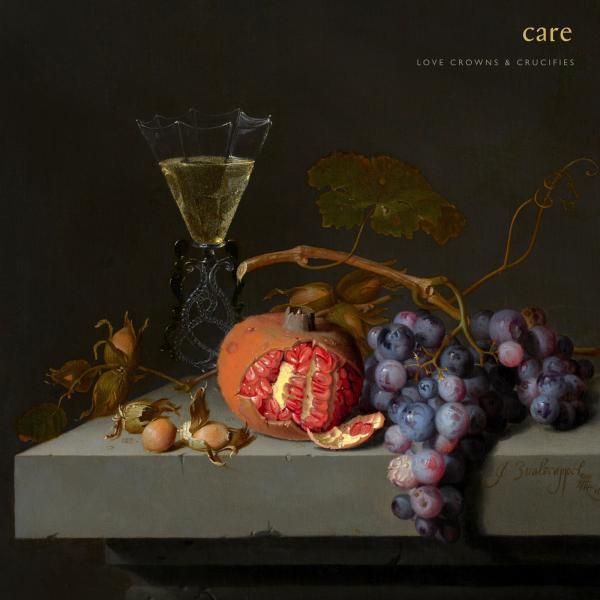

Care: Love Crowns And Crucifies
Needle Mythology
Vinyl | CD
Released 13th March 2026
One of Liverpool’s great lost bands finally release comprehensive album showcasing their brand of joyous, beautiful pop.
The landscape of pop is littered with great lost bands. There are those who failed to match their critical acclaim with commercial success, there are those who refused to play the fame game, and there are those who simply split up before a lucky break came their way.
Liverpool’s Care fitted into an entirely different category, where self sabotage was the reason for their going off the radar.
Care was put together by two artists now regarded as titans of Liverpool’s post punk scene; Ian Broudie and Paul Simpson. Broudie was guitarist in the near legendary Big In Japan and producer de jour for the rising tide of indie artists looking to move into the mainstream with The Lightning Seeds.
Simpson was a founding member of The Teardrop Explodes and then put together the magnificent Wild Swans. He was also wounded to the point of breakdown by a betrayal that saw his Wild Swans bandmates replace him as singer and take a song he had written into the charts as The Lotus Eaters. One of the band had told his bandmates that Simpson had quit the band and had arranged for Peter Coyle to take his place, also taking all money from the Wild Swans account to help with this transition.
In his wonderful autobiography, Revolutionary Spirit, Simpson say of the time “Too humiliated to tell friends and family what had happened, I retreated into myself, a spectre even to my long-suffering girlfriend”, adding the superbly bitchy “the last time I had looked, my fellow The Wild Swans and I weren’t trying to write yacht rock, we were aiming for post-punk glory.”
It was with this baggage that Care was founded. Nevertheless, these two creative forces pooled their substantial skills and created some truly beautiful music.
Single Flaming Sword was made Record Of The Week by Radio 1 and duly entered the top 50, a promising start to a band who seemed destined for success. Simpson says of the thought process of putting Care together “The blueprint was simple: Hot Chocolate rhythms, George Murray bass lines, classical music instruments with pop sensibilities. We, the architects, however, were complicated.”
The stars seemed to be aligned for Care to succeed magnificently, for, surely, nothing else would do. New Pop was on the ascendent, critical acclaim was theirs and they had the commercial clout of Radio 1 behind them.
But the mental turbulence done to Paul Simpson by the way Wild Swans ended was still very much active, causing him to walk away from the closest to a sure thing his life in music had yet handed him, saying “I can’t get past the pain and injustice of our end, and until I can, I can’t fully commit to anything else.”
Broudie was informed of this via a long, anguished letter, and so Care came to an end, leaving behind a trio of singles, an unfinished album and a huge amount of unfulfilled potential. Some tracks were released as the Diamonds and Emeralds album, but this was released without the knowledge of its two protagonists, never mind their cooperation.
The later success of Ian Broudie enabled Peter Paphides’ Needle Mythology label to gain access to the Sony vaults, where they were able to transfer all the music recorded by Care between late 1982 and early 1984 from the original quarter-inch tapes onto WAV files, discovering some lost gems as they went; alternative takes, instrumental tracks and forgotten songs amongst them.
All of these have been treated with the deference and respect they deserve and are now available as a double album set, Love Crowns and Crucifies. The album is available with two different sleeves (as shown above) that handily sum up the differences between the two creative forces at work; Broudie’s showing twin kites soaring weightlessly in a clear sky, while Simpson’s consists of a classical still life painting of fruit and wine on a stone slab, set against a dark background.
Love Crowns And Crucifies starts with the lush instrumental On The White Cloud. It is dense and sumptuous and shows that the high standards of its creators was something they found easy enough to meet. It does seem to be crying out for a vocal to raise it into something more pop and commercial, and this lack of a vocal is very possibly a casualty of Care’s sudden end. If so, it is a) brave and b) a statement of intent to start the album with it.
The fact that the classic Flaming Sword is the next track seems to underline this, as if to say ‘yes we didn’t finish everything we put our hands to, but we were able to create a flawless song when we put our minds to it.’ It still sounds like a forgotten gem, combining pop sensibility, swooning choruses and an arch knowingness that lifts it above its rivals. Flaming Sword could be released today and would still sound new, wonderful and legendary.
An Evening In The Ray continues the run of should-have-been-hits with a John Barry flourish that gives an impression of it being a theme tune for a ’70s detective show, its minor scales giving it a melancholy feel despite its catchiness, turning it into a real earworm. What we dealing with here is a superior strain of pop, with its feet rooted in the old school cool of the Liverpool scene of the ’70s and ’80s.
Listening now, it seems cruel that songs such as these were denied us at the time. Despite all the cool points a lost album may bestow upon its creators, Love Crowns And Crucifies is an album that flourishes in the light. Confining it to the dark robbed us of the chance to bask in its grooves at perhaps a more apposite time. It is hard to avoid the conclusion that Care could have been one of the defining bands of the ’80s, up there with the likes of The Smiths and New Order.
Third single, Whatever Possessed You, is another masterclass in swooping, soaring pop excess, with Simpson’s rich voice sailplaning over luxurious backing. It is uplifting without being forcedly happy and epic without even approaching pompous.
So far, Love Crowns and Crucifies consists of pop classic after pop classic and shows no signs of letting up. The album’s title track continues this theme, despite being a largely acoustic song. Somehow, even a lazily strummed acoustic sounds epic and stately in Care’s hands.
Temper again starts with an acoustic guitar but is soon supplemented by Broudie’s talent for catchy guitar lines. There is a Beatles-esque feel to the song, particularly in the harmonies and what sounds like a trumpet in the background. It does make me wonder how Simpson could have walked away from something that must have come so close to fulfilling all of his musical ambitions. The fallout from the Wild Swans troubles must have set off some severe disturbances in his mind.
Besides Four is another instrumental, this time with a jaunty almost musica box feel to it. Again, it is crying out for lyrics to transform it from a curio into another pop classic. As it is, it is an interesting glimpse behind the curtain into what was going on in the studio and in the minds of Broudie and Simpson.
My Boyish Days is another track that was released as a single and with good reason, although Love Crowns And Crucifies is packed with songs that could have been given the same treatment. It is perhaps the clearest example of a bridge between The Wild Swans and Lightning Seeds that we have had so far, with the feel of a true coming together of talent. The “wherever you go, I go” is one that will stay with you long after the song has finished.
Nature Prayed Upon is perhaps the first track that doesn’t stand out as a potential single, being a darker tinged song with a downheartedness that belies its pop sheen. That said, it is a superb album track and shows the range of colours in the artists palette. A Sad Day For England carries on this downbeat feel, with Simpson’s superb voice giving it an opulent feel despite the more minimal backing.
Diamonds And Emeralds puts us back in shimmering pop territory, with chiming piano runs and almost falsetto vocals. There are echoes of First Picture Of You that could (maybe should) have helped heal Simpson’s wounds after the song was stolen from him by his bandmates. The opening line of “I’ve just come into a fortune” belies the reality of Simpson’s penury that led him to declare “I kidded myself that skipping lunch and dressing in dead men’s suits from charity shops was romantic and character-building but, in reality, all it built was good cheekbones and resentment.”
There is a casual epicness to Care’s songs that seems to come entirely natural to them, as if they can’t help but create songs that seem to be beyond the reach of ordinary mortals. Maybe this is just the natural chemical reaction of putting two such talents into a small room together, the same way that the chemicals that go into fireworks create such extraordinary blooms in the sky.
Next up is another version of On The White Cloud, this time with lyrics and a more orchestral feel. It lacks the lavishness of the previous version but makes up for this with a string section. The vocals are lower in the mix than on other songs on the album, perhaps pointing to this being recorded at a different time to version 1. It is interesting to see how these different versions link us to how Care’s vision evolved. Even though their time together was brief, they seem to have crammed a lot of work into their lifetime.
Besides Three is a short, almost throwaway song, clicking in at under two minutes, that shows how Care were using the studio to record and save their ideas. It contains the germ of a song that could again have grown into something magnificent given enough love and attention. It is again a brave move to release sketches such as these on an album.
Chandeliers is another lavishly orchestrated Merseybeat-ish song that again illustrates Care’s knack for a pop hook, while Caretaking has an almost ‘80s soul feel, with Simpson crooning delicately instead of his more strident, upfront vocal style. It works superbly, and shows that Care could equally well turn their hand to more downbeat stylings should the songs require it.
Soldiers And Sailors is a mix of an abrupt rhythm section and a sweetly sung vocal, with funky guitar thrown in for good measure. It is another superb slice of casual genius. The strangely titled Cymophane (a cat’s eye stone apparently) leans more towards Ian Broudie’s later work, featuring a climbing guitar melody.
Love Crowns And Crucifies aims to be something of a completists dream for Care fans and features alternative versions of songs (the stream I have for review features songs called Besides One through to Besides Four, and I imagine these were tracks that were mooted as b-sides for future singles that never got the chance to be released until now). As such, we also get the 12” version of Flaming Sword that has extended instrumental passages where the horn section come into their own. Misricorde is an elegiac piano version of the same song superbly played. The fact that it stands up to this minimalist treatment is another testament to the skill of its songwriters.
Such Is life starts with what sounds like a piccolo, not that I’m entirely sure what a piccolo sounds like, before changing into a forward-rushing song where piano and strings take the melodies and hooks. The songs Care create more than stand up to this treatment and seem to flourish no matter what is thrown at them in the studio. Given that ’80s production techniques often sound old fashioned to our 21st Century ears, Love Crowns And Crucifies still sounds fresh and stands up well to modern day sensibilities.
The 12” version of My Boyish Days playfully extends and pulls out the various threads that make up the single while What Kind Of World sees a rare expansion into electronica, with what sounds like a drum machine backing and low, low bass notes on a synthesiser that put me in mind of John Foxx-era Ultravox. Simpson’s vocals supply the human feel that lifts the song while keeping the icy feel of the music. It is further proof that Care were not hemmed in by genre, nor limiting themselves to any one style.
Another 12” version comes up next in another look at Whatever Possessed You. Perhaps unusually, this 12” version clocks in at just over four and a half minutes, less than a minute and a half over the original, when 12” versions often went to double this running time. Perhaps this is another nod to Ian Broudie’s love of classic pop, where even extended versions are encouraged not to hang around too long and outstay their welcome.
A Deadly Nightshade remix of Diamonds & Emeralds reinforces this as, despite it sounding like a more electronic remix, it is actually shorter than the original.
The tracklisting for this album is different on the vinyl and CD versions, with the vinyl version finishing with Besides Two, another brief sketch of a song that means the album is bookended by what sound like unfinished versions of songs that could have grown into fuller versions given time.
It is a poignant reminder that this didn’t happen and that Care’s time as a band was cut cruelly short. Love Crowns and Crucifies is a wonderful round up of two great talents coming together and a frustratingly sad document of unfulfilled potential.
I can’t help wondering how the musical landscape of the ’80s and the lives of its two originators could have changed if they had managed to stay together and navigate the complex waters of psychic battles.
But things have a habit of working out and Love Crowns And Crucifies is here to show us that. It is a record to treasure and to play loud and often, rejoicing in the fact that, for a shining, hidden moment, beauty was created and it has now found its way into the world, lost no more.
~
Preorder/Buy Love Crowns and Crucifies here
All words by Banjo, you can find his Louder Than War archive here
A Plea From Louder Than War
Louder Than War is run by a small but dedicated independent team, and we rely on the small amount of money we generate to keep the site running smoothly. Any money we do get is not lining the pockets of oligarchs or mad-cap billionaires dictating what our journalists are allowed to think and write, or hungry shareholders. We know times are tough, and we want to continue bringing you news on the most interesting releases, the latest gigs and anything else that tickles our fancy. We are not driven by profit, just pure enthusiasm for a scene that each and every one of us is passionate about.
To us, music and culture are eveything, without them, our very souls shrivel and die. We do not charge artists for the exposure we give them and to many, what we do is absolutely vital. Subscribing to one of our paid tiers takes just a minute, and each sign-up makes a huge impact, helping to keep the flame of independent music burning! Please click the button below to help.
John Robb – Editor in Chief
PLEASE SUBSCRIBE TO LTW







Leave a comment