
 Chalk: Crystalpunk
(Alter Music)
Order HERE
March 13th
DL | LP
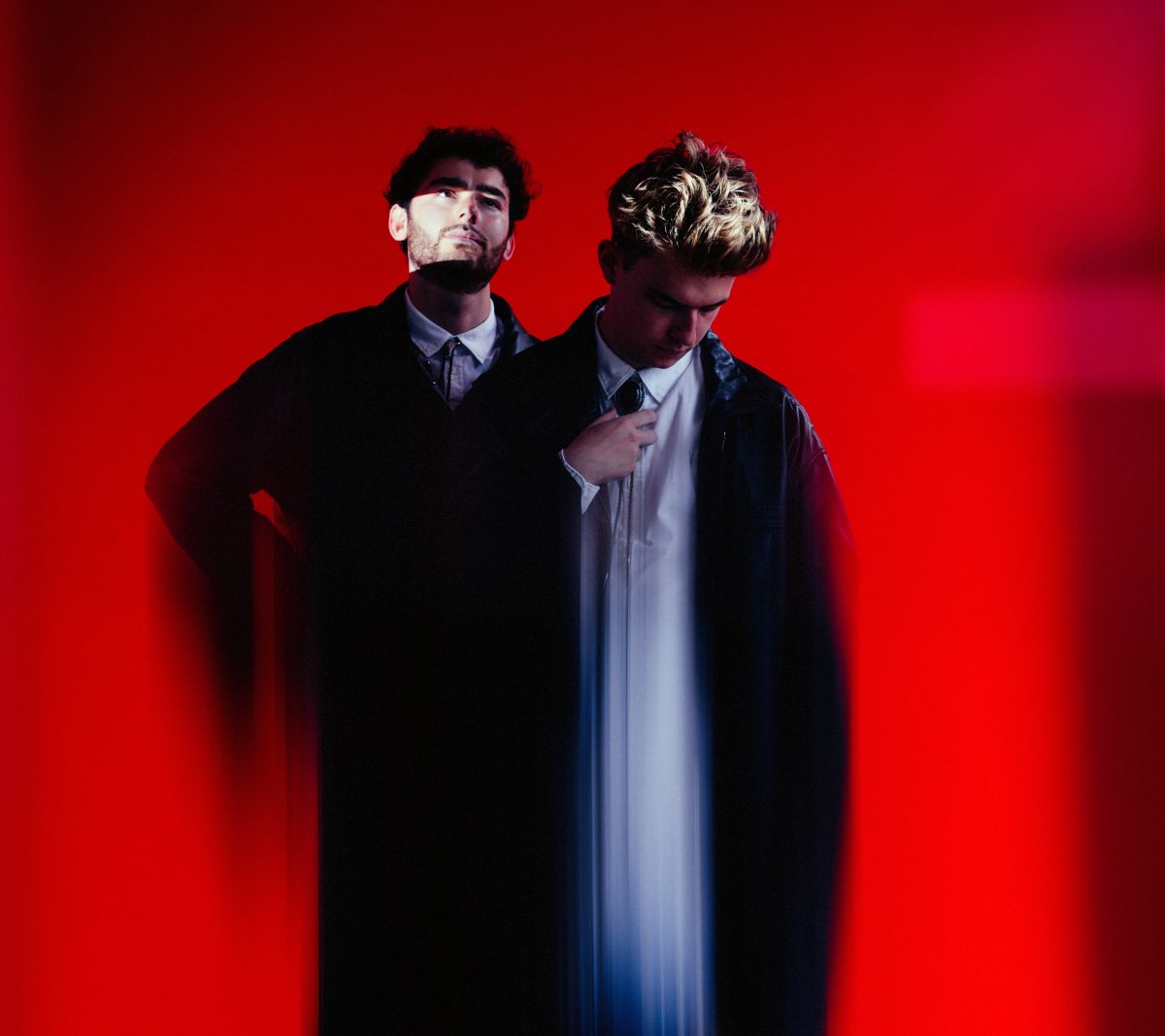
Ahead of the release of their debut album, Louder Than War speaks to Ross Cullen and Benedict Goddard of Chalk about Crystalpunk – their glimpse into the windows of the future by kicking against the walls of the past. By Ryan-Lewis Walker.
A glove. But not just an ordinary glove. A glove with barbs growing out of its fingers, a palm with a mouth wide open, a fist shocked into being pulled apart, recently clenched around a flail and uncoiled in relief – in victory. Neither held out nor pushing up, unconcerned with the pain of the clasp, the spikes penetrating through the leather-clad skin, metallic spores surging through this striking crossbreed between a crocodile tooth and a biker gang’s severed hand, a version of Rollerball directed by Cronenberg, the glove presents a striking demonstration of what has been endured, some astral pilgrimage now decorated with decades’ worth of edited memories, a lifespan of youth-sodden mutations. You look at the glove, and the glove looks back.
So adorns Crystalpunk, the new and debut album proper from Chalk. Eternally true to form, the conceptual, curatorial nature of Chalk remains a visual throughline, an ineliminable commitment to the gesamtkunstwerk not just still intact since their first EP (part one of a statement-setting trident), but now, on Crystalpunk – refined for all the world to witness in the chaotic twinge of the bloom.
AA”Crystalpunk gave us a world to exist in,” the band states, ”sonically, visually, and personally. It became an identity for that moment in our lives and for this debut album. The name came while we were recording, and it really shaped how we moved forward — the sound, the visuals, everything. A crystal can be clear and beautiful but still have sharp edges, which felt right for us. We wanted to create our own genre rather than letting anyone pigeonhole us.
AA”Of course, we can’t avoid being labelled by journalists or listeners that we remind them of a blend between this whatever band mixed in with whatever genre,” the band adds. ”I felt like it was mostly a personal preference to give ourselves this world of Crystalpunk to exist in and something that we felt was ours.”
Starting with the debut Conditions EP from 2023, and concluding with the third in February of last year, the evolutionary trajectory of Chalk can be traced from and through these EPs, eventually leading to Crystalpunk. Without those EPs, three strategies, three statements, three stages, each featuring at least two staple Chalk songs (Velodrome, The Gate, Leipzig 87), the Chalk we know today, the Chalk who have soundtracked the film to a psychological nightmare leaning into the deep wells of oblivion, might be very different.
AA”The first EP was us learning how to become a band and leaning into a more traditional post-punk and electronic route,’’ the band explains. ”The second came after touring the first. We took what we’d learned from playing live and poured that experience straight into it. By the third, we were fully embracing both the electronic and rock sides of the band. It felt more confident and instinctive. By that point, making an album felt like a natural next step.”
That ”next step” is totally embodied in Crystalpunk. From latest single, Tongue – a visceral blast beat of chugging industrial rock guitars chewing on a scream of stuttering glitches, percussive whispers, and molten modems suspended in a chokehold, to the blissfully triumphant confessionals of Pain – a synth-laden, riff-heavy gem of a song, it’s clear that Chalk aren’t fucking around, nor filling gaps, nor wasting time. They cling to every word, as every word has been endured, every frame entertained, every corner survived.
Partially pulled into the sort of spectacles often reserved for arena-filling pop bands with the hooks to justify the haircuts, and in other directions, drawn to the raw, existential whiplashes of a punk track baying for blood, forced to find a means to make sense of how memory makes a foolish victim out of us all- Pain paves the way for so much more to come – either self-pity, empowerment, sadomasochism or schadenfreude, or all of the above. Either way, it judders from the frayed void the same size as something, or someone, that once stood for so much.
Another single, and a perfect synergy of the electronic-rock/industrial-dance/post-punk-techno templates that Chalk have become accustomed to confidently bending to their own will, Can’t Feel It erupts with menacing energy. Iridescent and frantic, on the cusp of being consumed by the mists of the past, it’s an unashamed celebration of the innocence and sheer ferocity of yesterday, the tactility of which seems harder to grasp as more grains of time grow higher around our knees and harden into stone. The pining for a familiar horizon, hanging above yesterday’s offshore daydreams, also resonates throughout One-Nine-Eight-Zero. Birthed in Rotterdam as an instrumental before becoming an ”exploration of being young and your parents splitting up” and flitting ”between the perspectives of everyone involved,” it projects a fictional, familial utopia burning up with dark rays of vocoder and immersive whirlpools of pulsating pads softened with years of shrapnel.
AAA piece of history available to pull apart according to how one wishes to rewrite it, 1981 is a keystone to the album’s sublime sense of joy and horror. A year supercharged with the traumas of teenage energy and imagined to be the year Cullen’s parents met. ”1980 was a song title we had for a while,” he says, ”and I felt that they were both teenagers at that time, so it suited the track.”
Although conceptually based on the idea of duality, Crystalpunk is a document dedicated to youth, and, upon realising the promises encased within its cut, enables the future to be unlocked. Crystalpunk has a date – 1981, and a place – Belfast, and with it, a series of scenes starts to emerge.
AA”There’s a bit of our younger selves in every song, which I feel comes across in a lot of artists’ work. There’s always that younger version of you that we have that sometimes lurks about, although we are all different people and grown up, that inner child or youthful feeling never goes away. Tracks like Tongue and Longer lean into the heavier rock and punk side we grew up loving. 1980 feels the most youthful — we wanted something nostalgic but still modern, inspired by early 2010s electronic music. IDC is more of a response to contemporary electronic music – I was listening to a lot of 2hollis at the time and wanted to emulate some of his glitchy production.”
Perhaps people will say the same about 2026 in sixteen years, as they might say with every year, but electronic music in 2010- was there something significant about this year that Chalk took influence from? It was the year of multiple excellent electronic (and associated powerhouse noiseniks) albums, from releases by MIA, LCD Soundsystem, Factory Floor, Flying Lotus, Crystal Castles, Holy Fuck, Hey Colossus, Liars, Anika and more.
AAHowever, it was Pop at its optimum…Popness (coinciding with every imaginary pool party was the rise of influencer culture and a Skrillex song to match), including every little seed that implied stratospheric, creative growth under its canopy, that inspired the band: more Boys Noize than ‘by bros, for bros.’
In addition to it being the year EDM eviscerated and rearranged the music industry, and in turn the lives of those that bought into its climactic paradisiacal surge, the internet we know now is a very different internet compared to the previously unturned corners on previously unpopulated platforms it possessed back then. In this way, although only just over 15 years ago, a blink in an age that feels like one perpetual glare into the distance, what electronic music was, and how we consumed it, feels like a lifetime ago. But there was still gold to excavate from their respectful mines, no matter what arrived in the wake of the decade.
AA”I specifically remember making music playlists for the first time and buying compilation albums of DnB and listening to music on the UKF YouTube channel,” Cullen says. ”There’s so much music I love from the 2009 to 2011 era and lots of different genres, all of it under the umbrella of Pop music.”
Yet, although Chalk are influenced by a hybrid of various, timestamped genres, it’s the feeling of wilfully being taken into unknown territories of suggestion that scars with a deeper mark on the DNA of their euphorically warped, shapeshifting sound. The intense, emotive oddness evoked in the work of David Lynch in relation to Chalk’s equally immersive and devoted world is not insignificant. A surge in the blood, a hand at the back of the head, a strike of the spine, it’s an influence that feels visceral and innermost. One that overrides the mere melting together of influences from different fields, akin with the procedure of trying to ensnare a dream in its most tangible and potent state of imagery favoured by the late filmmaker.
AA”We’ve always loved the strangeness and surrealism of David Lynch. That feeling of something being emotional and unsettling without needing to explain everything. That approach definitely fed into how we made music and visuals early on. We like things to feel instinctive and a bit mysterious rather than overly literal.”
There is something to be said about the work of the great auteur, and the acute, cinematic tone that colourises Chalk’s visual world. From Pain to I Can’t Feel It, from IDC to Tongue, their singles are short films more than mere pop songs, and testament to their close connection to the practice of arthouse films. Sensory banquets, estranged from reality, yet tingle with enough traces of it to be possible, Chalk’s records offers the not too distant. The need to be acknowledged as a neighbouring universe.
Moreover, with Crystalpunk wrenching so much from the storehouse of the subconscious and harnessing its reverberations as it loudly resonates across the surface of their beloved city, it only makes sense that their influences should be a little abstract, a little distant, a little tricky to completely pin down in a literal manner of speaking. If Chalk had a manifesto, then it would read like Crystalpunk – it would feel as kinetic, as singular, as subcultural, as these songs. It’s a state of mind, a tribal feature routinely attributed subcultures, from punk, through the rave, and the safe havens in the face of animosity they offer it’s members.
AA”As soon as we locked in studio dates and early ideas, we devoted ourselves 100% to it. We worked every day with the goal of making something bold whilst challenging ourselves, so it became our lifestyle for a few months. It was one of the best periods we’ve had creatively — just fully immersed in making art and exploring ourselves. Even though the world felt especially heavy during that time and still remains to be, I feel like the enjoyment and energy we felt while recording or writing comes through in the music.”
There’s more to a city than its history. Absorbing what happens in the flash of an evening can unsettle previously righteous opinions that the past is a fixed deal, that automatic memory is irrefutable. Shadows of legacy might well be cast, and hard to walk out of, but new interruptions ensure that the nostalgia is dismantled at the ankles, that underground culture keeps replenishing itself with the possibility for dignified, mainstream tract, that new chapters are written, that new voices are heard. In thinking about a tour-de-force of modern Irish bands, from experimental progenitors Gilla Band to more recent luminaries Gurriers, from Sprints to Nerves, all idiosyncratically providing an unparalleled locus for the rest of the world to take note of.
This continuous reshaping of the atlas shares a similar frenzy of creative outlook and attention committed with Manchester’s underground innovators such as Crimewave or Silverwingkiller in the midst of a rapidly infectious air of Northern Gothic, all pulling the shell of their surroundings to pieces to expose something fantastically new underneath. This begs the question of how Chalk see, and situate themselves among this tidal wave of contemporaries from their homeland?
AA”It’s amazing seeing so many Irish bands doing well, and new ones coming through all the time. We’ve been part of that scene for a few years now, and it just keeps getting stronger,’’ the band states. ”We do feel a bit different, though. Maybe because of the amount of members on stage for our band and the blend of punk and electronic music we’re chasing. Bands like Sextile, Nine Inch Nails and Crystal Castles had a huge influence on us and continue to. We’re just trying to bring our own perspective and talk honestly about what it’s like being where we are from on this album.”
Those who have caught Chalk live will understand the power of the armada contained within each song, even more remarkably, is how such a spectrum of mentally complex and physically goliath ideas can be carried within songs that rarely (but not without exception) exceed four minutes. Experiences as indie kids, techno foot soldiers, post-punk gang members, it’s in the jaws and throngs of the live space, both battlefield and playground, that Chalk’s response to the world around them is born.
AA”There were a lot of ideas floating around for a few years,’’ the band states on the process of the album coming together. ”We explored them early on and developed them in the studio with Chris Ryan, our producer, who really helped stretch them out with us. We were also doing a summer festival circuit while writing and recording the album, so we were testing ideas live and seeing how they translated, then coming back and making changes based on that. It became a constant loop between the stage and the studio.”
”We think about the live setting every time we make music, especially Belfast,” they add. ”When we were writing the album, I kept picturing how it would feel to perform these songs live — how we’d move, how they’d hit physically. I treat Chalk as a physical space. We’ve always visualised the crowd and the energy in the room, and that definitely shapes how the tracks feel. But at the same time, we still write for ourselves first. If it connects with us, we trust it’ll connect with other people too. We both come together to make it work, but it’s much larger than either of us.”
Skem is a prime cut of the translation of, and translation between, the stage and the studio. This procedure creates a connective cord, an umbilical current of electricity exchanged between the tidal mass of an audience and the artist. An otherwise devastating wrath of a wrecking ball, stubbornly shooting through a series of re-fabricated concrete panels, but momentarily spared by a reprieve before the walls crumble again – it’s a rave-ready, strobe-stroked track primed to pull the pipes down from any venue played at, with the sample seizures of I.D.C, all acrobatic stabs of hyperpop nastiness, mangled scrapyard screeches, bass warbles and acid-infected grooves, following suit soon after.
Every city possesses its own language. Colloquial mosaics scatter and shatter themselves across every hidden inch of architecture like access codes or passwords to unlock the padlocks for its dwellers to recognise. They spot these codes they walk parallel to canals caked with dead swans and decaying shopping trollies, as they scuttle under bridges with crumbled, cobblestone edges thin enough to threaten falling into and disappearing forever, as they zigzag, all lost and illuminated by the blue-white lost lantern glow of their phones across the mazes of the metropolitan minotaur and notices these ghostlike glyphs cut into and bleeding down the canvas.
AAThere’s plenty of graffiti in Manchester that would make a good song title, and it also encapsulates the underground mood of the city. In this way, Belfast is a significant influence on the album, and we feel its vibrations virtually on every track on Crystalpunk.
”All I know is that it’s a tag that’s all across Ireland,” states Cullen. ”I’ve been getting the train into Belfast for half my life and have always noticed it as it’s just all over container units, buildings and train stops. I liked the word a lot, so we decided to throw it down as a title for a tune.”
It’s in the likes of Skem and the epic, progressive wormhole of Béal Feirste, where arguably the most experimental and dance-directed pieces Chalk have ever committed to a recorded artefact can be sourced. With the angelic ”shoulder to shoulder” introducing the former, followed by the ”I put my fingers through the bullet holes”, of ”letting the fuckers grind you down”, detonating a progressive heavy-hearted, iron-lined hymnal, psychically allied with growing up as a member of the ceasefire baby generation during the Troubles in Northern Ireland – and how, as physical wounds, violently burrowed deep into spaces that are still around us, the taste of memory is sweet with poison.
AAUpon checking the scars, creases or wrinkles of a space, these holes provide us with portals back to then. And when we finally find a way through them, as mirrored in the epic ending, sharing beautifully bizarre similarities with not just one, but two Underworld tunes, we dissolve on the spot, yet do so ”ever alone.”
With a slow, dissonant, dreamier, druggier chug, Ache is a claustrophobic album-ender that twitches with paranoia and floats with a morphine-sheen. As Benedict Goddard’s guitars glisten and fizz, Ross Cullen’s voice is submerged in a demonic blanket of grainy baritone and greets whoever the bed has (or more menacingly, hasn’t) been shared with, with a ”good morning, I wake up, and kiss your bones”: the final scene before the first name appears as the end credits start to roll.
AAWith Crystalpunk conceptually being a reference to the memories of youth, or at least an interpretation of them to see a survival of the future, ending it on Ache with ”good morning” is sort of perfect. From Tongue onwards, Crystalpunk is a mental vessel containing a narrative, throughout, a coming-of-age-tale? Yet, it’s also interesting how it’s the only tune from the perspective of another person, a disconnection from the self, but with the story within still striking hard.
AA”I pulled a lot from experiences growing up for the lyrics on the album,” Cullen says, ”but for Ache, it didn’t feel like my story felt connected to it. Family and friends of mine have gone through grief under tragic circumstances, and I wanted to address that on the record. Building an unpredictable atmosphere is important for us.”
So what of the glove? The black axis beaming throughout this whole adventure, this bludgeoning monument that solidifies all segments into place?
AA”The glove was originally designed for me to wear live during festival season, but it quickly became this strong visual anchor,’’ states Cullen, ”especially in the Pain video and the Crystalpunk aesthetic. Then, a behind-the-scenes still of the glove informed the final album artwork, and we shot it backstage in the dressing room when we supported Fontaines DC.”
Prepared for battle upon arriving in the heated vortex of their own influence coming full circle, on Crystalpunk, Chalk boldly present the opening of someone else’s: history happening now.
~
Chalk Live Dates –
12th-19th Mar – SXSW
25th Mar – Treefort, USA
10th Apr – Botanique Rotonde, Brussels, BEL
11th Apr – Trabendo, Paris, FRA
13th Apr – L’Amperage, Grenoble, FRA
15th Apr – Santeria Toscana, Milan, ITA 31
16th Apr – Bogen F, Zurich, CH
18th Apr – Lido, Berlin, GER
20th Apr – Tolhuistuin, Amsterdam, NL
22nd Apr – The Fleece, Bristol, UK
23rd Apr – Electric Ballroom, London, UK
24th Apr – Gorilla, Manchester, UK
25th Apr – The Wardrobe, Leeds, UK
14th May – The Arts School, Glasgow, UK
15th May – The Button Factory, Dublin, IE
16th May – Limelight, Belfast, NI
20th May – Bearded Theory
13th June – God Save The Kouign Festival, Penmarc’h
26th Aug – Custom House Square, Belfast (w/ IDLES)
Chalk | Facebook | Instagram | YouTube | Bandcamp
Photography | Glenn Norwood ©
Louder Than War | Ryan-Lewis Walker
A Plea From Louder Than War
Louder Than War is run by a small but dedicated independent team, and we rely on the small amount of money we generate to keep the site running smoothly. Any money we do get is not lining the pockets of oligarchs or mad-cap billionaires dictating what our journalists are allowed to think and write, or hungry shareholders. We know times are tough, and we want to continue bringing you news on the most interesting releases, the latest gigs and anything else that tickles our fancy. We are not driven by profit, just pure enthusiasm for a scene that each and every one of us is passionate about.
To us, music and culture are eveything, without them, our very souls shrivel and die. We do not charge artists for the exposure we give them and to many, what we do is absolutely vital. Subscribing to one of our paid tiers takes just a minute, and each sign-up makes a huge impact, helping to keep the flame of independent music burning! Please click the button below to help.
John Robb – Editor in Chief
PLEASE SUBSCRIBE TO LTW






Leave a comment