

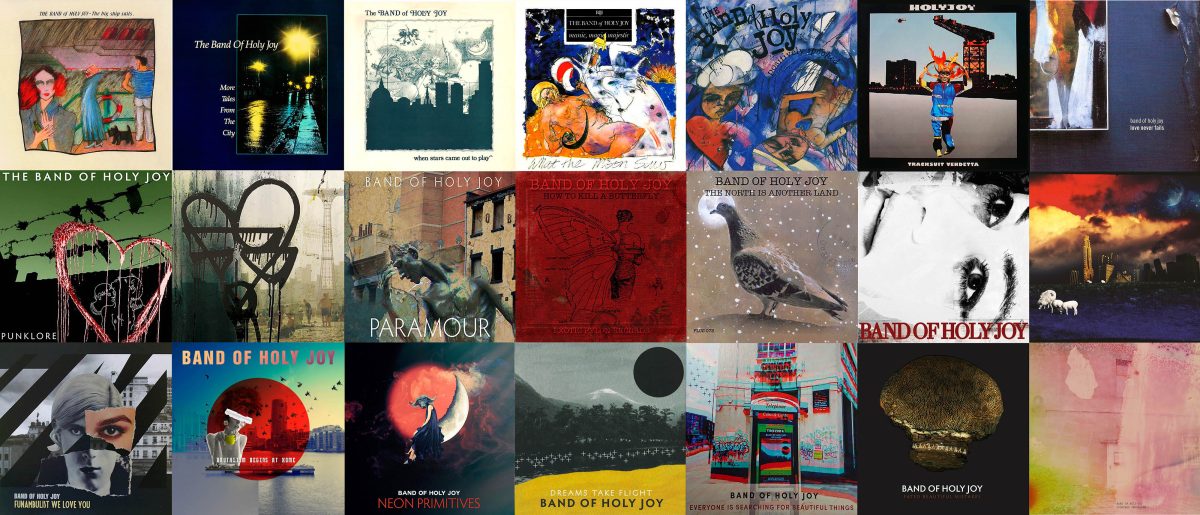

The Band Of Holy Joy : celebrating their 40 years of recordings (Part 1)
Self-confessed shameless music nostalgist Martin Gray takes a look back at the incredible 40 year-plus recording career of The Band Of Holy Joy, without question one of the most remarkable, consistently intriguing, yet perennially underrated groups ever to continually defy and transcend all trends and genres, personnel changes and health scares, and still release uniquely brilliant records to the present day.
(in March 2026 Louder Than War are putting in their first festival in 2026 – you must come! tickets and details here)
Back at the start of this year in January, one of the most astonishing and prescient albums in years was released to little fanfare (or indeed much hullabaloo except among the faithful followers who of course knew about it). It was, put simply, a staggering achievement that articulated within its songs all of the anger, betrayal, injustice, teeth-gnashing despair and outright stomach-turning nastiness of the post-Covid world into which many of us have been unceremoniously dragged into, totally against our will. The album was titled Scorched Jerusalem. The artist was The Band Of Holy Joy.
Having resolutely stuck to a singular and defiantly idiosyncratic path on the peripheries of the UK independent music scene for nigh on four decades (save for an extended hiatus between 1993 and 2002), The Band Of Holy Joy returned in 2025 brandishing what was by far their starkest and most lyrically brutal set of musical narratives to date, all set to uncompromising, take-no-prisoners arrangements that were hugely affecting – even chilling. Given their predilection for always going against the grain, charting their own particular trajectory, in hock or debt to no other contemporaries, and still always somehow managing to sound like no one else but themselves as they deliver another new recording that touches on all possible bases: be it folk, punk, garage rock, lo-fi, pop, abstract noise, experimental, avant garde, soundtracks, electronic or whatever takes their fancy, this makes it all the more remarkable that they have survived this long and continue to sound fresh and innovative with almost every new release.
The album was reviewed enthusiastically by fellow Louder Than War writer Ged Babey (himself a huge fan of the band, along with myself – see his review/interview piece with Johny Brown here and Vic Leys interview here ), but it’s such a remarkable recording that, having also deservedly featured at number 55 in the annual LTW ‘best albums of 2025’ listings – and with good reason – it is still worth returning to re-examine it at a later juncture in this multi-part article on the band.
I say ‘multi-part’ because I feel it would be as good an opportunity as any to undertake a detailed essay reappraising the output of this most manic, magic and majestic (and of course perennially underrated) of groups in the more than four decades of their truly remarkable existence.
Another main reason that influenced my decision is the simple fact that this juncture also marks just over forty years, in late 1985, when the Band Of Holy Joy made their vinyl debut through the release of their first 12″ EP on new south London indie label Film Flam records (they’d already issued a couple of self-released C45 and C60 cassette tapes of their earliest, most lo-fi recordings in 1983 and 1984 by this point).
Their introductory three track EP ‘Had A Mother Who Was Proud: And Look At Me Now’ was a truly eye-opening – and hair-raising – recording, one which I only belatedly discovered and purchased a couple of years further towards the end of the decade (1989 to be exact – of which more later). It was like nothing else released at the time and as a result stood defiantly apart from almost everything that was around. If much of the rest of the indie pop fare around 1985 was mostly guitar bands like The Smiths, Bodines, James and The Wedding Present, together with the emerging Creation Records acts, then this record was as good a slap around the face as any: the cat launched among the pigeons if you like.
The lead track Disgust is a 6.10 minute white knuckle terror ride – a broiling cauldron of sheer primal angst, with founder, vocalist and main songwriter Johny Brown seething, wailing, spitting and screaming out in anguish as if enacting out some sort of exorcism of sheer self loathing with unprecedented intensity, over a menacing electronic backing track comprised of stuttering drum machine, ominously prowling bass synth and eerily high-pitched organ chords, which all combined together to create an unsettling and claustrophobic hellscape which recalled some of the more unhinged moments of Soft Cell’s 1982 output (chiefly their epic 10-minute gothic chiller Martin) or indeed some of the classic Italian Giallo 70’s horror movie soundtracks.
‘Cross my heart and hope to die! I’ve given up – you wonder why!! Disgust! Disgust! …. ‘ It was absolutely relentless and a terrifying thing to behold – its sheer sustained catharsis never once letting up until the final ringing synth chord from hell incinerates itself into silence.
The two tracks on the flip are equally striking and uncompromising: Consumption is a doomy waltz of dread, based around a recurring two chord organ riff played on a cheap Casio keyboard with an accusatory Johny lamenting somebody’s fall from grace (‘twenty two, you look thirty five! Face white as chalk, black around the eyes!’) and is no less arresting, whilst Nylon Rose features a spoken narrative by Johny recorded outdoors in the street whilst periodically ambushed by a chaotic industrial bricolage of all manner of discordant sounds – junkyard detritus, random crashes, objects being kicked, pianos being smashed – which do their best to render the words indistinct.
Through all this cacophony a wheezy melodeon (or similar) and other toy instruments struggle to make themselves heard. It all sounds completely unique and harks back consciously to their earliest, most experimental and impenetrable recordings when they began life as an industrial post punk proposition very much in debt to the likes of Test Department, with whom Johny had originally shared a squat with.
This EP release was Band Of Holy Joy’s introductory foray into an amazingly prolific and downright eclectic genre-straddling recording career that has ultimately evaded pigeonholing and sustained itself right to the present day. In the intervening years there have been so many changes of sound – and band members too – that it is safe to say that only two other bands, that emerged from the same post-punk era, can possibly be written about in the same light: namely The Fall and the Mekons.
Like with The Fall (whose equally convoluted and wilfully perverse trajectory sadly reached a natural end after Mark E. Smith’s passing in 2018), Holy Joy’s line up has been fluid and ever-evolving, embracing over 60 different band members and collaborators, with founder Johny Brown being – inevitably, the sole constant throughout. Although Mekons have, incredibly, managed to continue through almost four decades of recordings with pretty much the same surviving eight member line-up, they too are nevertheless also contemporaneous in that all three have ploughed their own singularly eclectic and genre-melding furrows with scant regard for compromise or commercial whims, whilst also having substantial collaborative connections in the art, literature and theatre fields.
Early years 1984 – 1988
The Band Of Holy Joy’s inception proper goes back to the early 1980s. Having already tentatively dabbled with a scratchy punk outfit called Speed around 1977 whilst Johny Brown was still a teen, the catalyst for the band’s formation sprung from him – now relocated to London’s New Cross from his native North Shields – sharing a squat with members of proto-industrial noise renegades Test Department. The latter were beginning to make waves on the fringes of the post-punk scene and soon found kindred spirits in other similar acts such as New Zealand’s metal bashing EBM dance trio SPK. Many of them also shared a mutual love of the deconstructivist soundscapes of Berlin’s Einstürzende Neubauten so it was inevitable that their earliest forays into creating music were mostly decidedly uncompromising and fractured sound collages utilising all manner of esoteric instrumentation – things salvaged from junk shops, together with primitive electronic devices and analogue drum machines.
It was a noise which bore very little resemblance to anything else around at the time, such was Johny and co’s singular vision to create something that would be both improvisational and confrontational, with little regard for traditional structure. At this inaugural point, around 1983, his collaborators / co-founders included Brett Turnbull, Max Davies and [photographers] ‘Big John’ Jenkins and Martine Thoquenne, and subsequently would expand to include a few other key protagonists who comprised the definitive early recording line up: drummer Bill Lewington, trombonist Adrian Bailey and violinist Karel Van Bergen.
Initially, the recordings were very lo-fi, created and captured onto 4-track Portastudio equipment, and intentionally dense and impenetrable to reflect the schizophrenia, chaos and claustrophobia of the surrounding urban settings: effectively creating a genre that could be classed as ‘industrial punk folk’. Many of these early recordings were issued on a couple of cassette only releases – titled Favourite Fairy Tales For Juvenile Delinquents (1983) and More Favourite Fairy Tales (1984).
In among a lot of the tape hiss, discordance and sound collage experimentation (unsettling tracks – detailing dark subjects such as addiction / altered medicated states, neuroses, paranoia and mental collapse, the sleazy underbelly of city life and sensationalist media headlines – like Liquid Lunch, The Only Thing That’s Working in This Town, Drug Virgin, Today Smashes Down) were already original rough takes for what would become more familiar numbers such as Maybe One Day, Rosemary Smith, Consumption and First Hour Of The Day, which would be released on their upcoming singles after signing to emerging London-based independent label Flim Flam records (also home to The Beloved when they were still a four piece guitar band) in 1985.
By the time their second release – a 10″ mini-LP The Big Ship Sails – arrived in 1986 on Flim Flam, the Band Of Holy Joy had already gained a front cover on one of the weekly music papers – Melody Maker – and it was at this point where I first became aware of them and was intrigued enough to find out a bit more about this new combo that was being touted by a couple of the weeklies as a promising new act.
The Band Of Holy Joy had now eschewed their earlier ‘archaic electronic’ and neo-industrial / avant garde approach and shifted style again – this time into a more ramshackle collective brandishing all manner of junk shop acoustic instruments such as glockenspiels, accordions, woodwind, trombones, marching bass drums, banjos, harmonicas, double bass, cello and violin, underpinned by low budget Casio electronic keyboards. It was indeed a rather unusual if not unique sound as there was little reliance on the traditional bass guitar/guitars/drum kit set up that typified so many of the mid 1980s acts of the time. The group were ostensibly more of a folk proposition by this point and their sound had shifted into something which combined traditional sea shanties with more theatrical and cabaret leanings.
Their early appearances in the music papers (a front cover on the more chart-oriented weekly Record Mirror also followed) seemed to have them [inaccurately?] portrayed as wandering Salvation Army minstrels with Bertolt Brechtian obsessions, and then unceremoniously lumped in with two other London-based Irish-influenced punk-folk acts who were emerging at the time: specifically The Pogues and The Men They Couldn’t Hang. This was to do the Band Of Holy Joy a great disservice, as they bore little resemblance or indeed kinship with either of those other two bands. Any similarities between them would be superficial or tenous at the very least; furthermore, Holy Joy were far more concerned about chronicling the minutiae of personal disintegration and gleefully holding a mirror to social dysfunctionality, breakdown, urban sleaze and the endless paradoxes of city life than just obsessing over the same old tired and tested tropes that their contemporaries specialised in*.
(* with just two notable exceptions: the delirious twin odes to getting smashed and wasted – A Great Binge and Yo! – which featured on their second Flim Flam single of 1986, Who Snatched The Baby?)
The Big Ship Sails opens with Prams Piers and Bitter Tears – a throwback to their previous industrial sound collage beginnings – with huge booming percussion sounding like the inside of the hull of a ship being pounded, overlaid with unsettling foghorn blasts and all manner of weird junk instruments creating a disorientating preface. There is an undisputed twisted nautical feel to the proceedings and this is carried on deftly through the ensuing tracks right up to the closing number Maybe One Day. Rosemary Smith (sometimes alternatively titled North Shields) which follows is a beautifully straightforward folk waltz that borrows from My Bonnie and the first of several Holy Joy numbers during this early Flim Flam period which appropriates some traditional folk melodies and couplets.
First Hour Of The Day is a gleeful romp waltzing through similar territory – again featuring the Casio organ that is such a mainstay of these early recordings – before things get more unhinged and overwrought as the song accelerates to a frantic climax. The confrontational industrial bashing returns on Living Legends : pitching aggressive slamming drums with banjo, organ, ominous clanging piano and Johny screaming out the lyrics at full pelt – bringing to mind the earlier Disgust but this time without the nightmarish vortex of hellish electronics behind it.
By contrast, The Boy Sailor is the most shamelessly nautical themed of the lot – a majestic, keening sea shanty that lurches with such wild abandon that it could capsize at any moment….as it hurtles to its close you can almost imagine Johny teetering on deck and holding on for dear life as he narrates the tale of the spurned lover heading out to the vast open waters, vowing never to return…. Only the closing Maybe One Day brings things down a notch and concludes things on a more sedate note. Six short songs. Six wonderfully thrilling moments. Only the Band Of Holy Joy could come up with something as genuinely captivating as this.
Who Snatched The Baby?, their second 1986 release, was another 3-track 7″ / 12″ EP and aside from the two B-sides mentioned above also featured the titular track, another signature Holy Joy organ-driven waltz which dealt with one of the more familiar and recurring tropes among their canon: parental dysfunction, as Johny repeatedly laments ‘and I don’t understand you [this town / this world] anymore / and the future of our child looks very poor’. The fourth track on this release, the plaintive, almost lullaby-esque One Child which opens side 2 begins on a deceptively tranquil note (voice and reed organ) until one realises that the words are anything but comforting and the musical backing (booming and rumbling bass drums, trombone blasts, and tense strings) becomes progressively more discordant and unsettling to match.
Into 1987 and the Band Of Holy Joy now had the services of renowned improvisational artist Steve Beresford (whose CV includes collaborative stints with the Portsmouth Sinfonia, Brian Eno, John Zorn and The Flying Lizards’ David Cunningham) to oversee producing their next batch of compositions. From this a third single Rosemary Smith was issued and their debut full length album proper More Tales From The City (both again on Flim Flam), the first new material which showcased the band’s remarkable – and still very much unique – grasp of tales of urban destitution and social dysfunction married to curiously off-kilter folk / cabaret and exotica played on an unorthodox combination of analogue electronic and acoustic instruments – with a distinctly notable absence of either any electric bass or electric guitars.
More Tales From The City has been variously described by critics as: ‘an unremitting series of nervous breakdowns set to music’, ‘urban vignettes of love, hatred, scorn and betrayal’, ‘a soundtrack for misfits performed by a crazed Salvation Army band’, ‘twisted sea shanties and deranged exotica from the precipice of madness and despair’. All of those descriptions are in some ways appropriate, as the songs themselves are indeed often cloaked and drenched in the all-consuming air of somebody on the verge of ‘madness and despair’.
The subject matter is consciously radio-unfriendly – songs about infanticide (Don’t Stick Knives In Babbies Heads), the breakdown of a destructively obsessive relationship (Fishwives), one’s gradual spiral into drug-induced insanity (The Aspidistra House), absolute self-loathing (The Tide Of Life), awe of another woman’s hedonistic lifestyle (Mad Dot), grimy lowdown urban narratives (the near-twin pairing of Cities and When Stars Come Out To Play), and a brace of tunes with more downbeat romantic sentiments (Leaves That Fall In Spring and Goodnight Godbless Goodbye).
Most intriguing though is that a full seven of the ten songs on this album are actually in 3/4 waltz (or 6/8) time, a ratio that surely is unprecedented in any context. But it’s one of those things that is purely incidental given how much of the album flows so seamlessly from one track to the next, with only the frantic Eastern-tinged Mad Dot, The Aspidistra House and the decidedly relentless angst-fest Fishwives breaking the uniformity.
| “Holy Joy can shift from heartbreak to violence in the blink of an eye.”
Jonny Mugwump, The Quietus (in a much later review of 2010 release Paramour – but this can readily apply to pretty much any incarnation of the band) |
Mad Dot is an anomaly: a briskly-paced canter with Johny’s words spewed out so fast in one breathless, cartwheeling rush that the listener finds themselves also gasping for air and searching for the pauses in between. The complete opposite happens on The Tide Of Life – a funereal-paced organ-driven dirge that sounds so insistent, forbidding and merciless in its execution (the organ motif repeated over and over again – rather like the aural equivalent of snow blindness) it almost drags you down into its doleful vortex. But this conversely is what makes the track so effective and heart-breaking: Johny on the verge of breaking into sobs as he laments his own inconsolable predicament, inflicting upon himself one bolt after another in a never-ending volley of hopelessness and desperation.
The Aspidistra House is the sound of a lone figure trapped in his own cocoon amid increasing delirium as he contemplates his own surroundings bearing in on him. The scenario is made more or less complete when the sound of (either police or ambulance) sirens make their appearance towards the end as the protagonist screams ‘they’re coming to take me away…!!’. Leaves That Fall In Spring, meanwhile, eases itself in on a beautiful and stately piano and violin intro and breaks from tradition in that the Casio keyboard rhumba rhythm box pre-sets and tinny organs are held off for the time being (they do both re-appear with inevitability halfway through however!). The track sounds positively dreamy even when Johny’s words come in and when the tempo does kick into a faster gear at the mid-point it doesn’t come across as jarring in the slightest.
An unrelenting barrage of accusations and recriminations splatter their way all through penultimate track Fishwives almost as if the narrator is having a slanging match with himself. ‘you beast, you sow, you bastard cow! you’ve got a mouth like a sewer! who are you to call me a whore?! wash your mouth out with soap! you haven’t got a hope! (scumbag!)‘. All this melodrama riding atop that frantic Casio rhumba pre-set again – almost comically perverse given the context in which this conflagration is being acted out. By the track’s fade, near total hysteria ensues as the screaming becomes more unruly played out against what is now a curiously Hispanic / Flamenco backing.
Such a distinctly original album may not have figured in many of the music writers’ annual end of year ‘Best Of’ listings for 1987 but that hardly matters anyway. Many of these early singles and album highlights were captured for posterity a few months later on a wonderfully visceral live album When Stars Came Out To Play – recorded whilst the Band of Holy Joy toured a few dates across Europe (the bulk of it taken from a show at Amsterdam’s Paradiso venue). Crowd favourites like Don’t Stick Knives In Babbies Heads, Mad Dot, Who Snatched The Baby, Consumption, Fishwives and Yo! now sounded positively feral in these cathartic renditions – such was the sheer intensity and conviction with which these mini dramas were re-enacted on stage.
The following year, the Band Of Holy Joy shifted personnel slightly once again and signed to Rough Trade records, and it was from this point that their profile began to gradually become more widely known, not just because of welcome exposure via music programmes such as the exemplary magazine to alternative music Snub TV (aired on BBC2 for three series between 1989-1991 and a production from the same stable as Def II’s Rapido TV), but also more extensive touring, which also included a clutch of dates in seaside resorts, as well as a late 1989 support slot with the band James during their commercial ascendancy, who were often thought of later on as contemporaries to Holy Joy.
The seaside resort tour, which included a couple of shows at old Butlins venues, was fitting and appropriate given the band were now peddling a particularly intriguing new sound which combined the old faded glamour of end-of-the-pier nostalgic romanticism with a distinctly vaudevillian set up. This was most evident in the beautifully evocative video they filmed for the first single for Rough Trade (Tactless) from their upcoming second album, which opens with the members of the band engaged in a scramble with agents on the streets of the East End (or could it be Eastbourne?) before footage shows them performing the song on a ballroom stage in front of a motley assortment of privileged aristocrats, invited guests and pensioners who all end up dancing along in coupled pairs. The video is also memorable for another reason: notably the MC who introduces the band being none other than Vic Reeves (shortly before he became a household name on Channel 4 along with his trusty sidekick Bob Mortimer).
At this juncture, the band’s seven strong personnel featured the original quintet of Johny Brown, Bill Lewington, Big John Jenkins, Adrian Bailey and Karel van Bergen but now – with co-founder Max having departed after their live tours of 1987 – added two new recruits in accordionist/keyboardist Alfie Thomas and double bassist Andrew ‘Jub’ Davis – who was later more well known as a member of the Kreisler String Orchestra and The Carnival Band (with Maddy Prior).
Tactless, the single, was backed with a curious cover version of the old 1940s Latin/Bolero style instrumental number Zombie (performed by easy listening legend Xavier Cugat & His Orchestra). The original’s more sedate pace (featuring flutes, bongos, xylophones, muted trumpets, bassoon and gentle Spanish guitar) was completely reconfigured by the band, given a decisive tempo shift at double the speed and substituted the original’s acoustic instruments for electronics: the trusty Casiotone rhythm box (on the old rhumba setting again), and swirling wurlitzer-esque organs and accordions, thus once more conjuring up images of old faded seaside winter gardens and dance halls. In the case of Holy Joy’s current predilection for end-of-pier vaudeville decadence, this all seems somehow extremely apt!
The ‘glory’ years 1989 – 1991
Their second album which followed was serendipitously possessed of the most perfectly apt title of any Band Of Holy Joy release – Manic Magic Majestic. It encapsulated in those very three words the intrinsic sound and essence of Holy Joy by this point, and this writer, having become enraptured with this recording ever since the day it was released, has on many occasions gone on to laud and herald it as quite possibly one of the greatest records ever made by anybody. In 1989 it sounded unique and like nobody else. Fast forward more than 36 years later and it STILL sounds resplendent and like nobody else. A dozen absolute glittering rough diamonds of total and utter musical and lyrical brilliance. An outright all-killer no-filler masterpiece in more ways than one.
Occasionally a record comes along that has such an incredibly profound effect on the listener that they often find it hard to come up with enough words or superlatives to describe it. Manic Magic Majestic is one of those records. It is a truly exceptional recording, its rugged beauty ravaged with songs of pure raw emotion, keening angst, sadness, loss, misplaced hopes and dreams, despair and betrayal, vindication and redemption… that it often leaves me breathless. A lot of this is down to the arrangements and a curiously two-pronged combination of orchestral strings, acoustic guitars, double bass, trombones, accordions, pianos, glockenspiels, juxtaposed with digital instruments such as electronic keyboards and drum machines. This paradox of combining traditional with the modern ensures the album actually remains timeless.
There is also a sense of genuine heartfelt grandiosity about the album which can be discerned through many of its songs: a trio of which (You’ve Grown So Old In My Dreams, Bride and What The Moon Saw) verge on almost showstopper territory such is their emotional might and sheer awe-inspiring magnificence: this due in no small part to the passionate, perpetually teetering vocal delivery of irrepressible wordsmith Johny Brown and some truly jaw-dropping and stunning orchestration. This is music that is so unabashedly glorious that it can move mountains! Songs of such yearning, longing, lives lived and lost and heartbreak have seldom sounded quite so exceptionally moving and so boldly executed.
The frenetic rush of opener Route To Love initially deceives via its frantic ska-paced metre – ushered in with Johny’s by-now familiar blood-curdling wail, but the arrangement serves mainly as a foil to a tale of ‘chasing shadows and laying waste to ghosts’ as the sleeve notes put it so succinctly. Where there’s stories of loneliness and want that either end up derailed or become toxic or entwined in unwanted pregnancies and suchlike, there’s a gorgeously sympathetic articulation of all these feelings found in track two Baubles, Bangles, Emotional Tangles. The sparse and disquieting lullaby of Nightjars is a further high point: another late night tale from a city of perpetual sadness (‘there’s a gaudy moon over Centrepoint tonight / after a few drinks, the city opens up / that you feel it could swallow you up…’) that begins with a musical box then quickly swells to yet more sumptuous orchestral strings that lift things heavenwards. It’s simultaneously stately and beautifully haunting.
A gloriously sad, aching song like Tactless fully deserves to be a huge hit in a parallel universe – its entire four minute duration positively bristles and throbs with sheer pathos through its arrangement of weepy accordion, harmonica, double-bass, ravishing piano and strings, the gentle and unobtrusive Latino bossa-nova tempo and the angelic female backing vocal which sounds like it’s beaming down from another realm. But then along comes killer track number one to render it almost inferior: You’ve Grown So Old In My Dreams. Seldom has a song – any song – about the unforgiving ravages of time come across as portentously spine chilling as this one thanks to its incredible descending cascade of brass and strings that pour from the darkened heavens above like a broiling tempest the very split-second after Johny’s exhortation of ‘the sky’s coming down, the sky’s coming DOWN!’. The hairs on the back of my neck stand on end every time, without fail. This is what complete and absolute musical sorcery genuinely sounds like for those who are uninitiated.
Taking brief detours into first-person accounts of devil-may-care destructive nihilism and joy-riding (the deranged lurch of Killy Car Thieves) and revelling in the mania of hedonism (the schizoid slouch-and-sprint of Where It Hurts), we reach the closest thing to a shameless love song on here: Bride. The opening couplet ‘If I sold my belongings / bought you some flowers / Cos you still keep me waiting / hour upon hour…’ is typical of the bittersweet sentiment that pervades. The song is another exemplary accordion and string-drenched waltz that rises to an almost euphoric crescendo as Johny excitedly declares – his voice veering towards delirium – ‘I’m ready to make peace with my Bride!’ and you’re immediately hit with the realisation that you’ve just listened to killer track number two.
The consistency of this second half does not flag one bit even into the following title track (where Holy Joy practically play pop!) and the penultimate song You’re Not Singing Anymore, whose narrative of a destitute one-night stand revisits some of the danker corridors of 1987’s More Tales From The City. However, sitting between these two numbers is perhaps the album’s undisputed bona fide showstopper par excellence and – please excuse my overexcited tendency for hyperbole here – one of the most stunningly emotional songs about betrayal ever….killer track number three.
What The Moon Saw is a truly titanic achievement, something which only an artist such as the Band Of Holy Joy could convincingly pull off without it sounding contrived or hamfisted. Another of the band’s favourite waltz-time numbers, it even eclipses side one’s You’ve Grown So Old In My Dreams for sheer melodramatic passion. It may start innocuously enough with strummed guitar and violin, but it soon picks up in terms of added instrumentation and within its short 2.48 minute running time it hits an explosive climax of enormous proportions: with massed strings and brass providing a suitably stirring backdrop as Johny, consumed with hurt and anguish, tears out his accusations and wails his final pay off: ‘Oh but I was led astray….I was led astray… that’s what all you innocents always seem to say.’ as his world unceremoniously crashes down. If just one BOHJ song can leave me with tears in my eyes every time from its sheer devastating power and potency it’s this one. It really does induce goosebumps on top of goosebumps in me like no other song.
Closing out the album in valedictory style is Blessed Boy, a typically ebullient and almost autobiographical (Johny name-checks himself in the words!) account of a character portrayed as a ‘lazy bone idle, perpetually late, poor and improverished’ shaver, and ‘a young weasel head, more psycho than ever, back from the dead….’ to boot. It’s the showstopping finale in every aspect to a suite of songs so perfectly formed and succinctly arranged that one is hard pressed to find any weak points (the honest truth – there aren’t any), and when Johny signs off with a final indignant holler of ‘BYE BYE!!’, it’s as good a parting gesture as any after the emotional rollercoaster ride that the listener has just been taken on.
Just for the record, Manic Magic Majestic ended up being the joint number 1 best album of 1989 for me, sharing the honour with two other practically flawless albums : Doolittle by Pixies and Technique by New Order. It was just too difficult to pick between the three so I made this unprecedented decision which has never recurred since. But where would the Band Of Holy Joy go from here, I wondered? I didn’t have long to find out because they soon hit what would be the peak of their [commercial indie] success when their next batch of recordings came along the following year in 1990.
We already enjoyed a glorious long hot summer in July-August 1989. And, fortuitously, it was repeated the following year (it’s curious to also recall how, by some strange fluke, the most memorable long dry hot summers seemed to come along in pairs: 1975/1976, then 1983/1984, now 1989/1990 – and later we also had 1995/1996). But a few months before the new year dawned, the Band Of Holy Joy were on tour again, this time in support of a new interim single Evening World Holiday Show (with production by Martin Hannett) and found themselves opening for Manchester indie heroes James, who were beginning to garner an increasingly loyal following by virtue of not just their incredible live sets but also a homegrown cottage enterprise of quirky t-shirts that sold by the truckload, ostensibly turning them into a massive merchandise proposition within months – and doing wonders for their critical and commercial profile in the process.
Evening World Holiday Show is the Band Of Holy Joy ascending a few notches further still into the realms of giddy indie-folk-pop: a frenetic 6/8 canter with blazing accordions, keyboards and trombones upfront in the mix – as if they’d grabbed the spirit of the previous album Manic Magic Majestic by the scruff of its neck, shed its otherwise divine string section, and ploughed on regardless into more consciously accessible terrain. ‘Not just a cloud coming down from above / they’ve sanctified fear now they’ll privatise love …’ It’s a triumph for sure, backed with two equally ear-friendly B-sides, the melancholic part-spoken Broken Hearts Battered Minds and the relatively jaunty gallop that is Jack Mark II.
Mercurial vocalist and lyricist Johny Brown has spoken of this transitional period as the band undertaking a concerted effort to make a couple of [more immediate] pop records, as they’d seen the sort of success that the band James – with whom they were touring – were starting to have and quite fancied the idea of doing something similar. It was a shrewd move too as this meant their own audience began to swell with newcomers clambering on board the good ship Holy Joy as it were. With the label Rough Trade still relatively buoyant (it was still more than 18 months before it started to encounter choppy waters which again caused irreversible seismic changes), the band remained with them for the recording of the next album, Positively Spooked, released in spring 1990.
On this third long player, the Band Of Holy Joy fully embraced their wildly eclectic influences and came up with a dozen impeccable songs that – again – sounded like nobody else but themselves. Every one of its tracks could have been a single, such was their immediacy. It was such a wonderful surprise to hear a band, with a former reputation for being ramshackle and gloriously chaotic, sounding more confident, relaxed and, above all, playfully adventurous and very much together as one unified collective.
Whilst it is a distinct move away from the showstopping theatrical melodramas of their previous album (after all, why would anybody even think of trying to repeat that marvel?), it still nevertheless retains an edge and unease despite songs now taking on styles that range from straightforward breezy pop (Real Beauty Passed Through, Unlikely Girl) and dance-inflected numbers (Here It Comes) to sumptuous balladry (Bitten Lips), Cajun influenced sounds (Hot Little Hopes) to ska-pop (Freda Cunningham), New Orleans jazz (the title track) to Motown and northern soul (Because It Was Never Resolved), and even shades of Philip Glass-inflected chamber music (Torch Me).
Sticking with the same producer as on their previous album (Nick Tauber), it can be argued that Positively Spooked* is a logical progression / continuation of the more accomplished songwriting arrangements that were so much in evidence on Manic Magic Majestic. However, most of the songs on here are decidedly less emotionally fraught and tense, in keeping with this more upbeat vibe within the camp. The only difference in the interim during the recording of this album being another minor change in personnel – with double bassist Andrew ‘Jub’ Davis having now moved on to other projects and in his place a fellow north-easterner to Johny – Mark Cavener – taking his place on the record and for the upcoming tours.
*The previously released single Evening World Holiday Show features on the album in a re-recorded version – this time at a slightly slower and less frantic tempo. This new Tauber-produced incarnation also sounds slicker, but somehow stripped of the feverish lurch and bustle which made the original so wired and lively by comparison.
Much of Positively Spooked was conceived during the so-called ‘second summer of love’ – 1989, generally thought of as one of the best years for independent music, Indeed it was also one of my own personal halcyon years too – along with 1990 – as I experienced so many wonderfully divine moments (without the need for any stimulants, mind!) – all of which were soundtracked by some of the greatest music ever – including of course Holy Joy. One of these sublime high points was actually witnessing the Band Of Holy Joy at arguably the peak of their early career – when they once again opened for James at a sold out Blackpool Empress Ballroom on a truly transcendental night of sheer awe inspiring brilliance (from both bands) where the vibe was so totally euphoric that one could have bottled it and sold it to tourists afterwards.
Real Beauty Passed Through is a perfect opener in some ways: a bright, brass-augmented number that is so shamelessly POP that it had enough potential to be a hit. Johny sounds a bit more hopeful and, dare we say it, optimistic here: ‘for the past I’ve no allusions anymore / let those fools pass by my door’, but there still pervades a general air of bittersweetness in some of the words. Bitten Lips – the album’s remarkable centrepiece – is a touching and tender tribute to the tragically short life of Marilyn Monroe lookalike Kay Kent: a British model who made a living from impersonating her heroine, who was found dead aged just 24 in eerily similar circumstances (suspected drug overdose) to the Hollywood legend. Despite the crushing sadness that largely infiltrates Johny’s narrative here, there still lies that hope that for some, no matter how unforgiving the adversity, dreams are all we have.
Freda Cunningham – a perky ska-infused number – has as its cameo character an older and more worldly-wise Rosemary Smith (‘well then who should come along / but the gawk who used to push a pram / a beetroot little bairn forever crying for its mam’), but here she is imparting advice onto a young chap who at the centre of the story is trying to come to terms with his own fading adolescence and impending fatherhood. Is she now warning him about not repeating the mistakes that she made in her past youth in trying to bring up her child single-handedly? There are so many wonderful little tales and urban vignettes proliferating within all the songs on this album that it’s further proof of just how articulate a storyteller Johny really is.
Hot Little Hopes for example: another ‘going out’ tale that goes slightly awry (don’t they all just?), this time possibly set back in his native north east (a deft name check of famous Newcastle street Pink Lane – then home of the famous Pet Sounds record shop which I used to frequent almost religiously twice-weekly when I lived up there in the mid-1980s) and touching upon the ignominious ritual of dressing up with everywhere to go, but being quite clearly already rat-arsed even at the outset. I’m kind of assuming that there’s a subconscious reference here to the nightly shenanigans along the famed Bigg Market where any casual spectator will readily see many examples of what Johny astutely observes here – lasses who are ‘bare spam legged, white court shoed / tottering down the pavement crying, dying to be wooed…and later much later in the doorway of a shop…’). That said, the ‘tawdry setting of a nightclub’ where the encounter takes place could also be either of the city’s famed 80’s hangouts Rockshots or Tuxedo Junction!
The MDMA-fuelled hedonism of those all night raves of the late 1980s is recounted in Here It Comes, an upbeat track where the various protagonists are so off their faces (tabs and spiked drinks) in their search for as many parties as they can get to and gatecrash in the hopes of maintaining that euphoric peak that when the comedown finally arrives they’re filled with self-loathing – hence the amusing pay off lines at the end. Five tracks later and album closer Look Who’s Changed With The Times berates a friend who threw away his reputation to become a bit of a social pariah (‘you’re finished with the past, it hasn’t finished with you / all that bad karma like shit on your shoe’) but wonders if they will have redeemed themselves by the end (‘once upon you did everything wrong / now everything’s a mess I hope you’ve come out strong’).
There’s a perfect soundtrack for every mini-drama and tale here and it’s what makes Positively Spooked so wondrously uplifting. It’s quite the anomaly among the entirety of Band Of Holy Joy’s impressive and hefty catalogue – approachable and accessible – with the lurching chaos and paranoia that typified their earlier material notably absent this time. The UK tour which accompanied this album pretty much saw the band at their highest profile – critical and commercial. It really was a glorious watershed period for Holy Joy, made all the more significant when they were the main support to James on the aforementioned Blackpool Winter Gardens show in summer 1990.
Such was the lasting impact of the tours, the band lifted Real Beauty Passed Through from the album and released it as a four track 12″ EP along with three new songs (Chantal, Happy Go Lucky and an instrumental Lonely Cottage), again showing just how prolific they were, with pretty much all of the band as songwriters getting in on the act.
Aside from all of this however, dark clouds were looming on the horizon, as the record company Rough Trade began to encounter difficulties – particularly within the distribution arm of the label. Within the space of the next year it had collapsed, causing untold disruption to countless bands on the roster, of which some had recordings which were programmed in for release, only to bite the dust or be left forever hanging in limbo. Inevitably the Band Of Holy Joy were also caught up in this fallout, as they were readying some new material, some of which they had already started to perform on the 1990 tour – one number in particular passing into folklore as the ‘perennial elusive song’ that never got a proper release or found its way onto any album : A Town In Every Girl.
It later transpired that after their fruitful tour of Europe in support of Positively Spooked, they had a whole set of new songs written, virtually demoed and ready to have issued when Rough Trade distribution collapsed. Inevitably the momentum was lost from the two years that were wasted as they were looking for a new recording deal. It seemed that the only way forward was now back to the proverbial square one and a re-think and re-structure was in order.
There were indeed more surprises that lay ahead, but we would have to wait more than 18 months to find out exactly what they were.
Part two to follow soon.
all words written by Martin Gray
a much older live review of the Band Of Holy Joy by Martin Gray (not Martin Copland as erroneously billed) can be found here – his first ever piece for Louder Than War
follow the Band Of Holy Joy on social media
Band Of Holy Joy back catalogue is available on Bandcamp
A brand new solo album by JOHNY BROWN Dream A Memory of Home is released by Skill on 24 December 2026
A Plea From Louder Than War
Louder Than War is run by a small but dedicated independent team, and we rely on the small amount of money we generate to keep the site running smoothly. Any money we do get is not lining the pockets of oligarchs or mad-cap billionaires dictating what our journalists are allowed to think and write, or hungry shareholders. We know times are tough, and we want to continue bringing you news on the most interesting releases, the latest gigs and anything else that tickles our fancy. We are not driven by profit, just pure enthusiasm for a scene that each and every one of us is passionate about.
To us, music and culture are eveything, without them, our very souls shrivel and die. We do not charge artists for the exposure we give them and to many, what we do is absolutely vital. Subscribing to one of our paid tiers takes just a minute, and each sign-up makes a huge impact, helping to keep the flame of independent music burning! Please click the button below to help.
John Robb – Editor in Chief
PLEASE SUBSCRIBE TO LTW




Leave a comment