
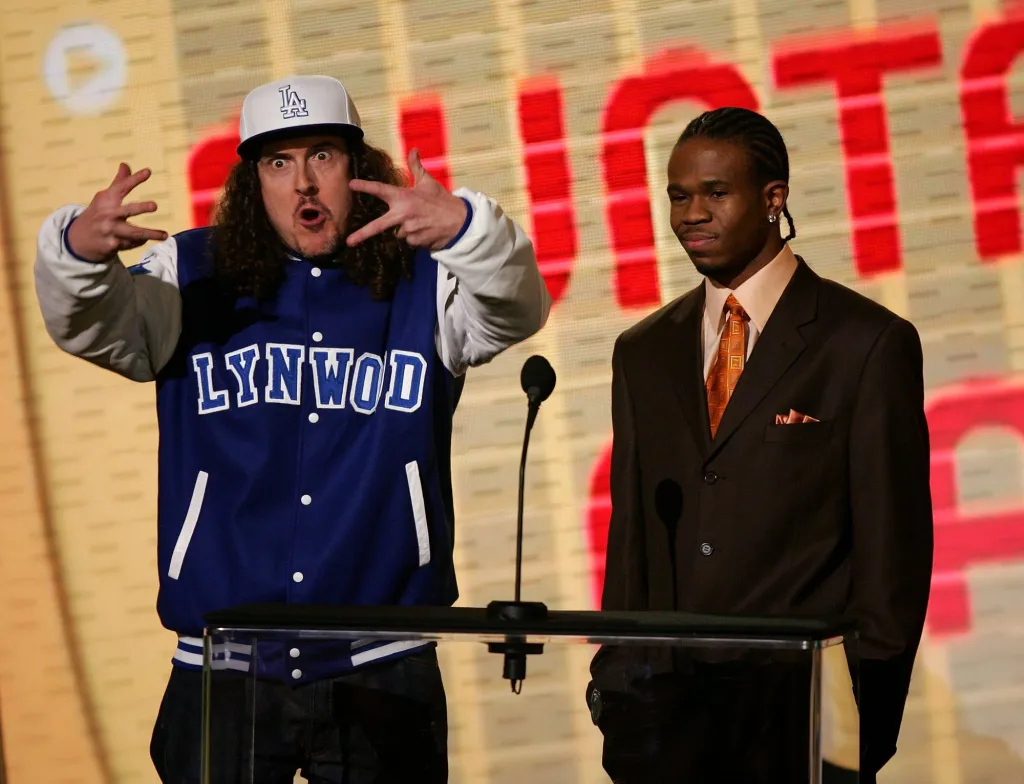
This week, Billboard is publishing a series of lists and articles celebrating the music of 20 years ago. Our 2006 Week continues here with the pop-comedy GOAT “Weird Al” Yankovic, who scored the first Billboard Hot 100 top 10 hit of his already-25-year hitmaking career in 2006 with his pitch-perfect Chamillionaire parody “White & Nerdy.”
Explore

See latest videos, charts and news
Even amid “Weird Al” Yankovic’s entire singular music career, 2006 was a particularly unique year. Roughly three decades in, the masterful pop parodist and accordionist achieved his biggest chart success yet with “White & Nerdy,” a song that embodied the many layers of both his talent and his sense of humor — that certain something that might just be called “Weird Al”-ness.
“White & Nerdy,’ off his twelfth studio album, Straight Outta Lynwood, smartly parodied Chamillionaire’s “Ridin’,” replacing the “ridin’ dirty” chorus with a decidedly less intimidating refrain. The Houston rapper’s track (featuring Bone Thugs-N-Harmony’s Krayzie Bone) calling out racial profiling and police abuse became an unlikely party anthem — and decades later would soundtrack countless TikToks and Reels — and climbed the Hot 100 to spend two weeks at No. 1.
Trading references to tinted windows, pistols and 40s for a tour through the geek lexicon ranging from D&D and Minesweeper to JavaScript and Klingon, “White & Nerdy” works as dead-on parody thanks to Yankovic’s trademark immaculate writing and production and surprisingly dexterous flow; a music video featuring both Easter eggs for hardcore fans and celebrity cameos for a wider audience (including an early-career Key & Peele) no doubt helped attract listeners, too. (Both the original and the parody landed in the top 40 of the Billboard staff’s recent 100 Best Songs of 2006 list, “Ridin’” at No. 10 and “White & Nerdy” at No. 35.)
Yankovic is no nostalgist — likely one reason why his career has lasted as long as it has — but he nonetheless remembers the moment when “White & Nerdy” came out fondly, both as an interesting moment of transition in the music industry and an unexpectedly robust time in his own trajectory. “Any kind of success always opens doors, but it’s a bit of a spectrum,” he reflects. “It certainly gave me hope, like, ‘My career is in a good place; I’m charting higher than I ever have before.’ Like, this is a nice trajectory to be on.”
Below, the recent Billboard cover star — who will soon set out on the 2026 leg of his monumental Bigger & Weirder tour (which kicks off May 26 at the Seminole Hard Rock Hotel & Casino in Hollywood, Fla.) — speaks about dual discs, MySpace shoutouts, his own affinity for Chamillionaire and much more.
Take me back to 2006 in your life. I assume that a lot of it was just about the lead up to releasing Straight Outta Lynwood. But what was your own music and media diet like at the time?
My daughter would have been about three years old — when we were doing the behind-the-scenes footage for that album there’s some shots of her as a toddler, walking around the recording studio, very, very cute. So, I mean, my life mostly revolved around having a toddler. Gosh, what was she into back then? She listened to my [The] Food Album — she liked that a lot. The Juno soundtrack, there were some songs on that that she was really into. But yeah, probably mostly kids’ music around the house at that point.
The music industry was at an interesting inflection point, firmly out of the CD era and into the iTunes era. How were you experiencing that at the time?
It was kind of a transitional period. I was still pretty focused on physical media. Straight Outta Lynwood was a dual disc, because I was trying to think of ways to get people back to physical media, instead of just like streaming it or downloading it. Which was a format that lasted about a week (laughs), but at the time [seemed like] extra value for your money. It had the making-of video and a few other things. I think also I provided a lot of stems, the instrumental versions of the songs. In 2006, I guess we thought, “Oh, well, this is what you do now!”
So you weren’t totally gung-ho on digital yet.
Well, I wasn’t sure if it was the future. I knew streaming was taking off, but I was more about seeing what I could do to make the physical medium more valuable, because I figured people could either torrent their music, or they could buy it legally through iTunes and I think my royalty rate on streaming and even on the digital downloads wasn’t as high as from CD sales. So I think I was trying to really guide people toward that, if possible.
Music videos weren’t quite what they were in your first heyday, but they still had value — and you clearly invested in this one.
It was sort of when I realized that YouTube was a real force to be reckoned with. The previous album, which came out in 2003, was sort of in a dead zone when MTV had stopped for the most part playing music videos, and YouTube wasn’t a thing yet, so at that point it was sort of like, why even make a music video? But in 2006 YouTube was really coming into its own, and I realized that doing a big-budget music video at that point made sense again. So we kind of put all our eggs in the “White & Nerdy” basket because we thought that that had a good shot — and it actually did quite well.
The celeb cameos in it are great. How did you land specifically on Seth Green, Donnie Osmond and Key and Peele?
Well, I just kind of went through my rolodex and thought, “Who would be fun to have in this video?” Seth Green of course produces Robot Chicken, so I thought of him immediately for all the action figures, because that’s sort of his thing — his house is full of action figures.
And then Key and Peele, at the time they didn’t have their eponymous sketch comedy show, they were most famous for being on Mad TV, but I knew them. It’s hilarious to me that people, you know, 20 years later watch the “White & Nerdy” video and they go, “Is that Key and Peele?” It was certainly an early appearance for them, before they really hit it big.
And Donnie, I just thought, who would be a better white and nerdy icon than Donny Osmond? We contacted him, and he flew out from Salt Lake City as a favor. I knew him a little bit, but we’re closer friends now. You never know what you’re gonna get when you have a celebrity doing you favors — you don’t know how into it they’re gonna be, or how prepared. And Donnie was so into it and so prepared, and just a hoot. He really brought it.
Was there ever any doubt that “White & Nerdy” would be a single?
When I wrote it, that was certainly the intention, but I honestly didn’t think it would do as well as it did. The original idea for that album was to have a James Blunt parody be the single. I was going to do a parody of “You’re Beautiful” called “You’re Pitiful.” I’d recorded it, I was going to do the video, and then we found out that James’ record label didn’t want me to do it, and it became a whole thing. And ultimately we decided not to go to war with Atlantic Records and I backed off.
And “White & Nerdy” I thought was good? In my mind it was conceptually very similar to a song I’d done a decade earlier called “It’s All about the Pentiums” — a very nerdy, computer geek kind of song, which I thought was really good, but it didn’t set the world on fire when it came out in 1999. So I thought, “Well, this is sort of like another version of that, and I’m sure it’ll do fine.” But I didn’t realize it was going to be my highest charting and biggest selling single. So I was very, very happy that happened.
Was it the song “Ridin’” itself that inspired you in the first place, or were you more generally a Chamillionaire fan?
I mean, I liked his music, and certainly when “Ridin’” came out, I enjoyed the song and it was No. 1 on the charts, it did quite well, and it came at the exact point where I was like, “Okay, I can’t do James Blunt. What should I do?” I worked on every variation on the theme, until the phrase “white and nerdy” popped into my head, and I thought, “Well, I can do something with that.”
It kind of checks all the boxes for me. It’s got a great memorable hook. I have come to really enjoy doing rap parodies, because there’s so many words to play with. A lot of pop songs are either repetitive or they don’t have a lot of lyrics and rap music — and in particular Chamillionaire’s song, had a very ambitious flow. It was something that I could really sink my teeth into.
It seems like the whole thing is a tongue twister, but are there any particular phrases or bars you’re proud that you got down?
I think there were three verses in Chamillionaire’s original song and I only did two. And I think the second verse I did was sort of like the Krayzie Bone verse, and that was very fast and a lot of interesting and internal rhymes. That was maybe more of a challenge, you know, but I love a challenge. That was a fun puzzle to put together.
Do you remember the first time you heard it in the wild?
It was probably on VH1 when they premiered it. I remember VH1 was very supportive. It was on their countdown — and I remember it hit No. 1 a few times on the countdown, which, you know, for me, that was a big deal. VH1 really kind of helped get that out into the world.
Were there any other unexpected places you encountered it?
I do remember when Chamillionaire put it on his MySpace page. Yeah, there’s a throwback. But that was a real big deal at the time! To have him be that supportive and excited about the parody, that was really fun. I always mention that Chamillionaire came up to me on the red carpet of the Grammys that year and thanked me for writing it, because he had just won the Grammy for rap song, and he said he thought my parody was a big reason why.
How did you feel when you heard about how the song was charting?
I’m a numbers guy — I’m obsessed with the Billboard charts. For many years of my life I would study those charts, I would keep careful lists of all the songs that ever made the Billboard top 10 singles. So then to have one of my own songs be one of those top 10 singles, that was a huge deal. And I mean, not that I wouldn’t have enjoyed it in my 20s, but it also just felt really good to, you know, not be a footnote at that point in my life and career — to actually be charting higher and be more successful than I ever had been up to that point.
This is still your highest-charting Hot 100 single. Do you feel it deserves that accolade? Are there songs in your catalog you think deserved this more?
I think there are songs that could have and should have hit a higher position on the chart. But if I have one song to have the title of my highest charting single, I’m happy with “White & Nerdy.” I think it’s a good embodiment of me personally, as well as, you know, kind of a fun song, and it’s something that we play in concert at every show. I tend not to dwell too much in the past; I’m very thankful for the success it had, and I doubt that I’ll ever hit those heights again. But it’s nice to think back now and then, like, “Oh yeah, at that point in my life, I was doing pretty well!” I’m proud of that song.





Leave a comment