

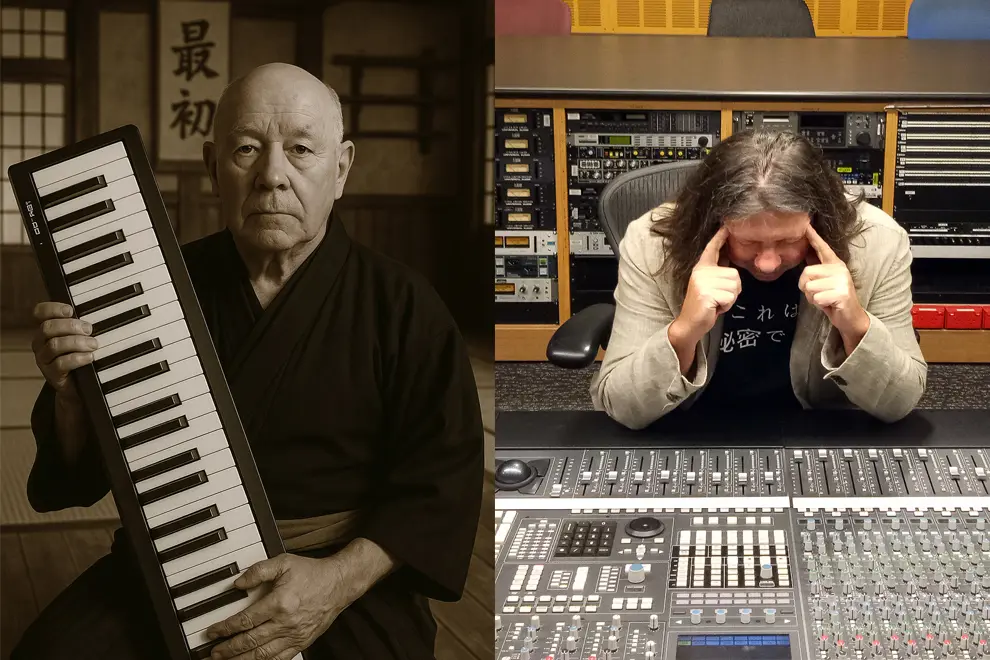
“The music has already been described as ‘cinematic’ which I take as a great compliment,” explains David Cafe of Wabi-Sabi.
Australian prog-rock bands have always found followings outside their home shores.
In 1975 Sydney symphonic-orchestral rock outfit Sebastian Hardie’s seminal debut album Four Moments triggered tours of Japan and the US.
Their keyboard player was Toivo Pilt, who was also in another prog-rock band Windchase.
Fifty years later, Pilt is now in Wabi-Sabi, with producer/engineer and multi-instrumentalist David Cafe.
With airplay on Australian community radio and the ABC, and interest from Brazil and France, Wabi-Sabi are also creating excitement in the Land Of The Rising Sun with their debut album Monsuta.
It was released there late last year as part of a three-album deal with Belle Antique/Marquee Inc. It has now green-lighted a second album.
But Belle Antique asked the title be changed: Monsuta means “Monster” in Japanese.
“We thought Monsuta sounded pretty cool in English but they felt it might be confused with Pokémon,” Cafe explains.
“They contended it had more cachet if we changed it to Legend Of Yamaryu, borrowing from the text included in the album artwork. Of course, they were right and we were happy to run with it.”
It’s no surprise about attention from that part of the world. “In general, Japanese are very discerning and respect well-crafted work.
“They also appreciate an audiophile production as it really brings to life their esoteric hi-fi systems, which are still common, as are CD and vinyl formats.”
He adds: “Their sheer population (122.7 million) offers a much larger audience than we could ever get in Australia for what realistically is a niche market.
Don’t miss a beat with our FREE daily newsletter
“While I prefer not to try and categorise our music if possible, there are notable examples of what is generally referred to as prog rock albums breaking into the mainstream with spectacular success.
“There was even a brief time in the early 1970’s that mainstream was prog, or vice versa. Back then, there was a ritual involved with listening to a new record – light the candles, the incense, pull the bean bag into the middle of the lounge room, drop the needle and light the joint.
“It was almost a religious experience. Attention spans seemed longer then.”
Pilt and Cafe have a strong interest in Japanese culture. The name Wabi-Sabi incorporates the Buddhist aesthetic which values nature and embraces beauty in imperfection.
“For example, you may have seen cracked pottery repaired with gold wire,” Cafe explains. “This embodies the philosophy Wabi-Sabi, the essence of which is captured in the new logo.”
However, interest from Japan is causing a dilemma. There’s a demand for live shows, and Pilt and Cafe always envisaged Wabi-Sabi as essentially a studio project.
“The Japanese love their live music and are naturally curious,” Cafe notes. “I was asked on several occasions if we would be touring as a live band.
“It’s not something I considered while producing the album, which is multi- layered and dense in parts and would be a challenge to replicate live.
“Not to mention a costly exercise. You’re looking at, at least, an eight-piece band to do it justice.
“But never say never, as our repertoire increases anything is possible. The next album may lend itself more to a live band performance.
The Marquee organisation also have a touring arm and regularly promote concert tours, which would be a natural fit for a Wabi-Sabi live show.”
A number of Japanese musicians have through the country’s music media expressed their desire to play shows as part of Wabi-Sabi.
Recording
The recording of Monsuta began in Sydney in early 2025, using state-of-the-art studio and top session players to tap into fresh textures, and inspired arrangements and textures.
Despite Sebastian Hardie flashbacks Wabi-Sabi is definitely a Pilt-Cafe project, and reflects their own paths.
Pilt’s parents migrated from Estonia and settled in a rural town south of Sydney with other Estonians. They helped build a church, and Pilt’s father was its organist and choir leader.
The young boy started classical piano lessons at age five, and continued until his early teens when The Beatles and The Rolling Stones led him to start R&B bands with Estonian migrant kids.
A turning point was Procol Harum’s atmospheric gonzo A Whiter Shade Of Pale (1967) “which left me speechless” at its Bach fugue on Hammond organ.
Pilt bought a beat-up Hammond, later adding Minimoog, and mellotron, forming a prog-rock band called Forever. At gigs, they were booed or fired as crowds wanted hard rock.
At a 2SM band comp at the Opera House (they came second), in the crowd were bassist Peter Plavsic and drummer Alex Plavsic scouting for a keyboard for their new band, Sebastian Hardie.
A few nights later after a Forever gig, Pilt found to his surprise his gear being wheeled into a strange van. The Plavsics were telling Forever’s manager to find another keyboardist as Pilt was now in Sebastian Hardie.
Their album Four Moments reached #12 in Australia, with a charting single Rosanna. They developed into a dynamic live act, including opening for Focus, Santana, Osabisa, and Yes.
Follow up album Windchase was less successful, and the band split. Pilt and guitarist Mario Millo formed the jazz-fusion Windchase and released Symphinity in 1977.
Cafe is a generation younger but his journey was similar to Pilt’s. Elder siblings introduced him to The Beatles, Bob Dylan, and The Stones, and he was a high school guitarist in bands.
He then moved on to prog-rock guitar heroes such as Pink Floyd’s Dave Gilmour, Jan Akkerman of Focus, and Mario Millo of Sebastian Hardie.
At 15 he’d also scored an apprenticeship from ATA Studios in Sydney, and began a career as recording engineer in 1977. Credits include Icehouse, Matt Finish, Swanee, Dragon, The Angels, Jackie Orszaczky, and Billy Field.
“(ATA) was where I met my sensei (Japanese for respected teacher) Duncan McGuire, who was a member of the incredible jazz-fusion band Ayers Rock.”
McGuire was also a member of Windchase with Pilt, and strong friendships were formed.
“Creating this album felt like a journey of rediscovery, taking everything I’ve learned over the years – the heart of what I was part of in Sebastian Hardie,” Pilt remarks.
Yamaryū – Guardian Beneath The Mountain is a mythological tale about an ancient monster whose role is to protect the planet. It can only be summoned by enlightened monks who hold the legend’s tradition in sacred lore.
Opener Monsuta is in three movements, all variations on a common motif and using symphonic keyboards and fiery guitar solos.
You can visualise Jōshin, the blind monk, and the solemn journey he undertakes on the evocative sweep of Pilgrim’s Dream, with its temple gongs, plucked koto and Shingon chants.
Cat Fink and Bittersweet venture into power pop, while Southern Sunrise builds up with dreamy guitar, mellotron flute, and Moog solo.
The closer, Café Vieillard, has a distinctly European flavour with waltz time and accordion. Bonus track Slinky Finger is a tribute to the sounds of ‘60s influential figures, soul sax player King Curtis and blues guitarist Freddie King.
Toivo’s composition Peaceful from the Windchase album, which has been discovered by new fans on streaming platforms, is revisited with the latest keyboard technology. The church organ from the original is augmented with harp, which is used throughout the album to complement Cafe’s guitar playing.
As a bonus, the Plavsic rhythm section makes a guest appearance.
Elsewhere the Wabi-Sabi duo used the cream of Sydney players as Ralph White (sax, trumpet and trombone on Yamaryu), Australia’s best soul saxplayer Geoff Oakes (on Slinky Finger), Greg Henson (drums), Victor Rounds (bass), Michael Kluger (accordion), Duncan Elliott (guitar) and Tramtracks colleagues Robert Forbes and Mark Hudson.
Cafe rejects The Music’s suggestion that Wabi-Sabi deep textures and imagery makes them ideal for Artificial Intelligence sonically, visually, and technologically.
“You might be confusing Wabi-Sabi with Milli Vanilli! There’s no denying AI is infiltrating almost every aspect of life, and it can be a useful tool. Its use in music and creative arts is also guaranteed to ignite heated debate.
“As a producer, I’ve always used any means available to achieve my vision. What that vision is however, is deeply ingrained in my psyche, the result of a lifetime’s devotion to real music. Plus, I have nearly 50 years of studio craft to draw from, so why would I want AI?”
After conducting a Dolby Atmos remix of Monsuta later in the year, Cafe is very keen to adapt the story Yamaryu – Guardian Beneath The Mountain to a visual format.
“A movie or anime based on the full story would work incredibly well with the right collaborator, who may take time to find,” he explains.
“The music has already been described as ‘cinematic’ which I take as a great compliment.”
This piece of content has been assisted by the Australian Government through Music Australia and Creative
Australia, its arts funding and advisory body









Leave a comment