

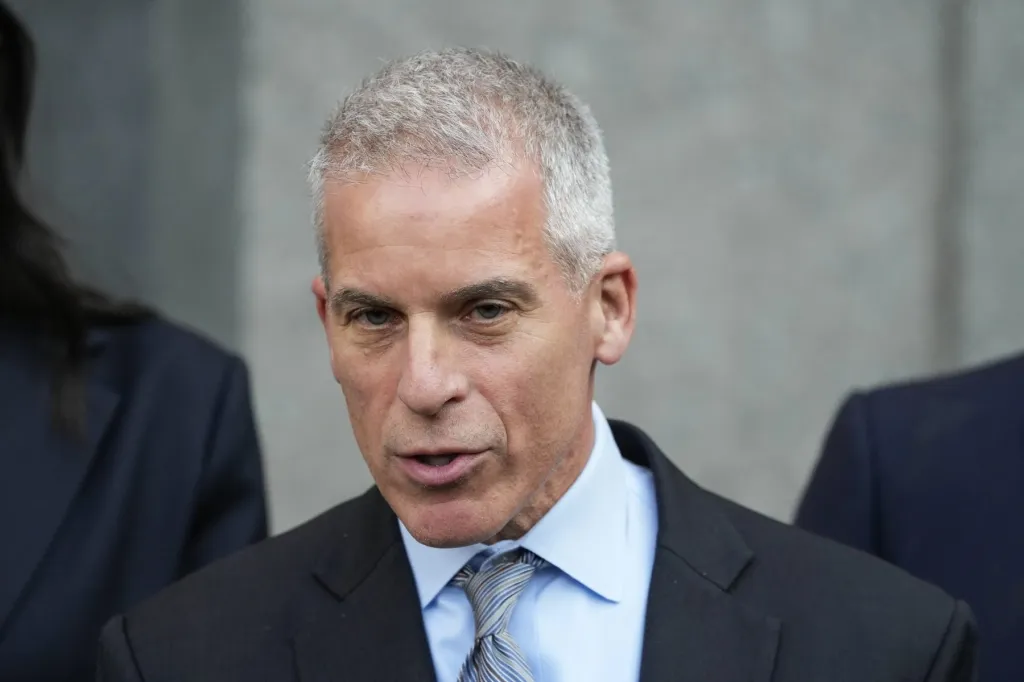
“If you don’t tell me how you got this information,” the judge said, “you and I are going to have problems.”
It was June 2024 in an Atlanta courtroom, two years into the Kafkaesque criminal case of Jeffery “Young Thug” Williams, and the rapper’s lead attorney, Brian Steel, had just publicly accused the presiding judge of holding an illegal meeting, in secret, with prosecutors and a key witness.
Rather than deny the meeting took place, Judge Ural Glanville demanded to know how Steel had learned about it. When he refused to name names, the judge issued an ultimatum: “I’m going to give you five minutes. If you don’t tell me who it is, I’m going to put you in contempt.” A second later, Steel calmly responded, “I don’t need five minutes.”
Related

That bizarre showdown has since become the stuff of legal legend — not only for the Hollywood theatrics (Steel was ordered to remove his tie and arrested on the spot), but also because it ultimately proved the turning point in the circus-like trial of one of rap most influential voices, sparking a cascading series of events that ended with Thug walking out of jail as a free man.
Steel, who has become a go-to criminal defense attorney for some of music’s biggest names, is known in the Georgia legal community for his calm, sincere demeanor, both inside and outside the courtroom. After 30 years of ugly criminal trials, he’s a pretty tough guy to fluster.
But in an extended interview with Billboard, even he gets heated when he recounts the “outrageous” incident with Glanville. “It just shows how the system is broken,” Steel says. “That is a perfect example of why people don’t trust the criminal justice system.”
When asked if he had ever considered caving under the threat of jailtime, Steel doesn’t need five minutes to answer that one, either. “Are you crazy? That judge could have taken out a semi-automatic and put it to my head,” Steel says with a laugh — sort of joking, but also, maybe not.
“I’d rather die than allow Jeffery Williams, or any other person, be under the thumb of a judge like that.”
——————
Decades earlier, Steel almost went another way. As the Queens native neared the end of his time at New York City’s Fordham Law School in the late 1980s, he was working at an accounting firm and preparing to go to New York University in pursuit of becoming a tax attorney. It’s a stable job; the world needs plenty of tax attorneys.
Then a law professor let him to take part in the 1990 retrial of Michael Quartararo, one of four Long Island boys accused of murder in a highly-publicized 1979 death of another young boy. Steel got to work the case, interviewing witnesses and spending time with Quartararo, talking about the years the man had already spent in prison. And as he sat at the counsel table during the trial, soaking in the experience, he slowly became convinced that his client was innocent.

Former Los Angeles Lakers guard Javaris Crittenton appears in Los Angeles court with Steel, in August 2011. (Photo by Al Seib-Pool/Getty Images)
Getty Images
But when the trial wrapped up and the jury returned their verdict, Quartararo was once again found guilty. Sitting in the courtroom that day, Steel was “shocked” as he watched the man being led back to prison. And he started to think that maybe tax law wasn’t his calling.
“After I saw that happen, I really couldn’t shake it,” Steel says. “I thought to myself, ‘Figuring out whether IBM and Siemens should do a merger for tax purposes, that’s important stuff, but maybe it’s not what I should be doing before I die. Maybe I can help some people out.’”
Thanks to an old college roommate who had raved about Atlanta, Steel applied to an internship at the Fulton County Public Defender’s Office, where he was eventually hired full time. The pay was meager, but the experience was priceless — leading murder trials as a 20-something lawyer, taking complex appeals up the ladder, and reading every case he could get his hands on. “I didn’t have a girlfriend, I didn’t have any money,” he says. “And I loved it.”
He was also witnessing the harsh realities of the American criminal justice system. He went to the homes of his impoverished Atlanta clients, tried to understand the lives that had led up to their cases, watched what happened to people as they faced criminal charges and then dealt with the long consequences of convictions. He even spent time in jail (“the sheriffs were so nice to me”) to understand what it was really like. And it left him with strong opinions. “We incarcerate and prey upon people, especially people of color,” Steel says. “And it’s just wrong.”
In 1993, he set out into private practice, where he slowly established himself as one of the top defense attorneys in Georgia, litigating criminal trials and appeals ranging from murder to tax evasion and everything in between. Over time, some of them started to involve musical artists — no surprise in a city that has become a key cog in the music business over the past 25 years as America’s unofficial rap capital. “I’ve represented a lot of people in your industry,” Steel says. “Thankfully, we’ve gotten a lot of cases dismissed before anyone is arrested.”
As his client list grew, Steel himself mostly remained low profile — until recently. His internet presence is minimal; he doesn’t advertise, and he doesn’t take many clients. His law firm is small, composed of him and his wife, herself a distinguished defense attorney. He’s actually still in the exact same office he moved into when he left the public defender’s office, including the same furniture. “I’m really superstitious,” he jokes.
And years later, his approach to the job is the same: Try to help people, and to understand the lives of the human beings he’s representing. “I get very close to my clients,” he says. “I meet their families. Because if I’m going to defend somebody, I gotta be invested. I gotta believe in the person. I gotta make it where if I lose this case, it’s going to ruin my life.”
——————
Back in the early 2010s, Steel got a call from a manager for Young Thug, who was just then breaking out with mixtape hits like “Stoner” and “Danny Glover” that catapulted him from Atlanta’s trap scene to a national profile. Thug had been arrested, the manager said, and had specifically asked for Steel after hearing about him from some of the attorney’s other clients.
That case was relatively small and quickly resolved. But a decade later, Thug turned to Steel again when he was arrested on far more serious charges.
In May 2022, prosecutors claimed that Thug’s “YSL” — nominally a record label under Warner Music Group’s 300 Entertainment — was also a violent street gang called “Young Slime Life.” Under the direction of Thug’s “King Slime” moniker, the DA’s office said YSL had wrought “havoc” on Atlanta for years, including carrying out an unsolved drive-by shooting. If convicted on the charges, Thug faced a lifetime in prison.

Steel arrives at the Fulton County Courthouse on Nov. 27, 2023 in Atlanta during the Young Thug case. (Photo by Christian Monterrosa/AFP via Getty Images)
CHRISTIAN MONTERROSA/AFP via Getty Images
From the start, the case was a mess. Just finding lawyers for all 28 defendants proved extremely difficult. Prosecutors also wanted to use Thug’s song lyrics as evidence against him — an already-controversial practice that Steel called an attack on free speech. After it took nearly a year just to select a jury, the trial moved at a glacial pace, eventually becoming the longest in state history. All the while, Thug sat in jail, having been repeatedly denied bail.
It was in June 2024, with no end in sight, when Steel unveiled his stunning revelation about the secret meeting. When he first learned about it, he says he almost didn’t believe it — that there was “no way” that a judge had met with prosecutors and a crucial witness about important testimony and didn’t alert defense attorneys. But when he raised it in court and Judge Glanville began threatening him, he says he knew that it “really did happen.”
“It’s a conspiracy. It’s insane,” Steel recalls thinking at the time. “And I’m standing in front of this judge, and he’s telling me that I’m going to jail?”
Related

The rest is history: the judge held him in criminal contempt and sentenced him to 20 days in jail. (In another Grisham-esque flourish, Steel asked to serve his sentence alongside Thug so they could prep for trial.) But the ruling was later overturned on appeal and, more significantly, Glanville was eventually removed from the case over the incident. He was replaced by Judge Paige Reese Whitaker, a judge with a reputation for efficiency who quickly began to criticize the prosecutors for “poor lawyering” and a “haphazard” approach to the case.
Whitaker’s appointment led to the case’s dramatic endgame months later, when another misstep by prosecutors led her to consider a mistrial. To avoid that outcome, the DA offered Thug a plea deal that would have sent him home immediately. But the deal would have imposed onerous restrictions on him and his future career, so he and Steel refused to take it — feeling confident enough to instead simply plead guilty and hope the judge would set him free.
The move was risky. With no plea deal in place, prosecutors quickly asked for a whopping 45-year sentence against the star. But it paid off: Whitaker opted instead to sentence him to just 15 years of probation. “It was definitely a gamble,” Steel says. “We took a shot and he was out that night and he’s never looked back.”
To this day, Steel is certain that he would have won an acquittal, saying his client was obviously innocent and wrongly charged. But when considering the guilty plea, he says he deferred to his client, who had been sitting in jail for more than two years: “Jeffery was like ‘Brian, I can’t stay here. I have a real life.’”
——————
Thug’s case became something of a cause célèbre: maybe due to the unapologetic use of his lyrics in the indictment; maybe due to him sitting in jail for years without a conviction. Whatever the reason, when Thug walked free, the reaction was more joyful than anything else. “Welcome Home lil bruddah, It’s been too long,” the rapper T.I. wrote on Instagram; a few months later, Drake released a song called “Brian Steel” that included a shout out to the now-famous attorney.
But not all of Steel’s clients have been so sympathetic; that comes with the territory when defending people charged with serious crimes. Every American has a constitutional right to a defense attorney, and everyone knows that people are presumed innocent until proven guilty. But when emotions get involved, that’s often not how it works.
Related

Over decades at the job, Steel has plenty of experience with that. He’s represented a wide range of defendants accused of pretty much any crime imaginable, and most of them didn’t have dedicated fan bases pleading for their release on social media.
“I’ve done the most violent cases, people cutting up bodies and eating the eyeballs, to white collar cases like tax evasion,” he says. “I’ve represented indigent people and the most vulnerable, as well as the most powerful.”
One of those clients was Jackie Johnson, a former Georgia prosecutor charged with hindering the police investigation into the 2020 murder of Ahmaud Arbery, a Black jogger whose killing sparked national outrage. Just a few months after that celebrated win for Thug, Steel was in court defending a prosecutor accused of covering up a hate crime that had galvanized the country.
At trial, he argued that there was no evidence that Johnson had ever done so — that an “innocent woman” had been scapegoated amid the national uproar over Arbery’s murder. And after five days of testimony, the judge agreed, acquitting Johnson on the grounds that prosecutors had failed to present even “one scintilla of evidence” that she ordered police not to arrest Arbery’s killers.
For Steel, the Johnson case was no different than the Thug case, subjecting an innocent person to the machinery of the modern justice system. “It was all a lie,” Steel says. “And yes, she got cleared, but she went through it for five years, getting death threats.”
——————
In April, two months after winning Johnson’s trial, Steel was hired to join the team of lawyers representing an even more famous musician than Thug — but one that the public was hardly clamoring to free.
Sean “Diddy” Combs, once one of the music industry’s most powerful figures, had been charged in 2024 with racketeering and sex trafficking, over claims that he forced his former girlfriend Cassie Ventura and other women to have sex with male prostitutes in sex parties known as “freak offs.” Across more than a year of civil suits, documentaries and the release of a hideous surveillance video showing Combs striking Ventura in 2016, many had made up their minds about the star.

Steel arrives for Sean “Diddy” Combs’ sentencing at Manhattan federal on October 03, 2025. (Photo by Michael M. Santiago/Getty Images)
Getty Images
At trial, Steel and Diddy’s other lawyers apologized for his acts of domestic violence, and admitted that the star had had “toxic” relationships with Ventura and other women. But they stressed that his alleged victims had been consenting participants in the sex parties, and that his behavior, no matter how unsavory, did not come close to the sweeping federal charges he was actually facing.
While not an ideal PR narrative, those arguments largely worked in court. In a July verdict, jurors acquitted Combs on the most serious charges, avoiding the possibility of a lifelong prison sentence. But he was still found guilty on two lesser prostitution counts, for which he was later sentenced to four years in prison.
Asked about the Diddy case, Steel is bluntly honest about his client’s conduct, saying that he had clearly “brutalized” Ventura. “This was objectively, brutally wrong,” Steel says. But like he and his co-counsel argued during the trial, Steel says that still doesn’t mean he should face a life prison sentence for different crimes.
“I’m coming onto the case and learning the case, and I start reading these communications that clearly show this was consensual,” Steel says. “I’m not saying the beatings were consensual. They were wrong. But that’s not what he was charged with. We’re going to say you should die in prison, that you sex trafficked people, when that’s clearly not true?”
Diddy’s case is currently pending on appeal, where his team is arguing that the judge sentenced him to an unfairly “draconian” prison term. They say the judge served as a “13th juror” who had been swayed by claims of coercion, even though such allegations had been rejected by jurors.
The way Steel tells it, the Diddy case is also no different than any of his others, despite the global media sensation surrounding it and the strong feelings people have about his client. Whether it’s an indigent defendant or wealthy one, a beloved rapper or a not-so-beloved one, he sees the same flawed legal system and the same ultimate goals.
“I’ve done plenty of cases that you’ll never hear about, [other] cases that are high profile — they all mean the same to me,” he says. “I just want to help people, ethically and zealously. And I don’t want to hurt anybody, and God willing, something good will come out.”





Leave a comment