
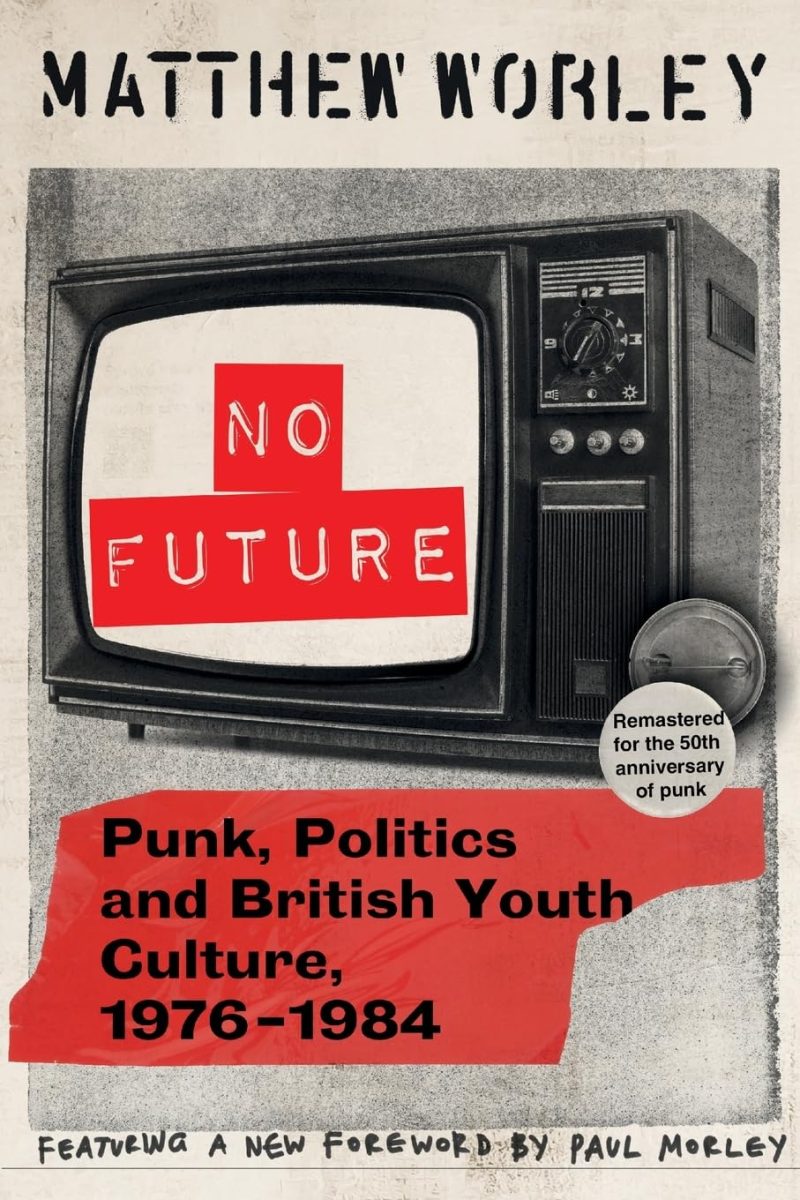
 No Future: Punk, Politics and British Youth Culture, 1976-1984 by Matthew Worley
Published by Cambridge University Press
Release date: out now (Buy it here)
With No Future, reissued now to mark the fiftieth anniversary of punk, historian Matthew Worley attempts something that sounds straightforward but proves anything but: a rigorous, unflinching examination of British punk and its politics that cuts through five decades of myth, nostalgia and received wisdom to get at what the movement actually was, what it meant, and why it still matters. The result is a dense, brilliantly researched study that manages to be both academically serious and shot through with the restless energy of its subject.
Worley is Professor of Modern History at the University of Reading, but don’t let that put you off. This isn’t a dry academic exercise written from a safe distance. He is a lifelong punk fan, a contributor to street punk magazine Street Sounds, and someone who knows the back catalogues of the 4-Skins and Cockney Rejects as well as he knows the Sex Pistols.
The academic rigour is present throughout, the language can be demanding in places, and anyone who didn’t previously know that Sham 69 were steeped in existential disaffection may need a moment, but it comes from a place of genuine love for the subject.
That combination of scholarly discipline and authentic insider knowledge is what sets No Future apart from the crowded shelf of punk literature.
The scope is admirably broad. Worley charts the full arc of punk’s cultural development from 1976 through to 1984, taking in not just the familiar first wave of the Pistols, Buzzcocks and the Slits, but the post-punk experimentation of Joy Division, the industrial provocations of Throbbing Gristle, and the fractious 1980s diaspora of anarcho-punk, Oi! and goth.
He is clear-eyed about punk’s origins: “the Sex Pistols tore open the cultural fabric, trashing the past and confronting the present to better refine the future,” – while resisting the temptation to let the Pistols swallow the whole story.
The provincial scenes that flourished beyond London’s media glare get their due. The DIY labels, the fanzines, the council estate kids Mark Perry described in Sniffin’ Glue as “waiting out there in the discos, on the football terraces” – all of it is given proper weight. What’s most refreshing is that Worley resists the gravitational pull of nostalgia. This is not a love letter to a golden age. His stated aim, laid out with admirable clarity early in the book, is “not to write a narrative history of punk remembered, but to examine the various ways by which punk was constructed, understood and utilised as a cultural medium at a particular historical juncture”.
Rather than the familiar narrative of X was bad, Y got angry, he presents punk as a genuinely multi-dimensional political and cultural force. The tension between punk-as-art and punk-as-social-commentary, he argues, was baked in from the start, and it was precisely this productive friction that drove the culture’s evolution through the late 1970s and into the 1980s.
The political chapters are some of the book’s most compelling. Worley covers Rock Against Racism with the thoroughness it deserves, situating it within a broader landscape of left-wing engagement with punk that ran from the SWP to the Young Communist League – who, remarkably, sent the Sex Pistols an open letter in 1977 suggesting a consolidation of punk and communist forces. He is equally unflinching about the darker currents, handling the emergence of Rock Against Communism and the NF’s attempts to recruit through punk with honesty and intelligence.
These were the movement’s ugliest contradictions, and Worley neither minimises them nor lets them define the whole picture. The cultural analysis is equally sharp. A particularly rich passage examines how punk’s energy found expression not just in music but in a wholesale reimagining of what youth culture could look like: “punk gave vent to frustrations of both socio-economic and existential origin at the precise moment when Britain itself was passing through a period of uncertainty and change”.
The chapters on gender and sexuality are especially strong, tracing punk’s distortion and dismantling of conventional masculinity through everything from the Sex Pistols’ name to Morrissey declaring himself “a prophet for the fourth sex” in an early interview with Sounds. Worley has a gift for finding the telling detail – the Nuclear Socketts’ ‘Shadow on the Map’ as an oblique reference to King’s Lynn, Conflict’s Colin Jerwood surveying 1984 and signing off with “Fuck authority… your oppression creates the hate” – that brings the period alive without tipping into sentimentality.
At times, the density of information is considerable. No Future is not a book to race through: it rewards patience and repays revisiting. One third of the volume is notes and source material, drawing on an impressive array of fanzines, contemporary journalism and academic literature that provides both rigour and flavour.
But Worley never loses sight of what made this moment so vital and so strange, and his ability to situate the reader inside the cultural moment: to make you feel the urgency and chaos from within, is remarkable. Fifty years on, with inequality rising, youth prospects diminishing, and the political landscape feeling increasingly bleak, No Future lands with uncomfortable relevance. The specific circumstances of 1976 may not be repeatable, but the conditions that produced them feel horribly familiar.
As Worley notes, punk was “the first modern youth culture born into recession”, and the generation that came of age beneath the shadow of no future found ways to make that despair generative, creative, and occasionally magnificent. His masterful study is essential reading not just for punk obsessives, but for anyone trying to make sense of what happens when a generation decides it has nothing left to lose.
~
Words by Thomas Sidwell, his author profile is here
A Plea From Louder Than War
Louder Than War is run by a small but dedicated independent team, and we rely on the small amount of money we generate to keep the site running smoothly. Any money we do get is not lining the pockets of oligarchs or mad-cap billionaires dictating what our journalists are allowed to think and write, or hungry shareholders. We know times are tough, and we want to continue bringing you news on the most interesting releases, the latest gigs and anything else that tickles our fancy. We are not driven by profit, just pure enthusiasm for a scene that each and every one of us is passionate about.
To us, music and culture are eveything, without them, our very souls shrivel and die. We do not charge artists for the exposure we give them and to many, what we do is absolutely vital. Subscribing to one of our paid tiers takes just a minute, and each sign-up makes a huge impact, helping to keep the flame of independent music burning! Please click the button below to help.
John Robb – Editor in Chief
PLEASE SUBSCRIBE TO LTW






Leave a comment