
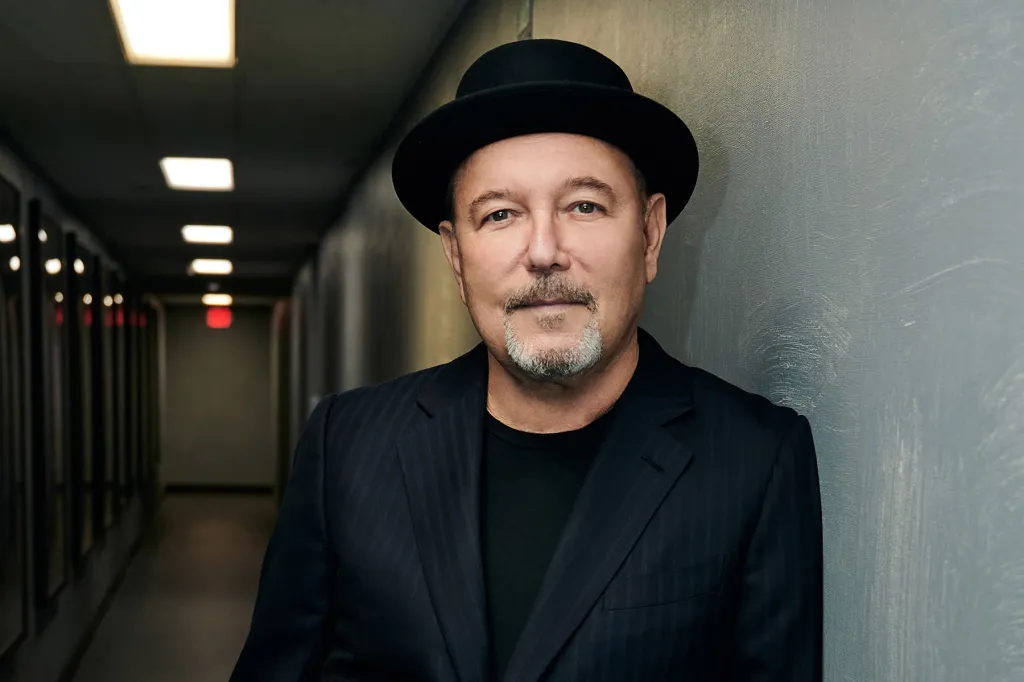
Rubén Blades was always an iconoclast. He got a master’s in international law from Harvard, but gained global prominence and unlikely commercial success as a salsa musician, known for his complex songs that told urban tales of daily travails and economic inequality. He won international acclaim as a recording artist but ran for president of his native Panama at the height of his music career. He became a Hollywood darling with prominent acting roles yet never hesitated to vocally criticize what he perceived as social injustices.
Explore

See latest videos, charts and news
Although Blades became a musician in Panama, he forged his path in New York, the birthplace of salsa. His first record deal was with the Alegre label, owned by music impresario Morris Levy, where he released his 1970 debut, De Panamá a New York. Levy later sold Alegre and another label he owned, Tico, to Fania Records co-founder Jerry Masucci in 1975, and for nearly a decade Blades released his subsequent albums at that legendary tropical music indie, many with bandleader and trombonist Willie Colón. Decades later, Blades became one of the first Latin artists to sue a former label — in his case, Fania — for unpaid royalties and copyright infringement. (Fania’s extraordinary catalog of over 20,000 recordings and compositions was most recently acquired by Concord.)
While Blades later spent time at Sony, he took full control of his musical output — from conception and recording to distribution and marketing — the moment he could. In 2004, he launched his own label, Rubén Blades Productions, and has released 11 albums on it since, for which he’s won 11 Grammys and 11 Latin Grammys (out of a total 13 and 12 wins, respectively). Twenty-three of his projects have reached Billboard’s Top Tropical Albums chart — the fifth-most in the list’s history — and he has placed tracks on Hot Latin Songs in three different decades.
Now 77, Blades remains astonishingly busy. After slaying zombies in the long-running series Fear the Walking Dead, he recently starred in the film Campeón Gabacho, directed by Jonás Cuarón (and produced by his famous father, Alfonso), and will soon begin filming Armadillo Untied alongside Antonio Banderas. And as ever, there’s new music in the works: Blades will soon release an album blending big band and 1970s salsa, inspired in part by the signature two-trombone sound of Colón and Eddie Palmieri, and will tour Europe and Latin America beginning this summer.
Through it all, Blades continues to post his unfiltered thoughts on politics on his blog, “Apuntes desde la Esquina (Notes From the Corner),” which he publishes on his website and social media accounts — and Penguin Random House will publish his memoir, Life’s Little Surprises, next year.
“The fact that I’m an artist doesn’t exclude me from the consequences of political acts or the effects of daily society,” Billboard’s Indie Icon says. “I aspire to present an objective perspective, an independent analysis that isn’t influenced by economic or ideological interests, nor by the ill will of those who simply want to destroy society and deny the possibility of justice and reason.”
You have long released music under your own label and in 2024 signed a partnership with Virgin. Why did you decide to take that route?
Record companies don’t convince me. They don’t protect artists’ rights as they should, they never pay on time, it’s impossible to understand their accounting, too many excuses, few benefits, too many traps. Labels present themselves as defenders of art, and they’re no such thing. The artists they sign create the material, and in the end, the labels keep their product, even when they’ve discounted artist “royalties,” which they never pay on time or fully, if they pay at all. If you try to calculate domestic or foreign royalties, you risk suffering from a brain aneurysm.
Fania only paid me $1,000 for Siembra [Blades’ seminal 1978 album with Colón, widely acknowledged as the top-selling salsa album of all time] and then claimed it hadn’t recouped its investment. I sued them twice, until I finally recovered my compositions, though not my master recordings. As for royalties? Goodbye!
After being exploited by record labels, the only path for me was independence.
Craft/Concord now owns the Fania catalog and has been releasing remastered versions of some of your past recordings. What ownership did you retain — or have you reclaimed — from your older releases?
I’m waiting for some of my recordings on labels like Fania, Elektra/Asylum and Sony revert to my control. I made some requests when the statute of limitations has expired, and I’ve recovered several recordings, like “Buscando America,” but only for the U.S. The rest of the world is controlled by the label, which is absurd and unfair.
Regarding Fania, the issue of reclaiming my masters is more difficult because, with the exception of Maestra Vida, all the albums I did with Willie Colón are considered collaborations. Therefore, the request to reclaim our recordings would have to be made by both me and Willie’s heirs, and that complicates things. I decided to rerecord Siembra in its entirety, and now I own that master. What I prefer to do is rerecord the songs on my own and not depend on third parties to reclaim my master recordings.
I don’t understand Craft/Concord. They are in possession of the history of Afro-Cuban music in New York, of the Fania catalog. Why don’t they do something meaningful with such a treasure?
Blades as a young salsa star circa 1970.
Echoes/Redferns
What was the good and the bad about being at a label like Fania?
The good: [Founders and owners] Jerry Masucci and Johnny Pacheco revived Afro-Cuban music, gave “salsa” an international audience and provided opportunities to many talents — from singers and arrangers to songwriters and graphic designers. Fania brought joy to millions of people, created a global musical movement of enormous importance, and its effects are still relevant today. Without the work of Masucci and Pacheco, I wouldn’t be here talking about this. They were two titans and visionaries who loved music and always defended it.
The bad: The company exploited its artists. It did not compensate us fairly for what they earned from us. We became their property, and our rights and contributions were not respected or appropriately remunerated, which eventually led to the label’s demise, my frustration with Masucci and my lawsuits against Fania.
Later, you went to Sony. What did you learn from both experiences and about the difference between indie and major labels?
Both Fania and Sony operated under the same paradigm: Everything for the company, and the minimum for the artists, arrangers, composers, graphic designers and sound engineers. My experiences with both labels were bittersweet. They gave me opportunities to showcase my talents but did not treat me fairly financially.
Is there a difference today between being an independent artist and being signed to a major?
It is tougher for the independent, but he or she will own their work. With a major label, you get a guaranteed money advance, but good luck getting an accurate accounting of royalties or more money later. And you lose control of your record — it now belongs to someone else. As an independent Rebecca Milzoff, I don’t have the organizational power of a multinational, but at least what I make belongs to me and I can leave it to my family.
What does being indie mean to you?
It means maintaining control of my recordings and ensuring that I will own what my talent produces. A record label, run by a president who doesn’t sing, play an instrument, compose, arrange or probably even dance, ends up owning a record that someone else produced. That’s absurd.
What advice would you give to an artist today who wants to have a long career like yours?
Don’t use drugs. Try to be original and sincere in your creations. Write your own songs and base them on the world you live in. Don’t just think about the moment; think about the future. Save money. Get good professional advice. Pay your taxes. Create your own publishing company and register your creations. Plan for retirement. Get health insurance. Treat everyone with respect. Pay your bills on time. Pay well those who help you succeed. Always respect your audience and never underestimate them. From the beginning, be clear with yourself: Why are you in music? What are you looking for, and what do you want to achieve? Those who aren’t clear about these things always make mistakes.
What advice would you have liked to receive?
To create my own publishing company immediately, as soon as I started writing songs. To create a retirement plan at the beginning of my career. I would have saved more money early on.
Your business is multifaceted. What is your most important revenue stream now?
Honestly, I’ve always lived on an annual budget, and that’s why I’ve learned that you can live well without necessarily being a millionaire. I was never interested in amassing a fortune. I have fixed income streams, like royalties for my musical compositions. And while tours always generate liquidity, I no longer depend on them.
What connection does your activism have to being an indie artist? Was there ever a time in your career when the industry discouraged you from being politically outspoken?
No record label or company wants to be deemed antagonistic toward the public they’re trying to reach. When an artist presents a public opinion on any issue, it can immediately alienate a portion of the buying market. The reason Fania originally allowed my songs to be recorded was Willie Colón’s involvement. He was their bestselling act at the time.
My compositions ended up making Fania millions of dollars, even after being denounced by some as political or worse. But my position was not just political; it was an urban commentary, a reflection based on what was happening all around us, in our cities and countries, and the effects negative political actions produce on society.
You’ve worked with many young artists, including Fonseca and Residente. How important is mentorship to you?
I don’t see my collaborations only as “mentorship” because I also learn from the artists I share with, no matter their age. The process of education is continuous; it doesn’t end. I enjoy having meetings or conversations with younger people, in schools or universities, for example, to answer their questions. When knowledge and experience are not shared, then what good are they?
This interview has been edited for length and clarity.





Leave a comment