
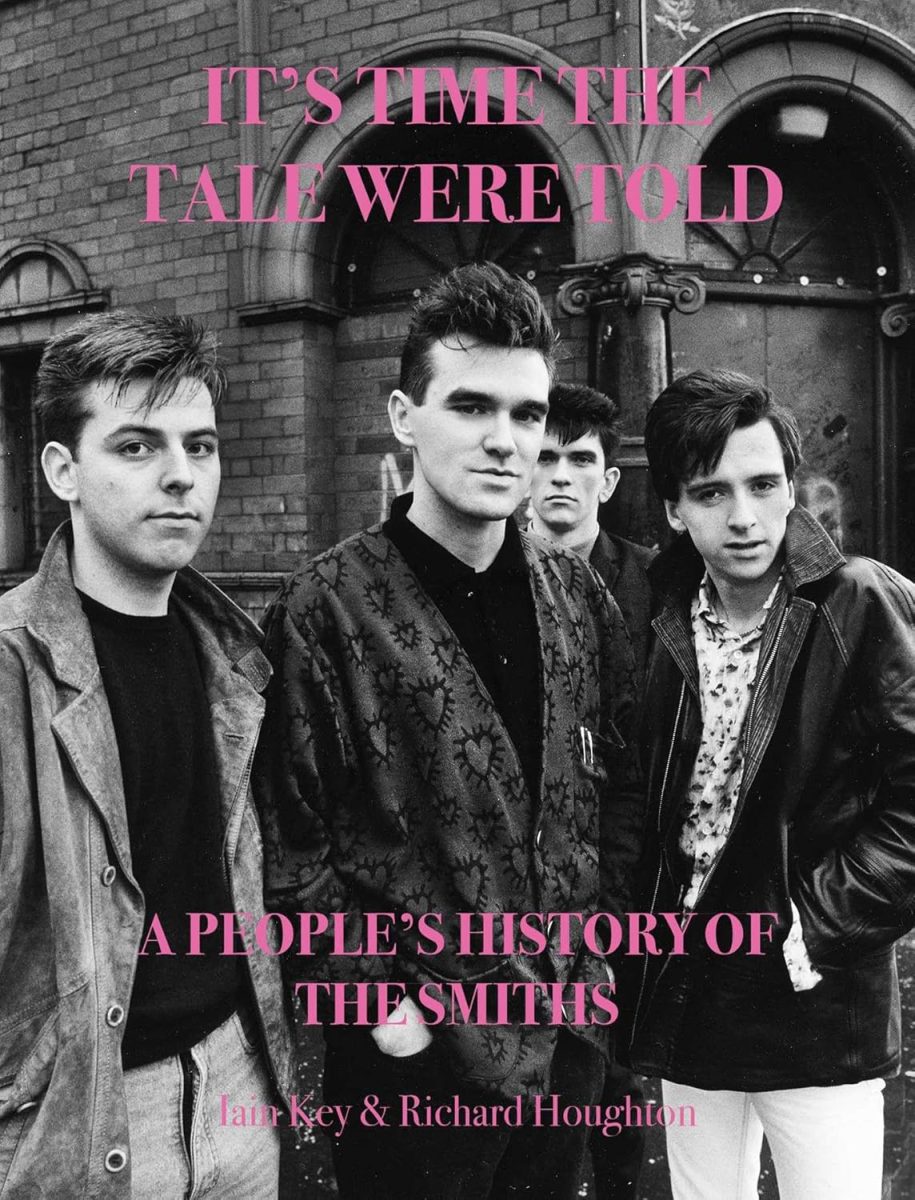
It’s Time the Tale Were Told by Iain Key and Richard Houghton
Published by Spenwood Books
Publication date: 12 Jun 2026
A look at the life and times of The Smiths, told by the people who worked with them and the people who loved them.
The Smiths were one of those once in a generation bands who defined their era and were adored beyond reason by their many fans, influencing their approach to sexuality and gender roles, their style and even their diet. Their fans loved them with a devotion normally reserved for cult bands, but they also managed to achieve mainstream success, a balancing act that most bands fail to achieve.
I remember walking through Liverpool one summer afternoon in 1983 and seeing my first Smiths fan, a Morrissey lookalike, complete with shirt, beads and quiff, and thinking even then that the Smiths were destined to be something more than just another band.
This was to be far from my last Morrissey lookalike, as Smiths mania hit the indie crowd and then spread out across the UK. Smiths t-shirts were everywhere, and fans were instantly identifiable. It seemed like The Smiths were becoming a movement all on their own.
I was lucky enough to see The Smiths six times, and they seemed to become a big band almost immediately. The first time I saw them was around the time of their second single, This Charming Man, and even then, they were selling out fairly large gigs for so young a band. They soon progressed to even larger bands such as Manchester Apollo and, for their last tour, Brixton Academy and Preston Guildhall, previously the preserve of the likes of Rush and Thin Lizzy. There was a feeling in the air that the indie kids were winning, that we were taking over. It was such a shame and a huge body blow that shortly after this, The Smiths were no more.
Their legend has survived well since then, despite what seems like Morrissey’s best attempts to destroy it, and The Smiths live on in the minds of their fans. And what memories these are and what fans these The Smiths had!
In It’s Time the Tale Were Told, Iain and Richard bring together a whole bucketload of these memories, presented in chronological order, to chart the rise and demise of The Smiths as experienced by those in the front rows, those who lived through their time as a band and the tumult of heady emotion that came with being a fan.
Far from being the arch miserabilists they were often portrayed as, The Smiths were a riot of fun, humour and friendship. Whole subcultures, relationships and cultural mores were built around being a Smiths fan, and Iain Key and Richard Houghton’s collection of memories demonstrates this in passionate first hand detail.
If it can be said that a band is effectively no more than the collective efforts of their fans, The Smiths were, and possibly still are, one of the greatest bands ever put together. And in that case, who better to recount The Smith’s tales than the fans themselves.
Not that this book is limited to the fans. We also hear first hand accounts from fellow musicians such as Simon Wolstencroft, rehearsal studio owners and studio engineers. The fact that the book is put together from people who experienced the band first hand gives it a feel of authenticity and a sheen of excitement.
The recollections start at the beginning, from early rehearsals through to the band’s first gigs and are tied together where necessary by commentary from the authors, which fills in any blanks and adds to the timeline. Fan’s memories start at The Smiths’ second gig, at Manchester’s Manhattan Sound club, where Anne Ford recollects, “There were about 40 people there. We were close to them as it was so small. Morrissey was Morrissey and did the flailing arms thing.” After this gig, the classic Smiths lineup of Morrissey, Marr, Rourke and Joyce was in place, and they played The Hacienda for their third gig, introducing flowers for the first time as, in Morrissey’s words, “it was so sterile and inhuman.”
Stockholm Monsters bassist, Ged Duffy, has an odd tale of acquiring chairs for the band’s family to sit on when watching the band supporting Richard Hell, and then having to guard the chairs to avoid the audience bumping into them, with family members making comments like ‘Oh Stephen, that was wonderful,’ or, ‘John, I never knew you could play like that.’
From here we delve into the familiar story of The Smiths, their singles, albums and Peel sessions along with many gigs. The memories contained in It’s Time the Tale Were Told add a personal flavour to a well known story. A lot of these memories are well detailed, despite the long years between the event and the recall, possibly as a result of being told many times down the years. In many of these memories, Morrissey comes across as quiet, apart and even aloof. Joe Whyte recalls “Morrissey not having much to say. If only it had stayed that way!”
There are tales from personal connections to The Smiths, as well as from the crowd, promoters, support bands and roadies figure in this glimpse behind the curtain. Memories are not confined to gigs, we also get fan’s reactions to The Smiths records as they were released, and even their radio sessions and TV appearances. This leads to a fuller picture, as each new step in the band’s career is discussed and ruminated over.
Early gigs saw The Smiths gathering the beginnings of their hardcore fan base, something that was to keep happening down the years. Dan Burke came to The Smiths late, discovering them through his dad’s CD collection, but the effect on him was the same as earlier fans; “The combination of Johnny Marr’s amazing guitar playing, Morrissey’s exuberant singing voice and those evocative, humorous lyrics was like nothing I’d ever heard before. The Smiths instantly became my favourite band.” Words that will surely chime with the experiences of many Smiths fans.
My own introduction to The Smiths is covered when they played the local college, and I managed to blag my way into the sold out gig. Surprisingly, for a small gig in a small town from a relatively unknown band, there are another five people recalling this same concert, including the guitarist from support band Red Guitars. Shortly after this, The Smiths appeared on Top of the Pops and then the Old Grey Whistle Test for the first time and their rise continued apace.
The venues the band played got bigger, and the shows were selling out well in advance. Henry Wood tells us, “Such was Smiths fervour at this point that tickets for this show had sold out weeks beforehand. Tickets were like gold dust, but I would not have sold mine for love nor money” before telling us that he only bought tickets for support act Billy Bragg!
The gigs were getting bigger but were still selling out. Anne McGlashan tells us about a gig at Glasgow’s Barrowlands: “I had been to Barrowlands a few times before, but this is the first time there was a queue, all the way around the corner. We must have been early, but we stopped to have a wee roll up on the way there. There were people in the queue holding bunches of gladioli. Everyone was buzzing – the atmosphere was electric.”
The Smiths soon became one of the biggest and most loved bands in the country. Michael Evans was at their Royal Albert Hall gig, “I was at the very front. I got absolutely crushed. Violence is the wrong word, but there was an atmosphere there that was more than worship. It was more than passion. It was beyond anything I’ve ever witnessed. Even to this day, I’ve never witnessed anything like I witnessed at that one Smiths gig. They are my Beatles.”
Fans from all over the world have contributed to It’s Time the Tale Were Told, covering their American and European dates and demonstrating that the love for this singular band was a truly worldwide phenomenon.
By the time of their last tour, The Smiths were a well drilled unit. Kate Arnold tells us their appearance at Gloucester Leisure Centre started with “still my best gig entrance ever. The drum intro to ‘the Queen Is Dead’ and Morrissey dancing in from stage left brandishing a placard with the title of the song on and – I think, although I might be making this up – a noose around his neck.”
The Smiths’ demise is covered firstly by people who knew and worked with the band before moving on to the fans, and backed up by images of how the music weeklies covered the split. It was a seismic event for Smiths fans, with Caroline Allen describing it as “the worst thing to ever happen to me as a youngster.”
The story doesn’t end here though, as singles, a live album and countless compilations were still to come, and Smiths fandom still continued. Love of The Smiths was also passed on through the generations, with new fans telling how their parents introduced them to the band and their music. This newfound love ran as deep as it did for the original fans. Richard Bowes felt that “Morrissey was speaking directly to me on ‘I Know It’s Over’. (Little did I know I was simply the latest in a long line of thousands who felt exactly the same.)
The book ends with a quote from Morrissey, who says, “I would rather eat my own testicles than reform The Smiths, and that’s saying something for a vegetarian.” As usual, though, I suspect he is being more quotable than truthful, and tales of him wanting to reform The Smiths have surfaced over the years.
It’s Time the Tale Were Told is an in-depth look at the affection, obsession, dedication and love that The Smiths engendered, told by the people who experienced it. It is a charming look at a tale we know well, and Iain Key and Richard Houghton do an admirable job of cataloguing and presenting the many views and stories.
As all great music books do, it makes me want to dig out The Smiths’ back catalogue and journey again through one of the most loved bands we have ever had.
The Smiths were more than just a band, and It’s Time the Tale Were Told is another chance to revel in all that they meant.
~
Buy It’s Time the Tale Were Told by Iain Key and Richard Houghton here
Words by Banjo, you can find his Louder Than War archive here
A Plea From Louder Than War
Louder Than War is run by a small but dedicated independent team, and we rely on the small amount of money we generate to keep the site running smoothly. Any money we do get is not lining the pockets of oligarchs or mad-cap billionaires dictating what our journalists are allowed to think and write, or hungry shareholders. We know times are tough, and we want to continue bringing you news on the most interesting releases, the latest gigs and anything else that tickles our fancy. We are not driven by profit, just pure enthusiasm for a scene that each and every one of us is passionate about.
To us, music and culture are eveything, without them, our very souls shrivel and die. We do not charge artists for the exposure we give them and to many, what we do is absolutely vital. Subscribing to one of our paid tiers takes just a minute, and each sign-up makes a huge impact, helping to keep the flame of independent music burning! Please click the button below to help.
John Robb – Editor in Chief
PLEASE SUBSCRIBE TO LTW



Leave a comment