

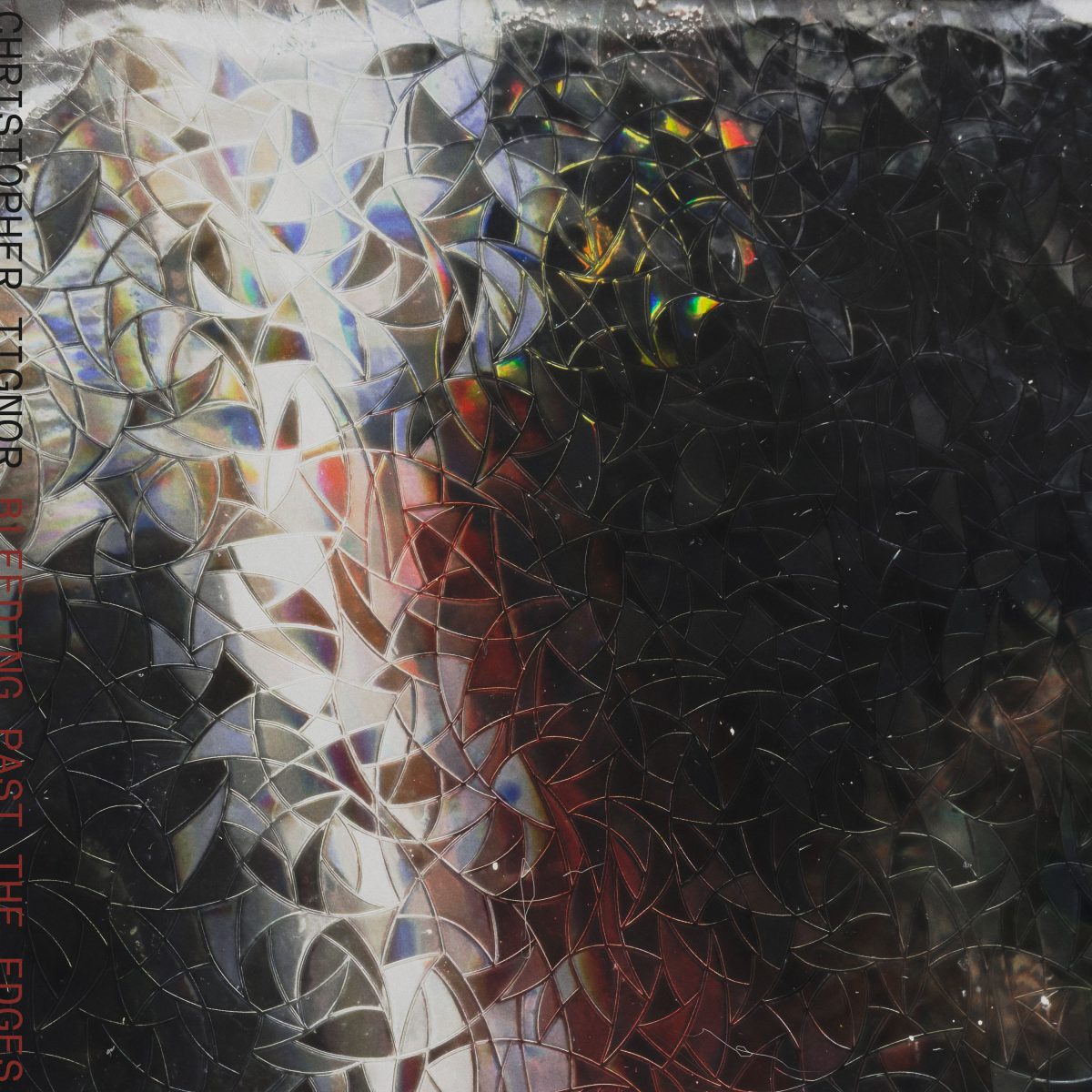
 Christopher Tignor: Bleeding Past the Edges
Vinyl | Digital
Released 29 May
Christopher Tignor is set to release his sixth solo album Bleeding Past the Edges. Man, violin, and self-coded software amalgamate in neo-classical experimentalism.
To call Christopher Tignor a polymath seems a little understated. Though what else can you call a man who:
- holds a PhD from Princeton (composition)
- holds an MS from NYU (computer science)
- holds a BA from (the aptly named) Bard College (creative writing)
Those are just his academic qualifications. He writes custom software that he uses in his music, and has had research papers published.
So, when it comes to making music, Mr. Tignor’s bona fides are of the highest caliber (Why Mr. Tignor? Well, back in the day before Twitter became the hellscape it is now, I played several tracks from his previous album on my Louder Than War Radio show, and he called me Mr. Brady. I called him Mr. Tignor in my replies, and for me at least it stuck – but for the remainder of the review, he shall be just Tignor to maintain a sense of impartiality).
Bleeding Past the Edges will be his sixth album as himself (along with three as a member of Slow Six, two as a member of Wires Under Tension, and one as a member of Disassembler – the review for which I wrote back when Closewatch Music was a going concern). It is safe to say that it continues his streak and further cements his place as one of the most visionary artists around.

The majority of the album comprises the Shadow Purposes suite, which is in five movements. Of the suite as a whole, Tignor says:
Shadow Purposes refers to the effect of the software, creating ghost melodies from each gesture, as well as the hidden nature of musical truth, uncovered from wandering these works’ vast musical spaces
It is the melding of the act of playing his violin, be it bowing, plucking, tuning forking (even I’m struggling to think of a better way of phrasing that), or striking, and his self-written software that Tignor is able to create, in effect, a one-man orchestra. The chorale effect is stunning, and developed in such a way that it doesn’t simply mimic at a different octave or timbre. I want to say that it is symbiotic, but I am not quite sure that this is the correct term. Symbiosis suggests an unplanned reaction to a circumstance; with Tignor, this is not the case. Each input generates a pre-planned response, but it requires the deliberate act first. No A.I., no loops, no backing tapes.
But I digress.
The first movement of the Shadow Purposes suite, Patterns of Goodbye, introduces a leitmotif that pervades the suite as a whole but which ultimately seems to decay over the course. Perhaps a nod to the entropy that all systems – human and manmade – experience over time. The chiming you hear is Tignor hitting a triangle with a tuning fork and placing the fork on the bridge of his violin. This resonance is interpreted by his software to generate the electronics one hears. One can figuratively hear the edges of possibility being bled past.
Path to an Unlit Horizon and New Tectonics (the second and third movements) feature Tignor’s supreme bowmanship, either as gorgeous sustained notes from which every nuance of emotion is wrought, or as staccato bursts that generate and sustain electronics. You can again hear the chorale effect, under and delayed from the originating stroke.
The final movement of the suite, A Sea Lit by Stars to Swallow Us, takes everything from the preceding movements and adds a delicate touch. It is a stunning way to end the suite.
Bookending the suite are the opening and penultimate tracks Weight of Words, and Blood and Black Ink. The latter is a contemplative piece that, to my ear, touches upon Eastern scales to great effect. The chorale here is used deftly, making sure that the originating notes are not overwhelmed, and its use on the Eastern flourishes act as an emotional catalyst. The former is a gorgeous lament where one can almost feel the heft of one’s discourse, be it to another person or as one’s own internal monologue.
Closing track Decision Tree, at just under a minute long, may feel lightweight in comparison to what came before it but don’t let its brevity fool you. Fifty six seconds is enough time for Tignor and his magic box of tricks (by which, of course, I mean his software) to turn one violin into a trio that is having a load of fun.
Before writing this review, but after to this record (and his two previous ones) I was amazed at how Tignor was able to meld his violin and electronics together. Having watched a couple of his explainer/101-type videos on YouTube I started to begin to have an understanding of how he does it. The amazement began to expand into (positive) incredulity and an even greater appreciation for and of his undoubted talent.
You don’t need this to know that Bleeding Past The Edges is a stunning album that melds contemporary classical music with the experimental. Having that knowledge simply enhances and elevates the album to another level. How one man can use his talent, skill, and imagination to bring analog and digital together seamlessly so that they are in sync is practically mind-blowing. Perhaps symbiotic is the correct word after all?
~
All words by Adam Brady, who hosts The Adam Brady Show on Louder Than War Radio. You can find his author’s archive here.
A Plea From Louder Than War
Louder Than War is run by a small but dedicated independent team, and we rely on the small amount of money we generate to keep the site running smoothly. Any money we do get is not lining the pockets of oligarchs or mad-cap billionaires dictating what our journalists are allowed to think and write, or hungry shareholders. We know times are tough, and we want to continue bringing you news on the most interesting releases, the latest gigs and anything else that tickles our fancy. We are not driven by profit, just pure enthusiasm for a scene that each and every one of us is passionate about.
To us, music and culture are eveything, without them, our very souls shrivel and die. We do not charge artists for the exposure we give them and to many, what we do is absolutely vital. Subscribing to one of our paid tiers takes just a minute, and each sign-up makes a huge impact, helping to keep the flame of independent music burning! Please click the button below to help.
John Robb – Editor in Chief
PLEASE SUBSCRIBE TO LTW






Leave a comment