
 Gang of Four were one of the pioneering bands who moved punk into post-punk, combining personal and feminist politics with guitar attack and funk basslines, and their influence is still being felt today. LTW’s Banjo sits down with singer Jon King to talk about the band, the times they lived, and his autobiography as it becomes available in paperback for the first time.
Gang of Four were an important band when they first burst into public consciousness. They were one of the few who seemed to be bringing about post-punk, forging a new music from punk ideals and refusing to limit themselves to three-chord thrash. They were determinedly anti rock, avoiding cliché, even new clichés, and combining feedback, sharp guitar stabs and funk backbones into their songs.
They were also sharply political, but avoided the sloganeering that was already becoming a staple of a lot of early punk records.
Their records have not only stood the test of time, but have even increased in reputation, and their influence stretches far into modern culture, with the likes of Nirvana, Red Hot Chilli Peppers and Franz Ferdinand taking cues from Gang of Four’s music.
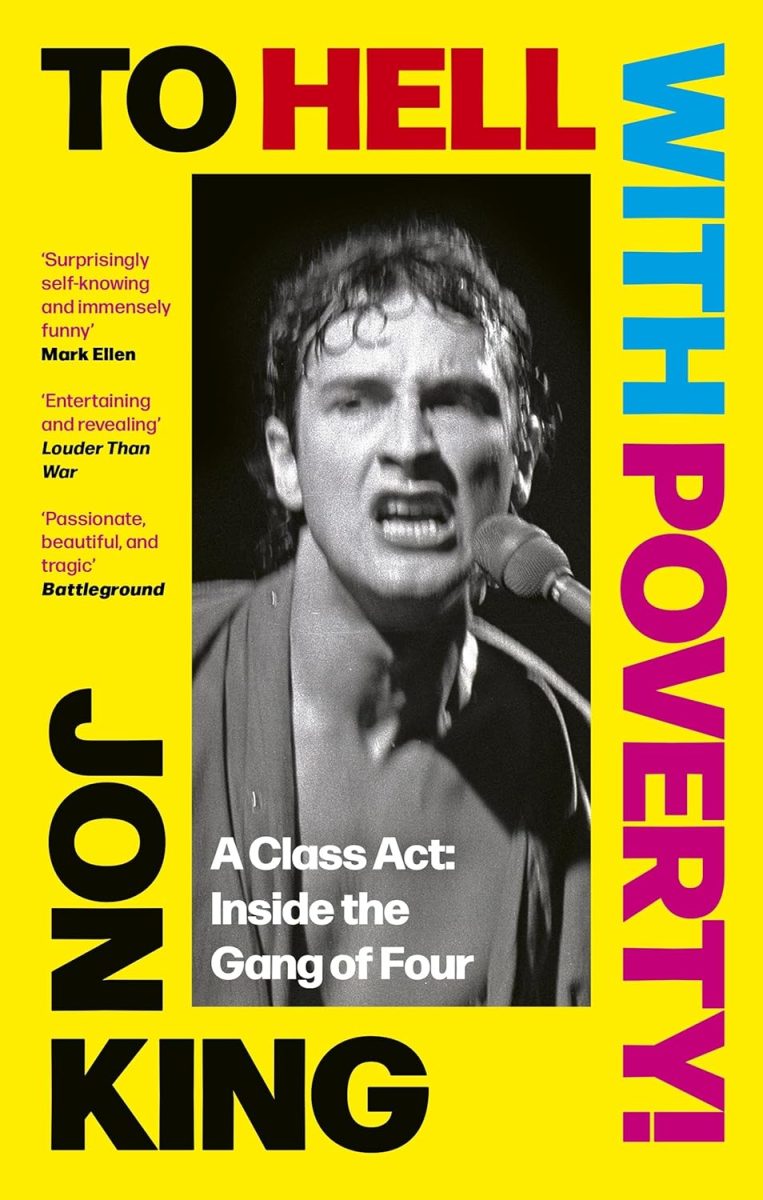
Singer Jon King’s autobiography, To Hell With Poverty, has recently been released in paperback and recounts his and the band’s life from the eye of the storm. It is rich in stories and is told with the almost casual acceptance of someone who was there.
We learn about King’s background and his desire to create, first as an artist and later as a musician. Gang of Four’s time together is covered up until the time of their first split in 1983 after the release of their Hard album, so hopefully there is a volume 2 on the horizon.
Jon King is an easy person to speak to. A single question or observation is all that is needed to elicit a long and full answer, complete with trips down a few conversational side roads. Our talk today is limited to the forty minutes we are granted by the free version of Zoom that we use for our interview, but this was such an easy chat that I don’t doubt we could have easily doubled that and still had questions to ask.
The first thing I tell Jon is that gang of Four were one of the first bands I saw, back at Liverpool Eric’s where I saw them rise from support band to headline status quite quickly.
“Yeah, and Eric’s was the site of the worst evening of my life.”
Really? Why is that?
“We were booked to play there, and it was sold out long in advance. We’ve reached headline status, and we had a sound check. It went terribly well. The queues were round the block. And between the sound check and us going on, [bassist] Dave Allen disappeared.
He was having a lot of problems with drinking and things like that at the time. And we’d had some issues with him, his health, before.
He disappeared, and we thought actually he’d done something bad, so we phoned all the hospitals and phoned the police, all this stuff. By the time we were supposed to be on at 9:00, Dave didn’t show up. We waited until eventually we got to, I think, 10: 15 or something like that, and the crowd was going really crazy. It was rammed to fuck, and we walked on stage and said, I’m really sorry, we’re not going to play tonight. We don’t know where Dave is. And he’d had a bit of an episode, and he was halfway down to London by that point. And it was terrible. That was a precursor to what happened a few months later on the American tour when he left.
I loved Eric’s so much. I absolutely love Liverpool, and I love playing there. But it’s also the place where Andy Gill got arrested for stealing a pear and a tomato. We went back to the hotel after a gig, and the night porter wasn’t available to make a sandwich. And so Andy and Phil Allen, Dave Allen’s brother, who was our lighting designer, just went in the kitchens and opened the fridge. to make themselves a sandwich, which I suppose you’re not supposed to do.
And the night porter came in and ran at them really aggressively and they ran off, Andy with a pear and a tomato. And they ran around like a sort of strange 1960s comedy programme, like Harry Worth or something. And he cornered them and then called the cops. And the cops came along, and they said, “Really?” And the night porter said, “I insist”, and they arrested him.
And I got the phone call about 1 am in the morning, because I shared a room with our manager, Rob, and the voice at the other end said: “Liverpool Police, we’ve got your guitarist, Andy Gill here, will you come down?” I said, No. I gave the phone to our manager, and he had to go down and bail him out.
And then, of course, he did have to come back up to go to court, and the magistrate was furious with the hotel. He said this is a total waste of the court’s time. He said that there’s no punishment to give out; it was punishment enough that he had to turn up to court.
He pleaded guilty by the way, so afterwards we’re wondering if he’d have to declare this on his US visa.”
LTW: The theft of a pear.
“And a tomato.”
LTW: And a tomato, which is a strange meal, really, isn’t it?
Your book has just come out in paperback. You must have relived a lot of memories when it came to writing it all down.
“Yes, exactly. I mean, the anecdote I just told you was one that obviously didn’t make it into the book, but anyone who’s been in a band would have been in equally pointless and silly situations.
I think trying to describe what being in a band is like is quite an interesting process because there are lots of sides to it. Lots of people describe it as being, I suppose, unending misery or unending debauchery, like the Motley Crue or Hammer of the Gods thing, it’s like it’s like braggadocio, trying to really do that. And then what I wanted to do in the book was try to bring to life the life that we all led at that time and why we did things. So I left out things like that. I didn’t want to talk about relationships or taking drugs or drinking and stuff, because that’s actually really boring.
I think anyone who has been in the entertainment industry will have run into all sorts of issues like that, a bit like Dave going AWOL because of having mental health issues, really, at the time, connected with drinking.
And they’re not interesting. But the side to it is, why did you do something? Why did you write a song? Like, why did that famous show by the Sex Pistols in Manchester, where there are only about 70 people there happen? I wasn’t at that show, but my great friends, the Buzzcocks, Pete, and the others were there. And it’s why were they there? And in Leeds, when we had a similar inspirational moment, there was the Anarchy Tour, which was one of the few dates that wasn’t cancelled, which was The Clash, Sex Pistols, the Damned, and the Heartbreakers for a quid at Leeds Poly.
In modern spending terms, you know, obviously it’s probably about a fiver, ticket prices have gone crazy, but probably in the real spending ability of a quid is probably 5 pounds now. Be generous, 10 quid. Can you imagine seeing 4 bands like that for a tenner? But it wasn’t sold out.
But when you go along, you realise that there’s something that’s different, like in that Dylan song, something’s going on here, but you don’t know what it is. And I think we all felt something was going on here. And you just knew you don’t know what it is, but you want to be part of it.”
LTW: That’s one of the things, actually, that kind of jumped out at me from your book. A lot of the autobiographies of people who were involved in the early days of punk, they have this sort of ‘road to Damascus moment’, like, as you say, seeing the Pistols at Leeds Poly. That didn’t come across in the book. It seemed like it was a progression from prog to Dr Feelgood to the new music. Did you actually feel that this is all different now, like, say, Joe Strummer did?
“No, I don’t. I didn’t really, because as I always wanted to be an artist, it was it’s extremely difficult for me to change track, to pivot from one thing to another. And what I knew I wanted to do was do something that was radical and might change the world in some way, like all teenagers and people in their 20s want to do, and I suppose actually people should do through their whole lives, to want to make the world a better place.
And for me, actually, the moment where maybe I decided to focus on the music and not on my art was when I was probably at my most successful point in the painting. I got to the regional finals of the Windsor and Newton Young Painter of the Year Award, which is quite prestigious. And I had a painting in the Mapping Gallery in Sheffield as part of, they were showing this show. And it was, I thought, quite a radical painting. It was called Pour Marx, obviously a pun on the book by Althusser, who I was reading a lot of at the time.
But when I was in there, I realised that the only people that were in the art gallery were people who go to art galleries. I mean, my father was an electrician and I don’t think he set foot in an art gallery of any kind in his entire life. He left school at 13. I never saw him with a book. He was a lovely man, and I admired him hugely, both before and after he died. But he had come from a working-class culture.
And it’s a bit like opera. I actually, like many people, love opera, but when you go to the opera, it’s a load of prosperous, well-heeled white people. Not that there’s anything necessarily wrong with prosperous, well-heeled white people, but you think, actually, where are the people like me? And so then I thought if you really want to make a difference, you’re going to have to go where the people are.
That was it, I guess. And for me, musically, the moment was having had a summer where I’d heard music like Blank Generation by Richard Hell and the Voidoids, the Ramones had released the greatest punk rock record ever, the Ramones. That actually was the template for all punk rock in that record. It was just so thrilling. I’m thinking of that and Television. I remember thinking they were all American. So when I went to Manhattan in the late summer of 76 and saw, because I could get in for nothing to CBGBs due to our great friend Mary Harron, I could see Television, could see Talking Heads, in a club way smaller than Eric’s.
CBGBs was small and was one of the most seedy places I’ve ever been to. And the New York thing was very much about culture. You’d have a band like Television with Tom Verlaine, where they’d name themselves after French poets, or Patti Smith; they all loved all that French poetry stuff. And you think, yeah, this is interesting.”
LTW: And do you think that coming from a background or a direction of being an artist and wanting to change the world, that’s where Gang of Four got that? I mean, you’re one of the most anti-rockist bands I think I ever saw. Do you think that comes from your artistic wanting to change the world background?
“Well, I think the thing is it’s taking what you’re doing seriously. I often think about some years later, watching Breaking Bad as a narrative. And it starts off, obviously, it can only be in the US that someone finds out they’ve got cancer and then has to become a drug dealer to pay for their health.
At the beginning, I read somewhere that it was seen as a dramedy, a vehicle which is comical as a vehicle for the talent to shine. But what they did, they took seriously the story arc, which was here’s a guy who’s at the end of his career, he’s got no savings, he’s got some terminal condition, he’s going to make crystal meth, and then you say, well, let’s take this seriously.
What would actually happen if you did that? You’d have to make it, and then you’d have to somehow sell it. And if you sell it, you’re up against criminals. And if you’re up against criminals, you’ve got to compete with those people. And in the end, he ends up becoming like the devil. He’s an appalling, terrible human being. But he was charming at the beginning and a bit of a buffoon.
And I think that when you’ve got songs where you start off with an idea, and you take it seriously, it takes you on a journey, like books do, of course.
I think the song that made me want to become a creative person was Highway 61 Revisited. I don’t know how Bob wrote that song, but the opening line, “God said to Abraham, Kill me a son. Abe said, Man, you must be putting me on.” And then it loops off, taking itself seriously.
And all those things are like A Change Is Going To Come by Sam Cooke. If you sit there and you think of the racism and oppression and violence against African Americans, you can either despair or you can hope that things will get better. And not just hope, fight for things to get better.
And so I have to think about how I can do this. I know really why EMI salespeople’s hearts sank when they heard Ether, the first track on [first album] Entertainment. I can’t remember how many bombs had gone off in London. Dozens had gone off in the mainland. I know in Northern Ireland itself, it was civil war, but it was always taken more seriously. But it really to be saying anything that was faintly suggesting that there were two sides to this conflict was really not cool.
But the logic of that song to me when I wrote it was to say that the price of our blessed lives is misery somewhere else. Like the price of a five-pound Matalan t-shirt is someone getting paid $0.50 an hour to make a Matalan t-shirt. And because you think it can’t economically be possible to make something as cheap as that without there being all this stuff behind it.
So the point for me was if we’re going to do this at all, there’s no point doing genre music. I love genre music. I’m a musician, and I love Dancing to Chic, and I loved Doctor Feelgood, of course, but you don’t want to replicate, although Andy and I did a really good job at copying Lee Brilleaux and Wilko Johnson for a long time, stylistically to start off.
So to be radical to me was to say there are largely two opposing sets of ideas. The oppression set of ideas, which is on one side and progressive ideas on the other. And when I did the cover for A Brief History Of The 20th Century, I had a Vichy French franc coin which used to say liberty, equality, fraternity as the national slogan. And then they changed it to work, family, country. And it seemed that argument is happening right now, and when we were working together, we had war in the Middle East, the threat of nuclear war, and right-wing gangs, and racism running rampant. Of course, things are different now. I make that as a lame gag, but it’s not a lame gag, it’s just a gag.
But we were in Leeds at that time. And one of the chapters in my book is just a list of the murdered women from the Yorkshire Ripper who deserve our memory. These women who the Yorkshire Police, who are among the most corrupt and incompetent, sexist, racist shops in the country, made famous in obviously the Red Riding quartet of books. But the man who murdered those women, I mean, he It wasn’t taken seriously because they were sex workers until they killed, in inverted commas, an innocent young woman who liked the Bay City Rollers.
And the head of police in Leeds said, ‘ok, you made your point. You don’t like these type of women. None of us do. It’s time for you to give yourself up’, which I quote in the book. And I think I lived in all of that. my women friends went on the Reclaim the Night thing, and so I thought, how can you not write about that? It’s like now, how can people not write about what’s going on now?
And I think the reason that at the moment there’s quite remarkable interest in [Gang of Four’s] music from the so-called Gen Z group, because I think it’s got relevance, it’s not fluff.
And of course, the other thing is, it’s really hard to describe what things were like. I’m now officially old, but when I was a kid, I did play on a bomb site. Absolutely. And wherever you were, if you’re in a city in the United Kingdom, whether you’re in Liverpool or Glasgow or Coventry or London, there was in the early 1960s, there were large swathes of just what often turned into car parks and things like that. But it was a disaster, I mean, all over the place.
And they sent round a pamphlet, Leeds and The Bomb, which I still have a copy of. Every city in England had to have this thing of what happens when a 5 megaton airburst bomb explodes over the centre of the town, and what you should do in the event of all this stuff. And the joke was how would anyone know the difference afterwards? Because Leeds was such a state.
It seemed like about a quarter of Leeds was being demolished at that time. The whole of the centre of Leeds, with that great oval building, the railway station, with these sort of marshalling yards with rusting old bits of metal and the smell of smoke and things like the Corn Exchange, which is now very bourgeois, opposite what is now Harvey Nichols, was just ruinous.
Before I wrote the book, I read quite a few things to sort of work out how to go about it. And I remember reading the brilliantly ghostwritten Elton John book, which was really, really funny and is fantastic. But then I read Bernie Taupin’s self-penned book, one of the greatest lyricists of the late 20th century, a genius writing for Candle in the Wind and Rocket Man and all those songs. But his thing is utterly boring, all it was I met so-and-so in a bar, we got really pissed. But tell me how you wrote Rocket Man. Tell me about Crocodile Rock. What was that all about? Where did the words for that come from? Or what you were doing?”
One of the things I remember reading about you is that Gang of Four used to have meetings where you would discuss an agenda or a manifesto, and you said that these meetings were equally as important as your rehearsal and your recording. Is that right? Did you sit down and plan a group viewpoint?
“No, not really. I mean, not in that sense, no, because I wrote the words on my own. So we didn’t really work collectively. We talked about things. It tended to be about whether or not we were going to do a gig somewhere or other or whether we were going to do a benefit for someone. And we were always being asked to do things, and we didn’t necessarily agree about what we did or didn’t want to do.
And I was really hostile to any approaches from any commercial organisation wanting to use that stuff. which particularly annoyed Andy. I mean, I said no to almost everything, which is quite difficult, really. But we did argue about everything, and I think it was a lot of displacement exercise because I think we were very feisty with each other. We weren’t really we weren’t kind to each other or nice to each other. And so it was very like being in a cockpit of sometimes open hostility, particularly between Dave and Andy. They would have fist fights about things.
As you mentioned at the beginning, not being rockist, which is true, we said we’re not going to do any of those things, there’s going to be none of that stuff that might suggest we’re in that rockist territory. But the most ludicrous example of that, which I do quote in the book, is that we were big in former Yugoslavia and we went out there and we were strongly identified there with the anti-communist drive towards democracy, which we didn’t know until we arrived. So when we arrived, it was quite crazy, we were playing in Ljubljana and Zagreb and it was seen as being very radical. There were a lot of cops around.
We did this show in a basketball stadium with a whole phalanx of cops in riot gear and an army division outside the venue. People inside had gone there, the young people, because they didn’t want to be ruled by these communist apparatchiks who just gave up to their families and ripped everybody else off. And we played this great show, and it went mad. There was about three or four thousand people there, and they got the cigarette lighters out because they enjoyed the rock’n’roll tradition. And it was a mark of rebellion, I think, as much as to say we like the show.
Hugo and I went back on stage to take a bow and expected Andy and Dave to come on behind us. And we walked on and took a bow. The crowd was going crazy, and we said, ‘Well, where’s Andy and Dave?’ And after a while, they came on, and Dave had a sort of bloody lip, and Andy had a bit of a bruised face because they had this really big fist fight because David put his foot on the monitor, and Andy accused him of being rockist. So Dave punched him, and they had a big fight about it. So it was very serious.
And I think for a lot of people on the left, the great curse is finding reasons to disagree with each other. You know, you’ve got your big enemy and then you can argue about a word, or you can argue about something, and you end up thinking ‘Oh, for God’s sake, you’re gonna get nowhere like this.’”
And do you think yours and Andy’s friendship would have survived better if you weren’t in a band together?
“I don’t know really. It’s hard to tell. The real problem with that was he was an alcoholic, and so I don’t know. We were really close; we were like brothers, but the paradox of the band was that the more that we played, the more that we did as a band, the less we saw each other socially. I mean, we just didn’t.
I actually shared a flat with Andy Corrigan and Mark White from the Mekons, and my social life was really that me, Mark and Corrigan were a little triumvirate. And John Langford used to come round and, you know, the people from Delta Five and all that. And Andy was very wrapped up with his girlfriend. He lived with his girlfriend and I didn’t really see him socially that much once the band got going.
And then when the book ends in 1984, and Andy seriously had cancer, and we had all of our money stolen, so we were completely broke, didn’t have any money. And back in London, you’re trying to sort of reinvent yourself really.
I don’t know, I don’t think so, to be honest. I think that the it was it was the alcoholism was so bad by the end. I wouldn’t sit next to him on an aeroplane because he was always drunk. He’d always be shouting and a steward or a stewardess would come over asking if you could you stop your friend using the C word and the F word and everything like that and I’d try and keep my distance.
I think again, this is the thing I didn’t write about because there would have been a different book after 1984. I think we went in and out of being really close, but by the time I got to the age of 40, it was all over with him. He didn’t speak to me for 10 years.
And the difference was that he was obsessed with being famous. He really, really wanted it. And I really didn’t. I said, ‘I don’t want to be famous’ and he said ‘You’re doing a really good job about it’.
I was a pain in the arse, I’m not saying that he was right and I was wrong. Again, in the book, I tried to describe how we were yin and yang, and everything I was, Andy wasn’t, and vice versa. And actually, when it worked together, like yin and yang does, it was really great. And I remember writing Paralysed, which is mostly Andy’s lyrics, 90% of it is Andy’s lyrics, but he’d start off with an idea and then he’d be very, very straightforward about it, which I really enjoyed. Or 5.45, because I said, let’s do something about watching the telly. And then he wrote ‘how can I sit and eat my tea with all that blood flowing from the television?’ and then my layer of it is ‘guerrilla war struggle is the new entertainment’.
But it was rare that happened because Andy wasn’t really good with words. He was a genius with a guitar. I mean, really. And so, we had our own different skills. And by the time we got to the, I thought, the really awful fourth album that he made, what I didn’t like about it was I didn’t hear enough of his guitar. I love guitar music, you know, and I love Anthrax and to Hell With Poverty and What We All Want, all that kind of stuff. And I can’t think of a song on Hard that’s got a guitar part on it that’s worth listening to.”
What did you make of Andy putting a gang of four together without you, without any of you?
“Well, I was very angry about that. I tried to stop him doing that. And I think my view was you can’t have the band with at least without two of the three original founder members in it. And the founder members was Hugo, me and Andy. And I felt that it was just really just like Gerry and the Pacemakers.
And someone unkindly said it was the first tribute band by someone to himself, which sounds a bit catty, but no, I didn’t like it at all. And I said, you wouldn’t have got Noel Gallagher going out as Oasis without Liam. And you wouldn’t have got the Smiths going out without the two of them, and you wouldn’t have Led Zeppelin without Jimmy Page and Robert Plant in it, so I think that I thought it was wrong to do that personally. I never saw them. I don’t know what they were like, but I didn’t like it at all.”
And this is unfortunately where technology cut us short, with a million things still to discuss. The easy answer to this is to read Jon King’s book for yourself and to place yourself front and centre of the heady times of one of post-punk’s most important, influential and meaningful bands.
That Gang of Four continue to fascinate and affect people almost fifty years later is a sign that all this isn’t going to go away anytime soon, which suits me fine. Their influence and integrity are perhaps needed now more than ever.
Buy To Hell With Poverty here
~
Words by Banjo, you can find his Louder Than War archive here
A Plea From Louder Than War
Louder Than War is run by a small but dedicated independent team, and we rely on the small amount of money we generate to keep the site running smoothly. Any money we do get is not lining the pockets of oligarchs or mad-cap billionaires dictating what our journalists are allowed to think and write, or hungry shareholders. We know times are tough, and we want to continue bringing you news on the most interesting releases, the latest gigs and anything else that tickles our fancy. We are not driven by profit, just pure enthusiasm for a scene that each and every one of us is passionate about.
To us, music and culture are eveything, without them, our very souls shrivel and die. We do not charge artists for the exposure we give them and to many, what we do is absolutely vital. Subscribing to one of our paid tiers takes just a minute, and each sign-up makes a huge impact, helping to keep the flame of independent music burning! Please click the button below to help.
John Robb – Editor in Chief
PLEASE SUBSCRIBE TO LTW







Leave a comment