


EMF
The Garage, London
6th June 2026
As EMF play another captivating set at London’s Garage, Ian Dench and new joiner Robin Goodridge (ex-Bush, Spear Of Destiny) catch up with Naomi Dryden-Smith to chat about Robin’s arrival, what’s coming up for the band, and Ian’s recent “aha” moment about the riffs in Unbelievable.
EMF are back at one of their favourite London venues, fresh off their tour of the East Coast in the States and Canada. It’s the first time UK fans have seen the new line up which now includes drummer Robin Goodridge, previously with Bush and Spear Of Destiny.
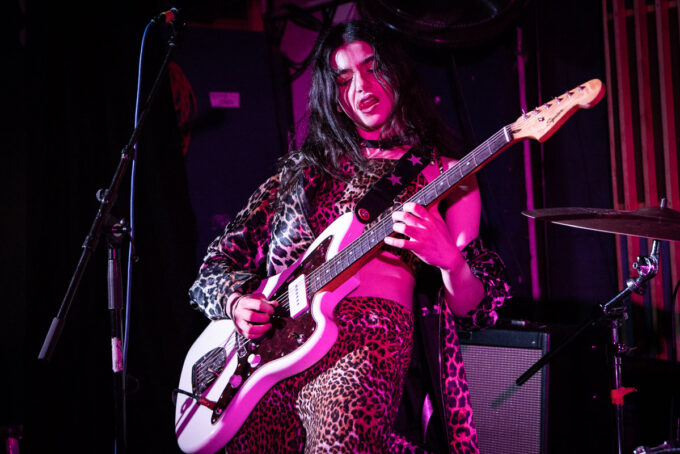
Their fifth gig in five days, the band are on great form, high energy and contagiously energetic, James Atkin in fine voice (despite pre-show fears). Standout highlights include The Day The Music Died and They’re Here, plus (of course) Lies, Children, I Believe and Unbelievable. The band sound solid together, Robin’s a strong addition, joining bassist Stevey Marsh to form the backbone supporting James and Ian’s 35 years (this year) of EMF. Looking forward to seeing all five of them together, with Derry Brownson back in the fold, when the time comes.
I catch up with Robin and Ian for a quick chat before the show, to get the lowdown on this new direction for EMF.
 So EMF and Bush! How did that come about?
RG: I’ve worked for a couple of bands that EMF’s manager, Liam Feekery, manages and I’ve known him since 2005. So when the opportunity came up, I threw my hat in the ring to play with these guys. Liam called me to ask would I be interested in playing with EMF. And I said, I’d love to – plus I’m due on a plane tomorrow to come and visit family here. (I’m currently living in Los Angeles.) And then we managed to just pull it together and we had a little bash around for an afternoon. Everyone agreed that it was worth pursuing from the point of view of we all enjoyed ourselves, I guess.
ID: We’ve lived parallel music lives, playing in bands in the ‘80s and trying to make it, trying to get into the industry, having a couple of failed record deals. And also stylistically, growing up in that time, when dance music and rock music were all coming together.
RG: I was always a raver in the ‘80s, as was everybody else, pretty much; there was no rock music. That was the era of loving Prince, and a few other acts, and waiting for something interesting to happen. And then dance music came along, and we thought, Oh, this is fun. And then, for me, luckily, things moved back away from dance music in the early ’90s, and you could be in a band again. Thank god, because being a drummer at the end of the ’80s sucked really badly, because nobody was playing in bands. It was all programming, and I was thinking, shit, is that my career over? And then thankfully, Nirvana happened, along with a few other things, and it just blew the doors off. Oh, we can have guitar bands again now! They should have been doing that all along, to be honest, but the record industry being what it is, it follows itself, doesn’t it?
ID: I remember something from the record company saying, like, oh, the guitar is dead or something like that. in the late ‘80s.
RG: Bush couldn’t get a record deal for two years, no-one wanted to touch us. All the English record labels turned us down, every single one. A friend of mine I haven’t seen in years who worked for a publisher took demos of us and Oasis, to her boss. She had Oasis and Bush in her hands. And he turned both bands down. Then we ended up getting an indie deal in America, who said, “oh yeah, we love your record”. Then it all went silent for about nine months, because they were a small company, and they were trying to do a deal with a bigger company to get a distribution, because they couldn’t handle it – they wanted a worldwide distribution. And then it all just kicked off.
ID: Yeah so people thought that guitar bands were over, and then Brit pop happened, grunge happened, hip-hop happened, all these things happened – and suddenly guitars and drums were allowed again. But it’s not the first time the record industry’s got it wrong, is it?
RG: So, I was with Bush for 25 years until 2018. Since then, I’ve been with Spear Of Destiny, then Theatre Of Hate, which is the connection with Liam. After COVID happened there were a couple of years with not much going on, bits here and there with Spear. And then this happened! I’ll commute for a while – I have a house in Brighton so I’m just going to bridge it for a while.
 So what’s next for the band?
ID: Well, on Monday we are going up to James’s house and I’m going to rehearse some new songs. Hopefully we’ll have a new album with Robin playing on it in the not too distant feature.
RG: It might be done by the end of this year, but you’ve got to give them two months at least lead-in time. So I’d imagine in the first quarter of next year, somewhere around then.
Have you guys got a lot going on in the Summer?
ID: Festivals in the Summer, and then we’re going to do Europe in September, then back to the States in November, playing the Dark Waves Festival in Los Angeles, a big festival there with Smashing Pumpkins, and Morrissey.
RG: It’s a big festival in Huntington Beach. It’s one of the big ones of the year. There aren’t really any festivals in LA, ever because there’s nowhere to do them; Huntingdon Beach adjacent, a little bit south of LA. Just about everybody does it because it’s in the LA catchment area for festivals – everybody’s willing to do it, because it’s like you get to play a big field full of LA people. It’s the only one. LA doesn’t have any venues to do it. It’s too expensive. So that’ll be good.
How about Australia?
ID: It would be lovely to do that and go back to Japan as well. Japan was a good market for us.
How are you finding it with EMF Robin, is it very different to playing with Bush?
RG: Well, of course, it is different from Bush; there’s a lot of very different colours in EMF. Bush was a guitar band, EMF are a guitar band with an awful lot of other influences, which I’m totally down with, I was there when it was all happening the first time. For me it’s my first time with them – for them it’s 35 years of first times. It’s the same soundtrack for me as it was, so it’s very familiar. We got together, and we played, and they said “your instinct seems to be exactly what we want”. There are a few little adjustments, but we were never more than two sentences away from “that’s exactly what we’d like you to do, just play quietly in his way… You do that at half volume and that’ll be amazing!” Sorry, I’ve been in a rock band for too long, I hit too hard! So I’ve been working on that. One of my many jobs is to try and play as quiet as possible. But I do get excited, and that’s the problem. But I’m working on that, I’m a work in progress. So, it is different but it’s good. Same feeling. It’s a good feeling. As opposed to me feeling like I don’t understand what’s going on. I understand exactly what it is. And it’s great.
 A little later, Ian reflects on how he suddenly realised only recently how many guitar styles and influences are in Unbelievable, that he’d put in subconsciously.
ID: It wasn’t until several years later that I looked at the guitar riff. I thought, oh, my god! it tells my entire musical history! So, on the way up, it does a blues thing. I’d got into The Doors who worked with a lot of blues riffs, and I loved all the blues players, like Big Bill Broonzy and Sonny Boy Williamson. I found them through Robbie Krieger, the guitarist for The Doors. If you listen to the duh, da, da, da, da, da, da, da, that is a classic blues sort of thing, and then that moves up to the top. And then on the way down again da, da, da, da, da, da, that’s the phyrigian scale, the flamenco scale. And of course, for my whole youth, my father would play all these Spanish things and I would imitate him, and eventually my father taught me Spanish guitar. And so I realised that’s where that came from! Because I don’t quite know why I did that. And then, of course, the third part is all played with a punk attitude. So there’s the blues, the punk, and the flamenco, all in that riff. I always wondered, where the heck did that riff come from? It came out of my head. But when I look at it, it’s what falls under my fingers, because of all the guitar styles that I played when I was learning.
That’s so interesting – when did you work that out?
My school asked me to go back and do a talk and I started thinking about my history, about two years ago. And I started thinking about music, because I was talking about my musical history and stuff. And I suddenly realised. Maybe that’s what it is. At the time, I just hummed it and it worked – but when I think about it, it’s biographical.
Where did the Spanish influence on your father come from?
He studied the trumpet, he was in an army band. Then he met Julian Bream, who was also in a band – he was one of the greatest proponents of the casting guitar during the ‘50s, ‘60s and ‘70s. Julian Bream was playing the classical guitar and my dad was obsessed with it. So much of the classic guitar is Spanish. My mum used to sing Spanish songs with him and I think Spain went into my heart. And then when I went to Spain, I met Virginia – she’s Spanish – and so somehow Spain’s in there, in some way.
Was your dad in a band or did he just play at home?
He went to the Guildhall School of Music, and studied classical guitar. I think he was horrified when I got my first electric guitar and started a punk band.
What do parents know anyway…
~
Words by Naomi Dryden-Smith: Louder Than War | Facebook |Twitter | Instagram | portfolio
All photos copyright, please do not use without permission – contact Naomi at naomi@louderthanwar.com
A Plea From Louder Than War
Louder Than War is run by a small but dedicated independent team, and we rely on the small amount of money we generate to keep the site running smoothly. Any money we do get is not lining the pockets of oligarchs or mad-cap billionaires dictating what our journalists are allowed to think and write, or hungry shareholders. We know times are tough, and we want to continue bringing you news on the most interesting releases, the latest gigs and anything else that tickles our fancy. We are not driven by profit, just pure enthusiasm for a scene that each and every one of us is passionate about.
To us, music and culture are eveything, without them, our very souls shrivel and die. We do not charge artists for the exposure we give them and to many, what we do is absolutely vital. Subscribing to one of our paid tiers takes just a minute, and each sign-up makes a huge impact, helping to keep the flame of independent music burning! Please click the button below to help.
John Robb – Editor in Chief
PLEASE SUBSCRIBE TO LTW



Leave a comment