
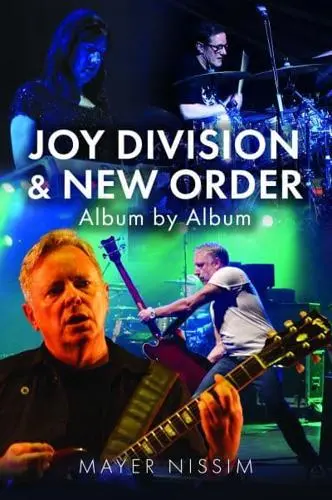
 Joy Division & New Order: Album by Album by Mayer Nissim (Published by White Owl)
ISBN: 9781036124335 | 178 Pages
On one of the rare occasions that Sumner and Hook are brought together under the umbrella of a single project, Mayer Nissim’s Joy Division & New Order: Album By Album discusses what brings fans of those bands together: the music. Kai Marshall reviews.
Manchester’s music obsessives have been picking over the ashes of the scene since the death of Britpop. The literature on the topic is as vast, if not more so, than the music itself. Where Mayer Nissim’s Joy Division & New Order: Album By Album fits into that conversation is through a deliberately narrow focus on the music of both bands. By placing the records at the centre of the project rather than the drama and legal disputes of the era, it diverges from Peter Hook’s personal accounts of the same period. Hook’s books are authoritative, but written decades later, they inevitably carry a revisionist edge, even if he was there for it all. As I’ve learned by digging into his hefty tomes, that side of the story isn’t exactly entry-level; it’s hardly pub quiz material. Nissim’s decision to stay with the music is, then, the book’s defining strength.
The book sets out to place the albums within their historical and cultural context, and the album-by-album structure largely achieves that by keeping the records front and centre. For some fans, the legal battles matter less than the immediate context of albums like Closer or Brotherhood. Ian Curtis’ death inevitably looms over any discussion of Joy Division, but Nissim is right to resist retreading that ground. He makes clear from the outset that stories outside of the music aren’t the focus, and to his credit, he sticks to it.
That focus allows for a more accessible way into the history. Rather than getting lost in internal disputes, the book offers a steady stream of detail about the bands and their orbit. Early band names like Stiff Kittens sit alongside rejected options such as Boys of Bondage, The Slaves of Venus, The Mechanics and The Out Of Town Torpedoes, all abandoned in favour of the far more memorable, if Nazi-adjacent, Joy Division. Those references are also only touched upon briefly, which feels appropriate given how thoroughly the subject of Nazi iconography in punk has been covered elsewhere. Jon Savage’s England’s Dreaming makes the case that such imagery was intended to provoke rather than signal allegiance, and more recent work like Daniel Rachel’s This Ain’t Rock ‘n’ Roll: Pop Music, the Swastika and the Third Reich expands on that territory. Nissim also notes that New Order carries similar associations, though he suggests this may have been accidental. He argues that, without Google, it is hard to imagine the band knowingly repeating a Nazi term. That point is less convincing. It is just as plausible that awareness of “Joy Division” as a Nazi term would not have been any more widespread than “New Order” in the late 70s and early 80s, which raises the possibility of a deliberate continuation rather than coincidence. Food for thought.
Where the book is most effective is in its handling of the music itself. Contemporary reviews are woven in to situate each album in its moment, and at times the approach edges into a blow-by-blow critical account. Movement, for instance, is described as an album that doesn’t quite sound like either band and yet finds its strength in that uncertainty and willingness to experiment. That interpretation is reinforced by the band members themselves, several of whom contribute to this project directly. Nissim deserves real credit for bringing both Bernard Sumner and Peter Hook into the same project, alongside key figures like Peter Saville. Getting both sides into one book is no small achievement.
It also exposes the book’s main weakness. Those interviews are often separated from the album chapters and sometimes move ahead of the point in the chronology being discussed, which makes the narrative feel jumpy. The insight is there, particularly from Sumner and Hook, but it is not always integrated where it would have the most impact. As a result, the book occasionally undercuts its own album-by-album structure. There is a similar inconsistency in Nissim’s treatment of the bands as a single entity. With Joy Division and New Order currently inducted together into the Rock and Roll Hall of Fame, he pushes back against the idea of viewing them as one continuous project. Yet the book itself emphasises how crucial the post-Curtis transition is to understanding New Order’s identity, and repeatedly draws strong links between the two. The groundwork for a case against joint recognition is there but the book does not follow through on the foundation it lays in order to make the argument.
Still, who really cares about the Hall of Fame? By stripping away much of the mythology and focusing on the records, Nissim offers a clear, accessible route into one of Manchester’s most analysed musical legacies. It is not the definitive account of the bands, and it does not try to be, but as a music-first study, it largely succeeds. As for any hope of a reunion, it is probably best not to get carried away. When asked, Hook’s response is brief and full of words beginning with “f”. That tells you everything you need to know. Plenty of high-profile reunions have happened in recent years, but the ones people most want to see tend to remain out of reach. Then again, if a certain pair of brothers can manage it, maybe never say never.
~
Purchase a copy of the book here.
All words by Kai Marshall. Read more from Kai on his authors archive and find him on Instagram
A Plea From Louder Than War
Louder Than War is run by a small but dedicated independent team, and we rely on the small amount of money we generate to keep the site running smoothly. Any money we do get is not lining the pockets of oligarchs or mad-cap billionaires dictating what our journalists are allowed to think and write, or hungry shareholders. We know times are tough, and we want to continue bringing you news on the most interesting releases, the latest gigs and anything else that tickles our fancy. We are not driven by profit, just pure enthusiasm for a scene that each and every one of us is passionate about.
To us, music and culture are eveything, without them, our very souls shrivel and die. We do not charge artists for the exposure we give them and to many, what we do is absolutely vital. Subscribing to one of our paid tiers takes just a minute, and each sign-up makes a huge impact, helping to keep the flame of independent music burning! Please click the button below to help.
John Robb – Editor in Chief
PLEASE SUBSCRIBE TO LTW





Leave a comment