
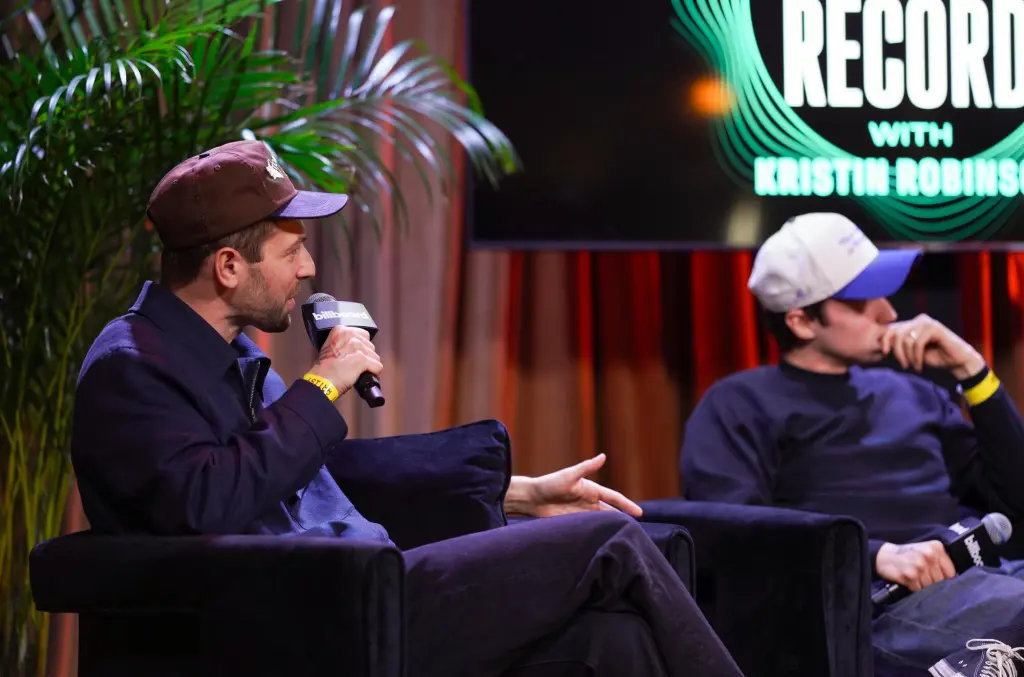
Jesse Coren and Andrew Spelman, two of the co-founders of popular digital marketing company Chaotic Good, joined Billboard at South by Southwest (SXSW) on March 14 to talk about how songs go viral in 2026, and how online discourse around artists can be manipulated in their favor by companies like theirs. The conversation, hosted by Kristin Robinson, was released on Wednesday (March 25) as one of two live episodes of On the Record, Billboard’s music business podcast. The other episode, featuring Mark Cuban, can be found here.
Related

Coren and Spelman first decided to start Chaotic Good in February 2025 after years of working as artist managers through their company Mutual Friends (Chelsea Cutler, Alexander 23, Quinn XCII). “There’s so much pressure on the artist,” Coren says. “How much are they posting? Have they posted today? Why haven’t they posted? As managers, our job is to support the artist. For a while, we were used to throwing our hands up and thinking, ‘Well, if they’re not driving it from their page, what can we do?’”
Then, after meeting digital marketing gurus Tim Weber and Adam Tarsia, the four decided to team up to create an agency that would take some of the marketing pressure off the artist. Instead of asking artists to post more self-promotional content, Chaotic Good builds a network of TikTok pages of all kinds — from fan pages, meme pages, sports clips and more — and plugs the artist’s song in the background to create a groundswell of support for the track.
Since its founding, Chaotic Good has become a go-to for labels and artists looking for this newer form of digital marketing, which Spelman calls “trend simulation.” The company has so far run successful campaigns for talents like Zara Larsson, Coldplay, Tame Impala, Mitski, Travis Scott, Childish Gambino and more.
Watch or listen to the full episode of On the Record with Chaotic Good below on YouTube, or check it out on other podcast platforms here.
Can you tell when the TikTok algorithm changes? Is there a moment where you’re like, wait — what was working yesterday is suddenly not happening today?
Spelman: TikTok is structured around trending audios, but the other side of that coin is that it’s also structured around trending formats. For a specific genre at a specific time, there will be a format that really works. What we’re paying attention to is when that starts to have diminishing returns — when we need to pack up camp and set it up somewhere else. Algorithm changes are more on the Instagram and Reels side as they figure things out. If you listen to Meta earnings reports, view time on Instagram Reels is up 30%, and that’s a real thing. They’re clearly perfecting the algorithm, and so we as a company have to pay more attention to it. We’ve been running a lot more experiments there. I think a year from now, if you ask me what’s changed, it’ll be that we’ve done a lot more on Instagram.
TikTok in the U.S. is now under new ownership, and I feel like, personally, as a TikTok user, I’ve noticed the algorithm is a little different. I’m wondering — has that impacted your business?
Coren: I think it’s more about being mindful of the macro scale of what this means. As Andrew said, paying attention to what competitors [like Reels] are doing and making sure we’re mindful that things may change at any time. We always reserve a percentage of our bandwidth to experiment and to make sure we’re building out emergency infrastructure in case something were to happen on any platform. I don’t think we’re seeing that much change right now, but it’s a signal that we should always be prepared for anything at any time.
Every genre of music caters to a different audience. Could you give me examples of different types of content that fare best for different genres?
Spelman: This is a really core principle of the company: We can drive impressions on anything at this point — we know how to go viral, we have thousands of pages. But making sure those impressions aren’t empty calories, that they actually find your audience, is the hard part. For a lot of underground rap songs, stretched-out clips of video games are really popular right now. For singer-songwriter stuff, I’m sure a lot of people have seen the yellow text quotes — we call that Pastel Tok. We think we were kind of the first people to do that, and now there are a lot of copycats, so you have to pivot to the next thing. When we spoke a few months ago about country, it was a lot of trucks and cowboy hats and things like that.
You guys feel very confident that you can make a song go viral online, but does that actually translate to streams? And do you still consider a campaign a success if there’s virality on TikTok but maybe not a huge conversion to streams on Spotify?
Spelman: That’s a great question. If there’s a ton of virality but we aren’t seeing conversion to streaming, there are kind of two options: there’s something irreducible about the song that people just don’t want to listen to, which we can’t fully control. But the first thing we check is whether we’re targeting the right people where the audience actually is. We may be driving a ton of views, there may be a trend happening, but it may not be connected to the song or finding the right audience for that artist. I still think a viral trend can be a really successful campaign even without huge stream numbers.
What would you say to someone who’s freaked out by these ideas that we are talking about — who feels like they’re being manipulated by artists and marketers online?
Coren: Unfortunately, a lot of the internet is manipulation. Andrew would always say everything on the internet is fake. All opinions are formed in the TikTok comments — which is a reminder to us of what we can help with. I don’t know if this will make anyone feel better, but a lot of what we do on the narrative side is controlling the discourse. Most people see a video or something about an album that came out, and that first comment they see becomes their opinion, even when they haven’t heard the whole album. It’s really important for us to make sure we’re ahead of it and controlling that narrative in the direction we want.
Spelman: In the past, a label and management team would do a great job getting their artist on SNL or Tiny Desk or Triple J, post it, and then kind of wait — and the comments would come in: terrible cover choice, voice sounds terrible, all that. What we do at Chaotic Good with our management clients is: The second the SNL performance drops at midnight, you should post 100 times saying that was the best performance of the year. The question is how you do that at scale. It takes a lot of work and infrastructure, but controlling the narrative is really, really important.





Leave a comment