

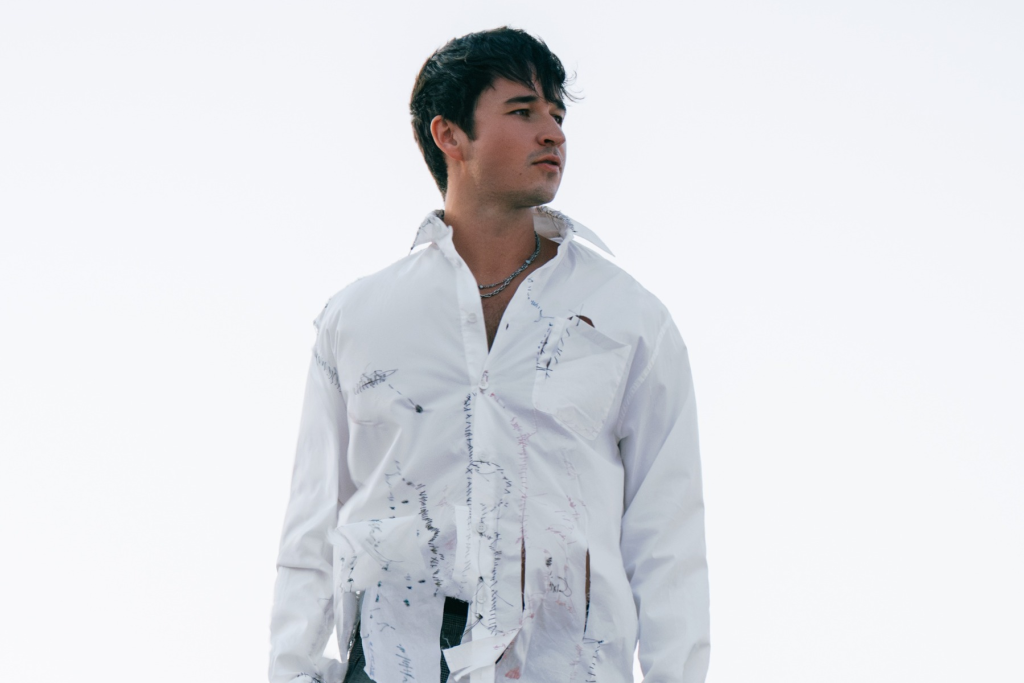
John Summit is currently one of the biggest names in dance music. Earlier this year, he released his second album, CTRL ESCAPE, teaming up with The Chainsmokers and Feid to take his original tech house sound to new places. While he’s been working on new music, Summit has simultaneously been building one of dance music’s hottest labels, Experts Only, which has topped Beatport’s global label chart a number of times since its founding in 2022 and released music from acts like Devault, Layton Giodani, Max Styler.
Related

As is common in the electronic music world, Experts Only is perhaps just as much of an event business as it is a label. Those releasing songs through Experts Only are often invited to participate in showcases, like its 60,000-person festival on Randall’s Island in New York City, or its ski weekenders in Vail and Whistler.
Still, Summit feels like he has “a lot of heads to turn.” Later this year, he will have the opportunity to do just that — he’s a headliner at Lollapalooza in Chicago, a rare feat for a dance act and a personal win for Summit, who grew up near Chicago. In October, he’s embarking on an arena tour in support of CTRL ESCAPE with 20 dates spanning Canada to California.
On the latest episode of On the Record, Summit talks about building his record label, how he’s planning his upcoming arena tour and why the dance music industry operates differently from any other genre.
Watch or listen to the full episode of On the Record below on YouTube, or check it out on other podcast platforms here. Read a segment of the conversation below.
Something I find really interesting about the dance music industry is that it’s very singles-driven, and people tend to hop around different labels. You did this too in your early years, jumping from Repopulate Mars, Defected Records and more. What was your strategy in aligning with these different labels?
A lot of labels throw events, too, which I wanted to do as well. I always wanted to play in Europe, and the only way to do that that I could think of [was] by playing Defected Croatia and their events in the U.K. and everything like that. To get on these parties and get their community to know you, you have to release music with them. In dance music there’s so many artist-run labels. I think [my label] Experts Only has its own community now, too. We have a festival with like 60,000 people in New York this year, so yeah, it’s becoming a huge thing, which is awesome.
Tell me about all the events you’re doing now as part of Experts Only.
We did the first New York festival on Randall’s Island last year, and we’re doing it this year a little bit bigger — just expanding it more, adding an extra stage, having a big list of talent there. And then we did the ski weekenders in February, as well. We did Valentine’s Day this year, and we’re gonna start going international with it. I can’t say anything yet, but there’s a lot more to come.
I did the ski weekenders because I used to ski every year growing up, and then I started touring so much — I was doing 250 shows a year — and I had to stop going. It was sad. Then I [was] like, “Well, what if we had the best of both worlds: skiing and house music and partying?” It turns out all the fans like doing that as well, because you ski by day, party by night — it’s the ideal scenario for me.
You’re headlining Lollapalooza this summer. Do you feel [that] as a dance artist you have to prove yourself even more than pop headliners to get that slot?
Yes. I see the comments [from] pop fans being like, “Who the f*** is John Summit?” And I’m like, “Damn, I thought I was doing pretty well.” But I think I still have a lot of heads to turn, which is awesome. I’ve kind of touched the pop realm, but I still think I’m just fully in dance, because I haven’t had a Billboard Hot 100 track or anything. I chart in the dance charts, but [mainstream pop] is just a different world.
There’s endless demand for you to play sets. You mentioned before that you did 250 shows in one year. Where do you draw the line for yourself with live music so that you still have time to make music, run the label and just overall not burn out?
That is something we try to figure out every single day. I mean, I burned out — not this past weekend, but the weekend before — and I canceled my first ever shows, and I still really feel bad about it. But I [had been] sick, sprained my ankle, and was fully just mentally exhausted. I had just come off this Asia tour that [then] went into South Africa. I literally went from a Red Rocks [Amphitheatre] five hour set, to Coachella, then dropped my album, then Bali, Bangkok, Singapore, China, South Africa, and then I had to go to South America, then I did four shows in Miami. It was too much at once.
Well, yeah, and your suitcase broke!
[Laughs] I had a full-on crash out during that. So I was like, yeah, maybe I should take a chill pill for a second.
It was tough. I come back from tour and my whole suitcase exploded — I lost half my clothes! But I think next — I have this arena tour in the fall for CTRL ESCAPE, the new album, and I think after that I’m going to slow down for a little bit.
Dance music is interesting because it could easily be one of the lowest costs of production for a show possible — all you need is a person and portable equipment —
Which is funny because I just came from EDC which is probably the highest cost festival in the world, but go on!
Exactly where I was going with this. These days many dance acts go all-in on visuals — like Anyma does, as a prime example — and just spend tons of money. Where did you find your sweet spot is between those extremes?
I think it’s just a balance. This year I did a pop-up set at Do LaB [at Coachella], which is a perfect example — the production is still amazing there, and of course they spend money on it all — but as an artist, I just showed up, ripped it and left. All I literally needed was my USB. We did also have our CTRL ESCAPE blocks on stage, though.
It’s great fun doing that, because I can be fully improvisational in my sets — there’s no visuals, no cues to follow. Even when I have that, my team knows how to punt and how to follow when I go off script. And then when I’m doing the arena tour, that’s going to be full-on production. You know what an arena tour is kind of like — where we’re figuring out the visuals and figuring out how much we want or if I want to make this more of a lighting show.
[I think back to] when Four Tet, Skrillex and Fred again.. played Coachella and they used Frank Ocean‘s leftover production and just stood in the middle. It was just about the music, and it was so well received — because I think dance fans truly are music-first, and then everything else is bells and whistles.
I heard that you lost a lot of money on your Madison Square Garden shows.
I lost $1 million. Well, I invested $1 million into myself actually; I’m correcting that!
Why did you decide that was a moment where the extra expenses were worth it?
It was a huge flagship moment for me. I’m one of the first few to really do that from [dance music]. There’s been a few others, of course, but no one really from my world — the tech house world — who had gone to a stage like that before. It was also a proof of concept. I always knew I wanted to do a full arena tour, so we’re doing 20-plus dates in the fall now… If I’m going full business right now, I can now [on the tour] amortize the production for 20 dates so we can actually make money. This is why you see someone like Harry Styles doing 30 Madison Square Gardens. If you just do a one off, you spend so much time, money, and energy just for one show. You really gotta take it on tour. But then I did that MSG show and realized it’s possible, and the fans loved it.
So many people didn’t think club music could work in an arena setting with the seats and everything, but then we did three nights at the Kia Forum [in] L.A. [at the end of] 2024, and that went f—ing awesome, and I broke even. Now I know that the arenas are a lot of fun, and I can take it across the whole country in a lot of markets that I’ve never really hit before with my show.






Leave a comment