

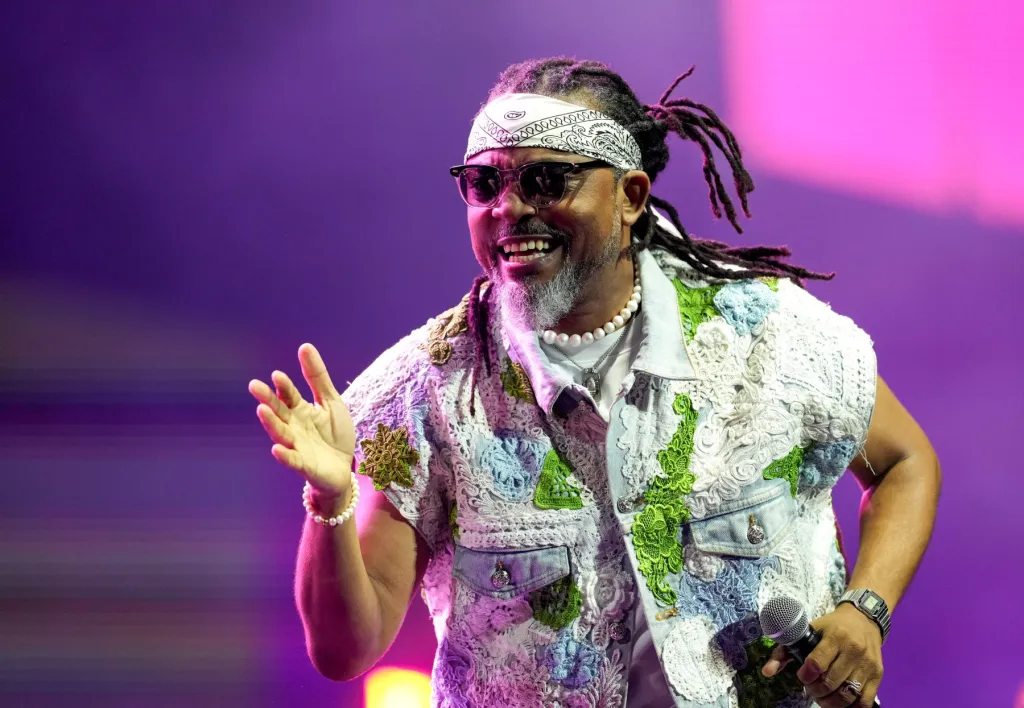
Sometimes, the universe aligns perfectly. Take the “Michael Jackson of the Caribbean,” Machel Montano, unveiling his new documentary the same week as the late, original Michael Jackson dominates the Billboard charts, for example.
On Friday (May 29), Like Ah Boss: Journey of a Soca King – Machel Montano officially debuts in the U.S. on all digital platforms. Co-directed by Sunseeker Media founder Bart Phillips and Montano’s manager, Che Khotari, the new documentary eschews the recent wave of 2016 nostalgia in favor of revisiting 2015: That year, Montano kept the camera rolling as he delivered a whopping 16 high-energy performance sets across seven days during Carnival season. That jaw-dropping run gave way to a Coachella mainstage appearance in 2016, collaborations with international music sensations like Ariana Grande (“All My Love”) and Ashanti (“The Road”), and a performance at Sadhguru’s India-set Maha Shivratri Festival in 2022.
Anchored by a Machel Monday performance in front of over 25,000 fans and primarily soundtracked by his 2015 smash “Like Ah Boss” — which has earned almost 20 million official on-demand U.S. streams to date, according to Luminate — Montano’s new documentary is undoubtedly triumphant. But it’s also strikingly honest.
Like Ah Boss: Journey of a Soca King doesn’t attempt to squeeze an in-depth look at Montano’s four-decade career into a 78-minute runtime — but the film does trace the darker moments of his storied life and career. From the devastating collapse of a VIP stand during his 2000 Real Unity concert (which left several attendees injured and numerous legal repercussions) to difficult battles with depression and other brush-ups with the law, Montano’s new documentary opts for an expansive look at his past 40 years, one that adds real weight and gravity to the innately effervescent energy of soca music.
And it’s an apt lens for a journey that began when the King of Soca was just a child. At the age of 9, Montano performed at The Theater in New York City’s Madison Square as a support act for Mighty Sparrow and other calypso stars. Years of local success, hit singles and carnival road anthems followed, and by 2012, Montano evolved into a Triple Crown Winner, with “Mr. Fete” earning the Groovy Soca Monarch title, while “Pump Your Flag” snagged Power Soca Monarch and Road March victories. In 2014, he won the Soul Train Music Award for best international performance with “Ministry of Road (M.O.R.),” boxing out crossover smashes like Sam Smith’s “Stay with Me” and giving way to his iconic 2015.
Today, Montano stands as Trinidad & Tobago’s all-time Road March champion, with his hit single “Encore” bringing him to 12 career victories, officially surpassing the late Lord Kitchener’s long-standing record of 11. Already inscribed in Caribbean history books several times over, Machel Montano’s sights are now set on a concerted effort to truly break soca music globally — and the first step is completing his ongoing Encore Tour, which kicked off in Jamaica back in April, ahead of two Central Park shows on Aug 8-9.
Below, Machel Montano takes Billboard behind the scenes of his new documentary, talks pulling from New Edition to attract a younger audience early in his career and reveals the global superstar still atop his collaboration wish list.
When did you decide you wanted to shoot a documentary?
We started in 2015; we knew it was a significant time. I was going through a transformation. I had just met Che [Khotari], and he came on as manager in 2014. I told him, “I want you to manage me to zero. Take me back down to my basic self and then let’s rebuild it all over again. But first you come on the road and see what Carnival is like.”
In 2015, we were trying to win the Road March again, and “Like Ah Boss” blew up. It was a hectic year with the Monk Monté album. I took on a whole new person, and my motto was “Cooperation over competition.” I wanted to start collaborating with younger talent and international artists to spread soca globally. So, we decided to bring the cameras on board to follow us winning Road March, going on tour, and then into the next year. We had some ups and downs and just kept the cameras rolling up until 2020.
Why did now feel like the right time to start sharing this with the world?
I hit a major milestone in 2026, becoming the King of all Road Marches and breaking Lord Kitchener’s 50-year record. It wasn’t something I set out to do, but it started to become more of a reality, and we went hard to achieve it. But now we’re focusing on breaking soca music internationally. We want to develop a new sound now that we’re reaching a point here the Caribbean is gelling together; jab, Dennery segment, bashment – there’s a togetherness happening.
What was it like for you to watch these years of your life back 10 years later?
I hardly ever look back or bask in the glory and the wins. We’ve been working constantly, so when you look back at it all, you get a better sense of the timeline and what the universe is trying to do with you or through you. You start to understand what it means to people and where the greatest impact is. It was nice to look at key moments like meeting Sadhguru and going to Coachella with Major Lazer to perform an Ariana Grande collaboration. It gave me inspiration to push harder. Even though I’m 40 years in and should be winding down, it feels like a new beginning.
What do you wish you could have explored more in the documentary?
I wish I could have told a little more of what I had to do to make soca music become acceptable to young people. When I started, the crowd was just 50- and 60-year-old adults with three-piece suits and canes. I was like, “Where were my peers?” I went to the clubs, and they were listening to dancehall music and hip-hop and New Edition.
I was a big fan of Teddy Riley and Heavy D, so I would remake things like the snares from “Poison” on my little Mac computer and use them in my performances to appeal to the young kids. Like a mother would slip medicine in your mouth by pretending it was an airplane, I would do that by slipping a hip-hop song into a soca set. I also started work with famous Jamaican artists, like Shaggy, Beenie Man, Red Rat and Mr. Vegas to bring some trendiness to soca and our local culture. And, obviously, I had to introduce some sexiness; shirt off, waist moving at 100 mph, lifting up girls, just doing anything that was attractive.
You touched on this in the documentary a bit but talk to me about creating soca music while battling bouts of depression.
That’s the curse of extremes; when you go too fast for too long, you’re definitely going to crash hard and slow right down. So much of soca music is about going nonstop, drinking alcohol and girls — and sometimes we even smoked weed to put all those things together. When you do those things at such a high level at such a young age, your body will get run down. When your body gets run down, your nutrients run down, your physical run down, and immediately the next thing to go is your mental and then your emotional [health]. I have a good, supportive family, but it was inevitable that at some point I would lose my ability to hold onto this system.
The biggest pressure with soca music is that you need to show up every year. You don’t take two or three years between albums. If you don’t have a hit this year, you’re nobody. You’re living with that constant pressure and fear. And when you crash, it’s not just not having hits; it’s also producing albums that are sitting in the attic not being sold. You’re losing money. So, you leave Trinidad Carnival, then head to Jamaica, Toronto, New York and London, hit Miami Carnival in October, and then you have November and December to make an album. And I didn’t want one super hit; I wanted to make albums that explored different songs for different communities. I also wanted to do my Machel Monday concerts, so I put a little extra pressure on myself, and it came crashing down. Sometimes you just need to give yourself that time and that space.
16 shows in seven days. Would you ever do it again?
We actually had one of those years again this year to break the Road March record with “Pardy.” But if I had to do 16 shows in seven days to break soca music globally, or to win a Grammy, I would do it. But I don’t think that’s necessary. I think we need to present the story of soca music, like what Bad Bunny did with the culture of Puerto Rico. I feel there is a level of Caribbean unity that must be achieved, including Haiti and Cuba and all the islands that we cherish, because the music is so similar.
What can people expect from the Encore Tour?
Expect me to have a really good time. I’m grateful to have both a young and old audience. I can’t wait to get finished with this tour and build the next 20 years of Machel Montano, but I have to be patient. People will get to hear my full spectrum of hits, and I’ve pulled out a song I’ve never sung before for each new show. Expect to hear all four decades of Machel Montano.
For the fifth decade of your career, what do you want to prioritize?
Global relevance and healing through music. My main goal is to make the world dance. I want to find the common thread that runs through soca, bouyon, Dennery segment, zess, dembow, reggaeton, even Afrobeats and the trends happening in India. I believe soca music is unity music.
We know you’re the King of Soca. Who’s the prince? Who’s the princess?
There are a lot of them out there, and each one of them will become the Queen of Soca and the King of Soca. Kes, Voice, Yung Bredda, Patrice Roberts, Nailah Blackman, Nessa Preppy — there are so many from different islands. Faith Callender, Trilla-G, 1t1, Litleboy, and Jordan English too. The whole Grenada crew with people like Muddy, Lil Kerry, and V’ghn. There are a lot of faces and a lot of people experimenting confidently.
Who’s left on your list of dream collaborators?
RiRi, holla! I’m writing songs for Rihanna, trying to get in her ear any chance I get. I would love to get her on a soca song. She has succeeded at every genre that she’s touched, and power soca is what’s left. I have this song I’m sitting on, and I can’t wait to come off the road to present it to her. I love her dedication and focus.
I love Tems too, and I also want to work with Moliy. We almost did a remix to “Backie.” Wizkid is a good friend of mine, and I’m hoping to do something with him eventually. I also want to do some Afrobeats and Indian collaborations, because I think those two elements speak to soca music.
What else can we expect from you in 2026?
I’m just focused on these shows and putting this documentary out there because I think it’s such a significant time to pass on knowledge to the younger artists. Expect Machel to take a step back at the end of the year and go dark. I’ve done that maybe two or three times in my career, and every time I have come out significantly transformed. And I have music that I’m working on.
Speaking to the Michael Jackson of the Caribbean, have you seen the Michael Jackson biopic yet?
Of course! I thought it was well done. Jaafar’s acting was definitely Oscar-worthy. It was really, really precise, and I understood why they told us that part of the story. I think this is going to be the Fast and Furious of music movies. We can do Michael 9 and probably just be hitting This Is It! I loved the quality of the acting; Colman Domingo and Nia Long were great. For the next one, I hope they develop the stories as we go along, because Michael was somebody that I looked up to. His DNA is in everything I do.
When they make your biopic, who do you want to play Machel Montano?
It will have to be quite a few people. When we’re ready to tell this story, we’re going to have to find the people who could really pull it off. I know they’re out there, so I can’t wait for that to be presented to me. But we have a couple of things left to do first — like topping the Billboard charts and winning Grammys. I’d love to repackage the history of Carnival into a $100 million Vegas show; I could probably end my days there like Sinatra.






Leave a comment