
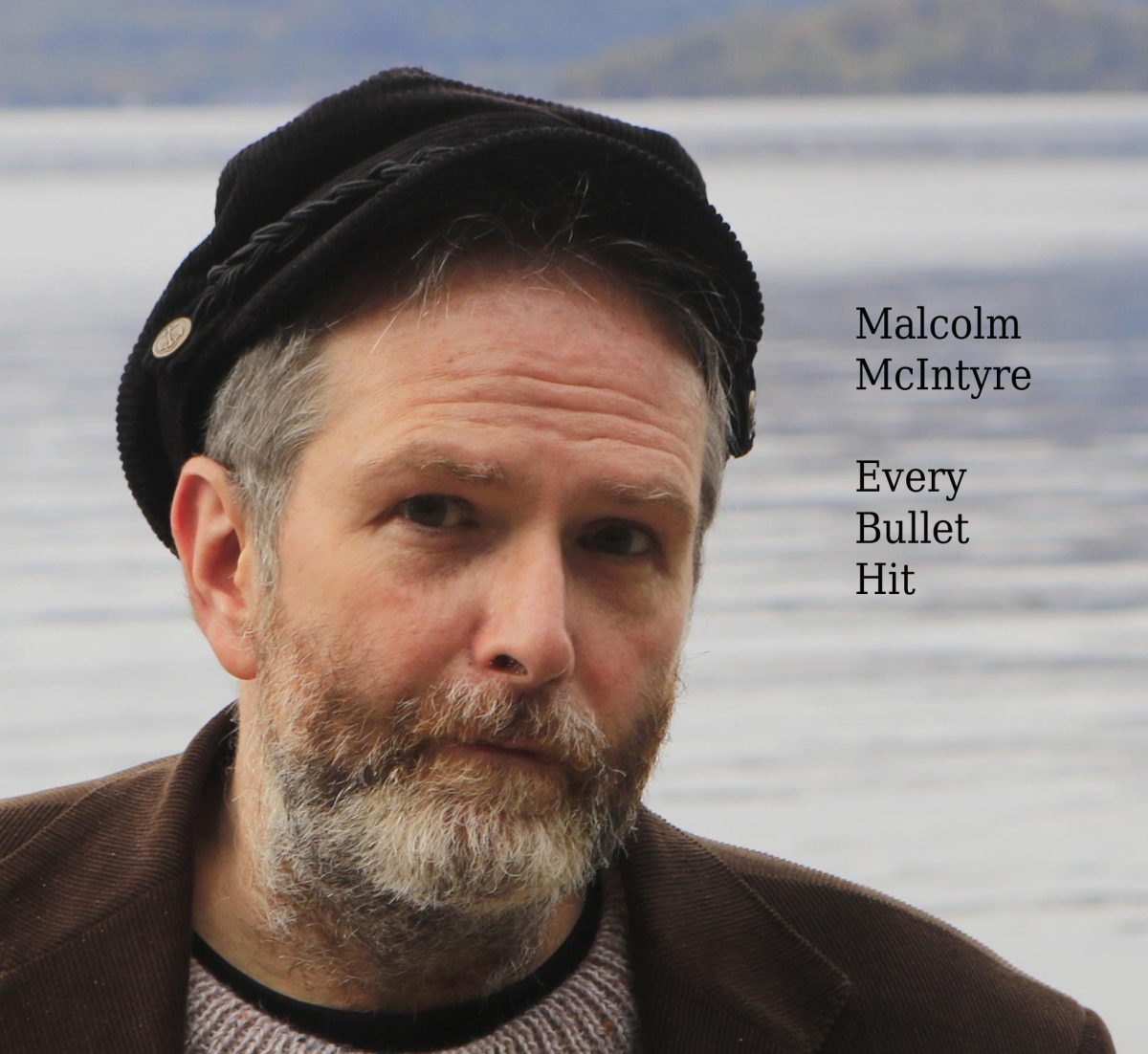
 Malcolm McIntyre – Every Bullet Hit
(Figaro Recordings)
CD / DL / Streaming
Out Now
Scottish singer-songwriter Malcolm McIntyre releases his career spanning debut album Every Bullet Hit. Iain Key reviews for LTW and interviews the artist.
It would have been around 3 years ago when I first heard from Malcolm, I was one of a number of people he had reached out to with recordings looking for airplay. As someone who appreciates the effort that an artist goes to in finding DJ’s contact details and sends a personal email, I was more than happy to listen and ultimately play the track The Mast That Sails The Ship.
What drew me to the songs he initially sent was the rawness of them, the feeling that there a was life and experiences in them which only age can bring. Additionally, with a lack of presence on Social Media, McIntyre not sharing what he had for breakfast on Instagram or what his latest binge watch is on Facebook their remains a little mystique, between the consumer and preformer, which is a a good thing.
Every Bullet Hit, the album is now here, released to streaming services late 2025 but now also available to buy. It contains 23 tracks lasting close on 2 hours. A double CD set, which would be a triple album if released on vinyl.
Thinking about what I have in my collection, other than compilations and live albums there are very few of this length that I own. I’m sure that given time a handful would come to me, but for the moment I’d have to settle on The Clash’s Sandinista, which still divides opinion to this day. Personally I think it’s a great record when you put it into the context of the time it was made, elements of it were ahead of its time, although I will accept that there are some of the more experimental tracks which would put the casual fan off, yet those arguably are also the ones that have inspired others more than the traditional fare.
Every Bullet Hit features songs written between 1989 and 2024 but recorded between 2014 and 2024 with the mastering done during the Spring and Summer of 2025. ‘Lo-Fi’ in nature, all the tracks were recorded on vintage 8 and 16 track digital recorders, with production and mixing by the artist himself. He also plays every instrument you hear as well. Whilst there is the occasional bit of hiss and flaw, as Malcolm says ‘occasional shortcomings’ however this only adds to the authenticity and charm of the set rather than detracting from it.
Sitting down and listening to any album can be a commitment these days, especially with the convenience of streaming and with the number of distractions of daily life. An release that is around 3 (or more) times longer than your average release initially I found challenging. That said have I have managed to do it a few times over the last couple of months. It needs to be done though, with Every Bullet Hit you’re not just listening to the latest release from an artist, you’re listening to a man bare his soul and open his heart, this is (almost) his lifes work, although he has since released a new track too. There are tracks which are more immediate than others, such as Subway Terror, To Those Who Let Me Down, Sometime Tomorrow, It Had To Be Spectacular and They Said I Wouldn’t Kill but, on each listen, more become familiar.
Given the length it’s easy to forget that you are actually listening to one collection of songs. There are elements of early Prefab Sprout on some tracks whilst others have the artist delivering a performance which Johnny Cash would be proud of.
If there is one release which deserves your time right now it’s this…
Buy Every Bullet Hit here
INTRVIEW
Louder Than War: Hello Malcolm, how are you?
Hi Iain, I’m doing great. It’s a sunny day in Glasgow, albeit it with hailstones! Hope you’re doing good too.
LTW: Before we talk about music, I guess it would be only proper that you introduce yourself to LTW Readers
Malcolm McIntyre: Hello Louder Than War! I’m an independent singer, songwriter, musician from Glasgow. I’ve been making music all my life, but only just started releasing it. This is my first ever interview and I’m delighted to be doing it for Louder Than War.
LTW: One thing I’m always interested in is what was the first music people were exposed to at home and what was the first act/artist that they got into?
MM: I grew up in a household dominated by classical music. The first music I can remember hearing was Herb Alpert. That was as close as my parents got to alternative music! I started buying singles at an early age. I was too young to worry about being cool, so bought records based simply on whether I liked them. That meant I bought Promises by Buzzcocks and Waiting For An Alibi by Thin Lizzy round about the same time, not caring one jot that one was a punk band and the other was heavy rock. My gateway album was Parallel Lines. I loved Blondie and the Sex Pistols. Then I discovered a band called The Beatles.
LTW: On your biography it suggests you were previously ‘active’ as a songwriter and occasionally in bands in your youth, how far did that go?
MM: I started my career in earnest in 1989 but struggled to find like-minded musicians. I’ve got a wide taste in music, and most people I met wanted to stick very rigidly to one style which I found very limiting and frustrating. I finally got a band together in 1993, but as so often happened my mental health struggles got the better of me, and I couldn’t continue with it. In 1997 I formed a band with my cousin and a friend. We made some great music, but unfortunately, we never managed to get a complete stable line up together, and we never quite managed to find the time to fully commit in-between stressful jobs and life events. Joe McAlinden of Superstar/BMX Bandits mixed and mastered our demo, but it wasn’t to be. The band just kind of fell apart in 2004, at which point I largely quit music for the best part of a decade.
LTW: You’ve just released your album Every Bullet Hit. 23 tracks clocking in at almost 2 hours long, a double CD but in truth a triple vinyl in old money. Was there ever a consideration in releasing it as 2 or 3 separate records?
MM: I felt at my age I had to do something a little out of the ordinary to attract attention. There are thousands of classic single albums, but not many triples. I also just wanted to get everything out there so I could concentrate on writing new material. Most double and triple albums have a fair amount of filler. I’ve hopefully managed to avoid that. Over to Louder Than War listeners to let me know. The triple album approach worked wonders for Cindy Lee, so here’s hoping.
LTW: It is an odyssey. Rather than a ‘regular’ album, as the songs were written, recorded and mastered over the last 12 years (although some date back further) it does feels like a retrospective of a full career, despite it being your debut…
MM: It’s a retrospective of my career, but also my life. I like the fact that it’s got an autobiographical feel to it. There’s 35 years of life distilled into approximately 2 hours of music. It maps my evolution as a writer, musician, listener, but also as a person.
LTW: I’m interested in your writing process. What comes first, the lyrics or the music?
MM: The songs I’m writing on at the moment, I’m concentrating on the lyrics first. To be honest though, I don’t have a masterplan, so in many cases in the past the music came first. Often when I’m writing music lyrics just start to flow naturally. Musically, I usually start off with something fairly simple, then over a few sessions put in a few twists and develop it from there. I like to explore when I’m writing. Most generic pop artists at the moment seem to select a standard chord progression and work from that template and it ends up very formulaic. I avoid that and also steer of those guitar chord books! The best way for a guitarist to write is the exploratory approach. Move a finger here and there and see what you find. Having a sense of adventure and discovering things yourself is where the fun and excitement builds, and that’s what pushes and inspires you to create great work. That’s when you find the most beautiful and unusual chords. I take as much time as I need to get the song I want. The music for She Can’t Tell You Why was written in under 15 minutes, Paraiso Perdido took 7 years!
LTW: You play every single instrument on the album, which is very impressive. Is the ability to pick up and play instruments something that’s always come naturally to you?
MM: To be honest I’m fairly basic! I like to think I’m reasonably handy on the guitar, but everything else I tend to fumble about with, and do my best within my limitations. I pretty much never practise unless I’m rehearsing something I’m going to record. For me it’s all about writing and recording. I hate practising! I can come up with some great guitar parts, but because I don’t practise, I’d be hopeless in a jam situation. So no extended improvisational blues soloing for me (thank God)! The trumpet was the hardest. I spent 4 weeks trying to teach myself, armed with only A Tune A Day book and YouTube instructional videos, and then just had to go for it. I must admit, it’s the one instrument I’d like to take lessons for to learn how to play it properly. It’s a beautiful instrument and I’d like to use it more often in the future.
LTW: You have suffered from severe depression in your life. Do you find writing and recording is a form of therapy?
MM: Writing and recording can be very cathartic. I’ve been struggling with my health recently, and writing has been my best friend over the past few weeks. Now I’m in a good place again, and as a bonus, I’ve got some great new lyrics and music. When I was in my twenties it was probably the exact opposite. I’m a perfectionist, and I lost confidence and found it almost impossible to write. They were horrendous years health wise, and fallow times musically. Fortunately I survived, and Subway Terror, which might just be my most popular song, emerged from that era. My GP recently urged me to write down what I’m feeling when I’m depressed. Sound advice. Writing is a great way of exorcising and making sense of pain and difficult situations.
LTW: I do like in the booklet for the CD you give an insight into every track. As well as what you’re thinking and feeling I think there are a number of situations people can relate to…
MM: It seemed like a much more interesting approach than just reproducing the lyrics. Hopefully people can relate to the songs and see themselves within the songs. Obviously, some of the lyrics deal with mental health, suicide and alienation. I really hope anyone out there who is struggling can take strength, inspiration, courage and something positive from those songs. So many suffer from mental health problems. It’s vital that people know they’re not alone, and that it does, in time, and with experience and learning and developing coping mechanisms, get better. If you are in a difficult place, I hope these songs serve as an ally.
One of my favourite songs on the album is It Had To Be Spectacular. So many artists from my generation, and successive generations, have been targeted with deeply hurtful accusations of plagiarism. This song is for all of us, and future songwriters and musicians. As a New York synth duo once sang “Keep them dreams burning, forever”.
LTW: There are a few tracks where the vocals are very ‘Johnny Cash’, possibly more noticeably on They Said I Wouldn’t Kill. Who have been your biggest influences on your music?
MM: I’m more than happy to take a Johnny Cash comparison! I listen to many different genres of music. Punk, pop, jazz, alternative, soul, heavy rock, classical, singer songwriter. I’m open to all forms of music. My all-time favourite artist is Todd Rundgren. But so many others! The Beatles, Joni Mitchell, Cheap Trick, Iggy Pop, Bobby Womack, Laura Nyro, Ramones to name a few. They’ve all had a big impact on me. And so many great much missed jazz artists. The list is endless. Listening and absorbing as much music, and as many genres as possible, is essential to my development as a writer and a musician. There are no closed doors, I don’t rule anything out!
LTW: I have listened to the album on a number of occasions, and I never get tired of it, I’m not sure if it’s due to the length or because there is such a variety of songs. In your words, it’s a wide range of styles including power pop, post punk, avant-garde, synth and more. Are you happy with it?
MM: I’m really happy with. As a perfectionist, there’s always going to be things I’m not 100% happy with, but that’s the same for all musicians. There’s a lot of great songs, and despite the wild mix of styles I think it hangs together well. It’s a lo-fi recording of course, but I think it’s turned out very well. Lo-fi is a valid and quite rightly much loved genre. After all, Yo La Tengo are lo-fi, and who doesn’t love them? They’ve made some fantastic music.
LTW: The CD will be available to buy from your website and it’s already on streaming. What would you like to happen next?
MM: I’m not sure what to expect. I’ll be contacting as many publications as possible to see if they’ll review it. I want as many people to hear, and hopefully enjoy, the music as possible. I will also contact radio stations to see if I can get any airplay. I’ve chosen She Can’t Tell You Why as the lead song. I’ve put so much of myself into making this album, rest assured I’ll be doing everything I can to promote it!
LTW: Are live dates an option?
MM: Definitely. A friend is currently in the process of trying to put a band together for me. I’ll be concentrating on vocals and saxophone. Initially, it will be in and around Glasgow, but I want to play throughout the UK and beyond.
LTW: Before I let you go, you told me you’d already recorded your next single?
MM: I mixed it yesterday and will hopefully get it mastered this week. I’m working on a number of new songs, but the one I’ll be releasing first is one of two songs of empathy I’m writing. It’s a song for Tourette Syndrome activist John Davidson who’s had a particularly tough time of it over the past few weeks following the fallout from the Baftas. He’s a wonderful individual who has endured so much in his life and is doing important pioneering work to promote awareness of Tourette’s. This is my message of empathy, support and solidarity to John.
LTW: Malcolm, thank you for chatting about the album. It’s definitely one I’ll be listening to for some time to come
MM: Thank you so much Iain and to everyone in the Louder Than War community. Hope you enjoy the album!

Photographs by David Harkins, supplied by Malcolm McIntyre
All words by Iain Key. See his author profile here or find him via his LinkTree
A Plea From Louder Than War
Louder Than War is run by a small but dedicated independent team, and we rely on the small amount of money we generate to keep the site running smoothly. Any money we do get is not lining the pockets of oligarchs or mad-cap billionaires dictating what our journalists are allowed to think and write, or hungry shareholders. We know times are tough, and we want to continue bringing you news on the most interesting releases, the latest gigs and anything else that tickles our fancy. We are not driven by profit, just pure enthusiasm for a scene that each and every one of us is passionate about.
To us, music and culture are eveything, without them, our very souls shrivel and die. We do not charge artists for the exposure we give them and to many, what we do is absolutely vital. Subscribing to one of our paid tiers takes just a minute, and each sign-up makes a huge impact, helping to keep the flame of independent music burning! Please click the button below to help.
John Robb – Editor in Chief
PLEASE SUBSCRIBE TO LTW


Leave a comment