
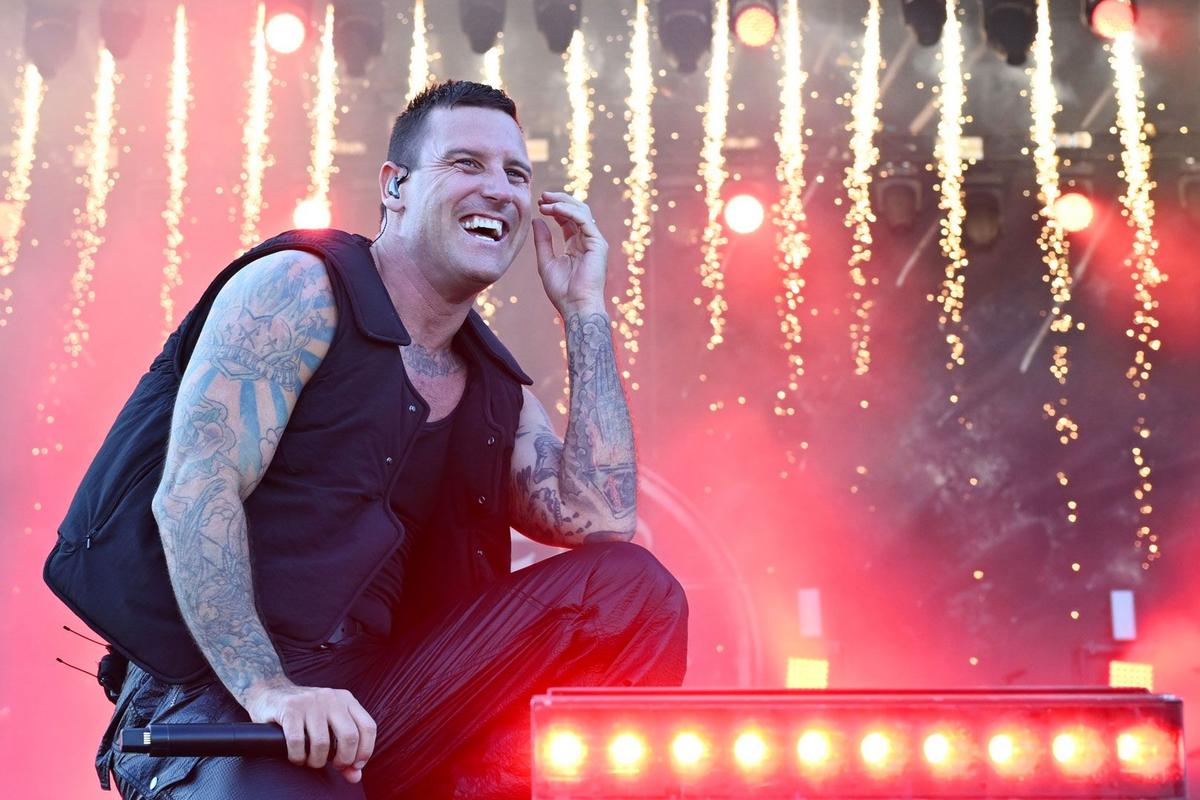
Metal messaging may not always be the most positive, but metalcore giants Parkway Drive have found their light in some of the darkest times with their latest single, “Sacred.”
Singer Winston McCall admitted to Full Metal Jackie on her weekend radio show that going the uplifting route is not the most natural thing, but it felt so in this case. “I’m generally someone who writes quite negatively. We’ve literally had an album called Ire. And it’s strange,” he shared.
Viewing it as a rallying cry in trying times, McCall says, “I found myself just wanting to create something that had positive momentum behind it, that was very outwardly channeling the aggression into something that was a moment of light rather than a moment of dark.”
He adds, “I think there’s just something to be said for metal serving that purpose. It seems to always be the counter to what culture is doing at this point in time. And right now, it’s very hard not to feel just like the knives of division cutting every which way it can through families, through friends, through societies.”
“Sacred” is currently a standalone single, though McCall reveals that Parkway Drive have been working on new music that could eventually turn into an album. Within the chat he offers an update on where things are going musically.
The singer also shares his gratitude for logging two decades of music, especially given their start. And he reflects on the role that the fans have had in their musical journey. He also takes us into what it meant to play the legendary Sydney Opera House with an orchestra last year. Check out more of the chat below..
It’s Full Metal Jackie and it is a pleasure to welcome Winston McCall of Parkway Drive. The band had an incredible 2025. Of course, the Summer of Loud tour. You played one of the biggest shows of your career at the Sydney Opera House. Winston, thinking back to 2003 when all of this started, did you ever imagine you’d be checking off so many milestone moments? And also how does it feel to be at this point?
Hell no. Honestly. We’ve had the most insane career in any feasible terms of the imagination. To be honest, when we started, we just started with the goal of playing to some friends in a local youth center. That was literally it.
It was just like, “Let’s start a band so our friends can mosh.” There was never even a goal of, “Hey, we could write a record.” The first time we ever recorded songs was the first time any of us had ever stepped in a recording studio. The first time we ever went on tour was the first time we’d gone to see gigs on the other side of Australia, let alone play them.
So, the idea that we’d be 23 years into this, and within the last six months, we’ve done the biggest tours of our entire life and played in the most iconic venue in our entire country and played with a symphony orchestra, it’s just been one of the most bizarre lives that I can imagine.
But that being said, I’m very, very grateful that we’ve been able to do this for so long and it still gets better.
Parkway Drive, “Sacred”
That was “Sacred” from Parkway Drive. And of course, we got that song last year, which so far isn’t tied to an album. It speaks to a very 21st century problem. It’s heavy, it’s aggressive, but it’s uplifting. Winston, what got you riled up to approach the epidemic of negativity in our world? And thank you for giving us this positive moment as a result.
It’s really interesting, because I’m generally someone who writes quite negatively. We’ve literally had an album called Ire. And it’s strange. I’ve always found that the negativity in my life comes out through the lyrics that I write and through the aggression of the music.
But I’ve just found that it’s been so dominating in every aspect of society these days, that when I came to write, I found myself just wanting to create something that had positive momentum behind it, that was very outwardly channeling the aggression into something that was a moment of light rather than a moment of dark.
I think there’s just something to be said for metal serving that purpose. It seems to always be the counter to what culture is doing at this point in time. And right now, it’s very hard not to feel just like the knives of division cutting every which way it can through families, through friends, through societies.
It just seems like everything is an attempt to shatter just safety and community that we have as humans. And I wanted to do something which was like, “Hey, how about we have a rallying cry? That’s it.” And it was, for me, that’s what I needed. So it’s kind of what I put out there.
Winston, as I said earlier, “Sacred” is not tied to a new record. And I’ve even seen you say that you’re not necessarily working toward anything right now. Do you feel at this stage in your career, it’s more that music will be on a “as it comes” basis? And what are some of the things you’ve found in doing it this way as opposed to creating a larger artistic vision?
It’s almost down to a shift in the process, simply down to the options we have for the process becoming a lot more fluid, basically. It’s really crazy the amount that technology has changed the recording process and the creation process for music over the last three years. It’s gone at warp speed, which puts you in a position where I guess we have more options with what you want to do.
For a band like us who is used to creating a large body of work, which you have to remain focused on for a large period of time, it takes a couple of years to write an album. And over that, you’ve got to hold focus for up to like ten songs all at once and make sure you’re putting everything into all of those songs and they’re all cohesive all at once, simply down to the fact that you can only afford to go into the studio for a certain amount of time. You can only take that time off to get into the studio.
All of a sudden, it’s not as as constricted as that. So leaning into that option means that you can be a lot more reactive and a lot more instantaneous with what you’re doing and take it in smaller chunks and being more laser-focused on individual pieces of work, rather than having to have that all in, constantly dedicated approach to just one overarching theme.
So, for us, it’s about taking things as they come and being able to just lean into the options that we have and build something in a new way. Because as people that have been doing this for a long time, it’s really exciting when a new avenue opens up.
“Sacred” was kind of our first tester into that area. And we’re definitely working on new music that I guess an album will be the end result of it. But it’s really cool, the idea that we can write something and then within a month of having that just go, “Okay, cool. It’s good to go. We can give it to people now.”
As people who live in Australia, it’s hard to do that. Normally, we have to fly around the world and take months out of our lives to record an album. And now we can kind of just smash it out in a couple of days and it’s good to go.
We were talking earlier about new music, so I thought I’d ask if you could just sort of give us a little update about the direction, inspiration, or give us any sort of a status update.
“Sacred” was a really good touchstone for us because we really got to experiment with what we wanted to lead off with. And for us, we’ve been approaching everything at this point in time like we really want. We’re moving to a consolidation of strength.
And we’ve been a band that has expanded and expanded and expanded its sonic palette over the years. We feel like, at this point in time, we’ve stretched the elastic band of light and dark so far that we don’t feel necessarily the need to keep stretching it even further.
But within what we’ve already adventured into within the sound, we know where the strengths are. We know where we really wanna flex, where we really want to consolidate what the Parkway identity is and use it in the strongest way possible. And that’s taking parts of our identity which we know are the real core elements of Parkway and just driving them home and sharpening them as hard as we can.
So it’s quite direct. It doesn’t lack anything in terms of the expanse that we want to create with it. But it’s definitely something that’s gonna be built from the strongest place that Parkway exists in the first place, which is definitely anthemic, melodic and really, really damn heavy.
I like the sound of that. And timing wise, anything you can share?
No, not really. That’s the thing. We’re working literally every day. We have a bunch that we are actually working on and looking to make time for. But I guess the blessing and the curse that we’ve had going on is we’ve just had crazy stuff pop up for us, which have been huge opportunities that we can’t say no to, which has meant we’ve just had to push the recording and the writing part back by months as things happen.
Like, playing in the Opera House literally just got dropped in our lap and that was gonna be writing time and all of a sudden we had six months to create an orchestral show for a for the Opera House in Sydney. So things like that keep popping up and there’s a bunch more happening as well. And in the meantime, we still work while we can. So, I can’t say, “Hey, expect it now.” Because who knows at this point in time? I keep getting surprised. Not surprises, but they’re surprising.
Winston, I have to imagine that there are certain pinch me moments in your career. There are iconic venues in every country. Please take me back to the feeling you had when the initial vision of playing the Home Show at the Sydney Opera House became reality. What was the biggest challenge of getting that together? And were you able to savor that any in the moment as the show was happening?
You asked all the correct questions there. Because they’re all crazy.
It’s something that came along when we were actually doing our 20-year anniversary tours in Australia. For anyone that’s seen footage of that, it’s the most insane production we’ve ever put together in any scale. It’s literally mind-boggling. And a friends’ production company who we’ve worked with actually came to us and they’re like, “Hey, we have an opportunity to film something in the Opera House if you wanna do a show.”
At the time, we were like, “Don’t talk to us about that because we’re trying to build this arena tour. We can’t talk, we can’t think about that right now.” But a week after the tour finished, we flew down to the Opera House, and we expected it to be something where we were trying to talk our way into being able to play this prestigious venue. And then we found out it was actually the other way around where they’re like, “No, we’d really like you guys to come and play in the Sydney Opera House. It’s known as the house of the people and we want to let everyone know that this is a venue which is accessible to everyone. It’s not something which you should feel excluded from, so we want Parkway here.”
From that moment, we had six months to put the show together. And we knew we had to do it because you can’t really say no to an opportunity like that. It’s literally the symbol of our country. It’s the most iconic building in our nation and if you’ve ever seen it in real life, you know why. It is so dramatic and so stunning and so beautiful to be able to put something on there. So we had to do justice to it. We had to create a show, score the songs, figure out the setlist, figure out how to communicate from our non-musical language, ’cause we can’t write or speak music to an orchestra, of what we had in our mind for this show and then dress it and come up with the entire concept. We had six months to do it and that’s literally a third of the time it normally takes us to put a show on.
I’m shocked that it came together. The entire show was an homage to our home, Australia. It was supposed to represent Australian culture from start to finish and I think we nailed it really, really, really well with everything that we did.
I’m really excited for people to see it, because right now it’s only like 1,000 people that got to actually experience this because it was a very small concert hall. But I only got to experience it very briefly as well.
The way that the rehearsals were, we rehearsed with the orchestra, I think it was two hours before the show. We did a full dress rehearsal, went and had dinner for an hour and then came back and played the show and then it was done. That was it. There was no second show. There was no other chance at this.
I can just remember getting to the intermission, going, “Wait, wait. What’s happened? We’ve already played an hour,” and then coming back onstage, and then all of a sudden we’ve at the final song and I was like, “Oh my god. It’s done.” And then that was it. There was almost was no time to savor it.
So I’m looking forward to seeing the footage and hearing the live recording back myself.
It’s Full Metal Jackie. Winston McCall with us, Winston, I’ve heard you use underdogs in reference to your own journey, but I also know it’s often used to identify Parkway Drive fans as well. They’ve been a big part of this journey for the band throughout the years. What establishes a Parkway Drive fan, especially back home, from other fan bases in rock and metal?
That’s such a good question. They have been the driving factor of this band. I think anyone who’s chosen to get behind us at any point in time has realized the connection between band and fan. We’ve never been shy about the fact that we as people have never felt an abundance of confidence in our place. We’re small town people who started a band in Australia that was very outside of the box of what was going on and took it around the world when not many people knew who Australian bands were.
We always relied on our fans and the people who connected with our music to lift us up and that’s always been there even in the creation of songs and the crowd chants and everything that’s gone on. That’s been fueled by the fans. They’ve been the ones who have carried us to the position that we’re in. It’s always been that willingness to lift each other up, to feel willing to sing together, to look out for each other and I guess be on this journey with us.
READ MORE: Fans on Reddit Name Their Desert Island Metalcore Albums
It really feels like a community in the sense of, I get the feeling that the fans are excited when we succeed. It’s exciting to see how far this little project that started in a tiny town in the middle of nowhere can actually go and they get a feeling of accomplishment when it goes to new places and is taken to new places and we’re able to create new things for them to enjoy. I’m sure that’s probably something that’s shared by other fan bases around the world, but there’s something very personal about what we have and the connection that we have, and it makes it special and warms my heart, to be honest.
Winston, obviously you had an amazing 2025, but how important is it to go live some life and learn how to pace yourself as a veteran band? How vital is time off from the album or tour cycle for yourself, and do you have a big passion when you’re not playing music?
I don’t think I’ve learned to pace myself yet. I’ve learned to survive the pace and I’ve become fitter, so I’m better at taking the pace. That’s it.
The time off is really important, and we have come to acknowledge the fact that this band is not stopping. It took us a very long time to realize that this isn’t something that’s just gonna go away and it’s not something we want to go away. We want to maintain what we do and continue to excel and continue to be able to push through new boundaries and aim for new horizons.
So that time off and being able to be realistic and knowing to tell yourself, “Just stop. Just stop for a second. Go and recharge. Be with the people you love. Go for a surf. Go to the gym. Relax. Like, stop thinking about the band for a bit.” Or you wanna think about the band, but just don’t for a while, is super important.
It’s just mental health. Obsession is something which can drive you insane and that’s also something we know full well from experience that when we put everything into everything all the time and we just say, “Just achieve the mission no matter the goal.”
It can hurt. That’s the thing. None of us wanna be in that place and we don’t need to be in that place. So we’re very, very particular in making sure our mental health is at the forefront of what we do, because if that’s not there then everything’s gonna fall apart.
We’re still all surfers. As soon as we we go home, the first thing everyone’s doing is checking the surf and it’s straight down at the beach. That’s still the second love.
Thanks to Parkway Drive’s Winston McCall for the interview. Stay up to date with the band through their website, Facebook, X, Instagram and YouTube platforms. Find out where you can hear Full Metal Jackie’s weekend radio show here.
See Parkway Drive and some of the other top metalcore bands’ best albums in the gallery below.
The Best Album From 11 Legendary Metalcore Bands
These metalcore albums all represent something different, showcasing the diversity of the bands in the scene when at their very best.
Gallery Credit: Bryan Rolli



Leave a comment