
The night that Zena White moved from the United Kingdom to America, she dropped her bags at her new Manhattan apartment and walked a few blocks to the Lower East Side’s Bowery Ballroom. It was October 2017, and White, who had relocated for a new job at Brooklyn-based Partisan Records, was checking out Cigarettes After Sex, the dream-pop band that had recently released its debut on the indie label.
The band’s career — and White’s, too — would soon change dramatically. Less than a decade after playing small clubs like the 575-capacity Bowery, the Texas act is headlining arenas, with its debut album certified platinum and over 3.2 million equivalent album units moved across its three studio sets, according to Luminate. And White is now Partisan’s COO, helping to oversee its eminent indie roster.
“The era that I have been at Partisan is really neatly bookended by Cigarettes After Sex,” White, 40, tells Billboard from Los Angeles, the night before Coachella launches with Partisan signees Geese, Blondshell and Interpol on the bill. “We were really focused on setting up a global footprint for them and then using that global footprint to advance our capabilities as a company and as a team.”
Related

Co-founded in 2007 by Tim Putnam and Ian Wheeler, Partisan featured in its early years a modest roster led by indie-rock bands, most notably Deer Tick, and the catalog of the late Afrobeat great Fela Kuti. But in the last decade, under the guidance of Putnam, now its president, and White, its small-but-mighty roster has become one of the most lauded in indie music. Partisan is responsible for launching next-gen rock heavyweights Fontaines D.C. and IDLES, home to critical darlings including Blondshell and Laura Marling, steward of catalogs for the legends Cymande and DJ Rashad — and behind the biggest indie-rock breakout in recent memory, Geese.
Putnam and White have carefully built Partisan into a powerhouse, reinvesting the fruits of the label’s success with Cigarettes After Sex — and, soon after, Fontaines and IDLES — to help it grow. Their savvy business approach, though, has gone hand in hand with an ear for singular, left-of-center musicians and a willingness to support them as they build sustainable careers.
Putnam, 52, understands what an unsustainable music career looks like. After college, in the early 2000s, he ended up in the Portland, Ore., area, working for Hollywood Video, and joined a band that cycled through labels, managers and agents. “I was obsessed with music,” he says, “although the idea of making a living from it felt like someone else’s reality.” Putnam eventually moved to New York in 2004, getting a job as the night manager at the Knitting Factory club in downtown Manhattan. Wheeler, a journalist who liked Putnam’s band, approached Putnam wanting to write a piece about it; when Putnam told him that they were between labels, Wheeler suggested they start their own — “which I thought was a pragmatically terrible but exciting idea at that time,” Putnam says.

Putnam
Jasmine Archie
They began working the label, Partisan, out of Putnam’s apartment, and when Putnam heard Deer Tick play at Knitting Factory, he sensed “the label would have a purpose” if it could work with the band. After learning that the label that had released Deer Tick’s debut wasn’t paying royalties, he helped the group exit its deal and they “began a partnership that became the foundation of the first 10 years of Partisan Records.”
Concurrently, Knitting Factory investor Stephen Hendel was producing the Tony Award-winning Fela! jukebox musical and had acquired the rights to Kuti’s recording catalog. Hendel needed a label on which to release Kuti’s music, and Knitting Factory CEO Morgan Margolis approached Putnam and Wheeler about reviving the dormant Knitting Factory Records to release Kuti’s music, in exchange for an investment in Partisan. “This was how we learned to run a record label,” Putnam says. “There would absolutely be no Partisan Records without Fela Kuti.” (Putnam and Partisan worked Kuti’s catalog through a strategic partnership with Knitting Factory Records before that label formally merged with Partisan in 2014.)
And, Putnam adds, “Partisan in its current form wouldn’t be here without Cigarettes After Sex. Their success came at a turning point for the label, subsequently allowing us to grow in ways we otherwise could not have.” Enter White: Of Scottish heritage but born south of the border, she grew up in the remote town of Penrith, England, where she immersed herself in MTV and Napster but “was desperate to be near live music.” As a college student in Bristol, she started working for a promoter, going into artist management after leaving school before landing at The Other Hand, which did European label management for American indies including Stones Throw and Daptone.

White
Jasmine Archie
In 2014, Partisan linked with The Other Hand because it wanted help growing Cigarettes After Sex, which, several years after forming in 2008, only had music on YouTube but had sold out a European tour on the strength of its virality on the platform. White had already been eyeing a professional change, and as the release of the band’s debut neared — undergirded by The Other Hand’s savvy assistance — she asked the label’s GM what was next for Partisan and what it needed. Putnam needed to return to his A&R roots, he told her, so someone else would need to run Partisan’s business.
“I was a Napster kid in my teenage years … I never thought I’d work at a record label, because everyone was leaving record labels,” White says. “But working in label services, I learned more about business models in general and particularly building value.” White, who had earned a master’s degree in entertainment law while at The Other Hand, pitched herself to lead Partisan’s operations and landed the gig.
“Tim and Zena have created a truly special label with Partisan,” says Cigarettes After Sex’s Greg Gonzalez. “It’s been a beautiful thing to be such a deep part of each other’s stories for the last while, and even sweeter as friends to say how excited I am to see everything flourishing for them in such a wonderful way.”

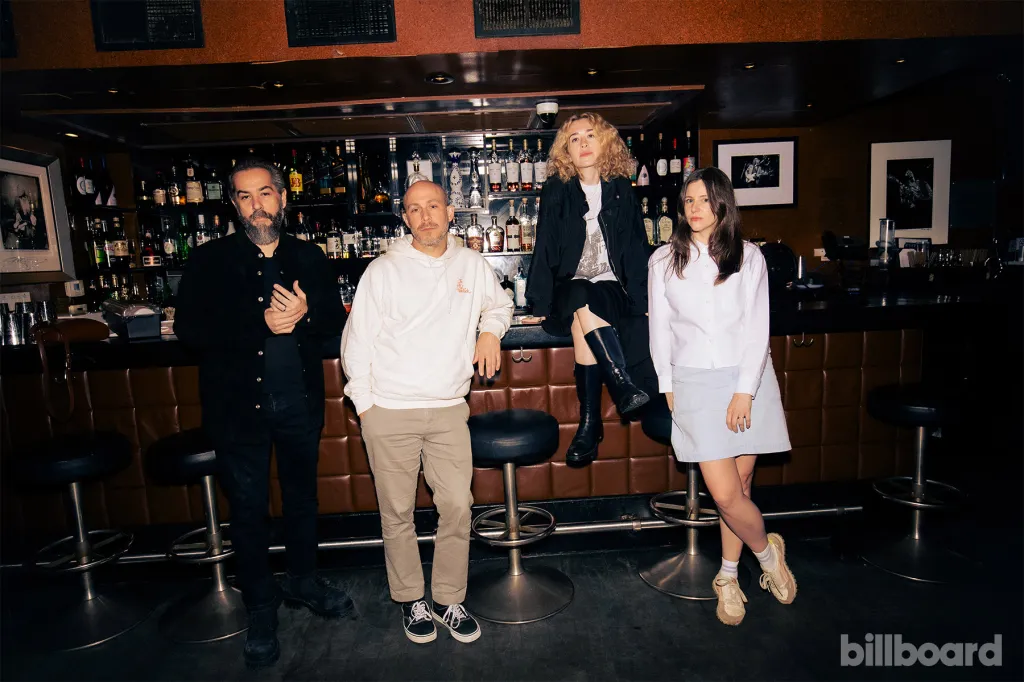
From left: Greg Gonzalez, White, Putnam and Blondshell.
Jasmine Archie
The successful pre-pandemic triumvirate of Cigarettes After Sex, Fontaines and IDLES allowed Partisan, White says, “to reinvest in being able to do a better job for the artists that we work with — and it also allowed us to attract other artists.” (Fontaines was signed to Partisan until 2024; Cigarettes After Sex and IDLES remain on the label.)
The most significant of those new signings began to take shape in April 2020, when the attorney for a band of Brooklyn high schoolers sent Partisan the rough mix of what would become Projector, Geese’s 2021 debut. Putnam and White immediately clocked the potential, but as Partisan navigated the upheaval to its release calendar caused by the pandemic, they questioned whether the label had the bandwidth to take on Geese and properly support it. When [PIAS], which at that point distributed Partisan through its Integral division, suggested that Partisan and [PIAS] label Play It Again Sam jointly sign Geese, however, Partisan was in.
“Beyond their talent at such a young age, the songs had something uniquely special,” Putnam says. “I spent a lot of the pandemic driving around, listening to their music.” After a Zoom meeting, Geese inked a deal with Partisan and Play It Again Sam. (As for how he pitched Geese on joining Partisan, Putnam says, “if I had given them something which overly felt like [a pitch], we probably wouldn’t be having this conversation … They’re New Yorkers.”)

Blondshell
Jasmine Archie
“In many ways, because of the circumstances of the pandemic, Projector was a bit more like an EP campaign,” White explains. But the band quickly began to make waves with the set’s nervy rock music and its undeniable Big Apple chic; “New York Has a New Band of Buzzy Post-Punk Teens: Geese” a New York Times headline read the week Projector came out. Two years later, Geese blew up its sound — and earned a cult following — with the concept album 3D Country, a wild fusion of blues, punk and art-rock that frontman Cameron Winter described at the time as a story “about a cowboy who does psychedelics in the wild west and fries his brain forever … Ultimately he finds himself in the end and it turns celebratory.”
All this is why both Putnam and White shrug off the notion that Geese arrived out of nowhere with Winter’s late-2024 solo debut, Heavy Metal, a wrenching set of idiosyncratic piano ballads that had surprising traction on TikTok, and Geese’s fall 2025 opus, Getting Killed, which immediately took the indie-rock world by storm and launched the band to the tops of year-end lists and festival bills, as well as Saturday Night Live. “It was more of a relief than a surprise,” Putnam says. “It didn’t catch us off guard because internally, Geese’s rise wasn’t fast … When Getting Killed was delivered, we knew the band had made something special. Also, the success of Heavy Metal primed the pump and extended into the release of Getting Killed. One fed into the other, and now both are feeding each other.”
“We’ve been in a Geese and Cameron Winter campaign,” White concurs, “and that has been building since 3D Country.” Partisan was “almost entirely prepared” for Getting Killed’s release, she adds, although that “almost” was significant: Even when Partisan cautioned physical retailers that demand for Getting Killed would likely dwarf interest in 3D Country, many insisted on using the prior album’s sales as a reference. The day Getting Killed dropped, Partisan completely sold out of the vinyl album; the set subsequently topped Billboard’s Indie Store Album Sales chart for three nonconsecutive weeks, and its jangly single “Cobra” reached No. 21 on Alternative Airplay.
For White, “the way that [Geese and Winter] caught fire and caught people’s ears honestly gives me hope for the musical era that we’re in. People are rejecting the algorithm. They want to think and feel. They don’t want to be fed things.”

Cigarettes After Sex’s Gonzalez
Jasmine Archie
And as Putnam, White and the label’s London-based global vp, Jeff Bell, continue to cement Partisan’s status as one of the era’s foremost indie labels, that’s something of a mission statement. When PJ Harvey sought a new label home for the first time since 1993, she turned to Partisan — which helped her release 2023’s Grammy Award-nominated I Inside the Old Year Dying, a record White neatly sums up as “an electronic folk album in partially Dorset dialect.” After a career spent mainly on Matador, Interpol recently signed with Partisan, because it “wanted to do something different,” White says. (“Veteran artists can still be developing artists,” she adds.) Elsewhere, Partisan is hard at work breaking Ezra Collective in America (the British jazz quintet received the 2023 Mercury Music Prize, and a Barack Obama cosign shortly thereafter), and the label remains a champion of local New York talent, by way of Julia Cumming, the Sunflower Bean frontwoman who released her solo debut in April, and genre-bending electro-punk act Lip Critic, which dropped its wild sophomore album in early May. (For its part, Cigarettes After Sex’s profile also keeps growing: During Karol G’s headlining set at the first weekend of Coachella, she brought out Gonzalez to debut a new collaboration, “Después de ti,” that they officially released later in April.)
“What strikes me about Tim and Zena, and what drew me to Partisan in the first place, is their decency,” says Sabrina Teitelbaum, who as Blondshell has put out two acclaimed albums on Partisan since 2023 and will release new music this year. “They respect art and understand what a big responsibility it is to put records out. Artists work so hard on songs about the most private details of our lives and it’s not easy to find people to handle them with the care they deserve. Tim and Zena are extremely capable in terms of their business, but as people they are just so solid and always working to support the visions of their artists.”
And even as Partisan makes major business moves — in 2024, it inked a global distribution deal with Virgin; it added a publishing division, Left Music, in 2020; and it recently launched the electronic-oriented Select Discs, which joins the section1 imprint it started in 2021 — Putnam is committed to retaining the spark that made him launch the label in the first place.
“I’d like us to have more fun,” he says when musing about the future. “All work and no play makes Partisan a dull label.”
This story appears in the May 9, 2026, issue of Billboard.






Leave a comment