

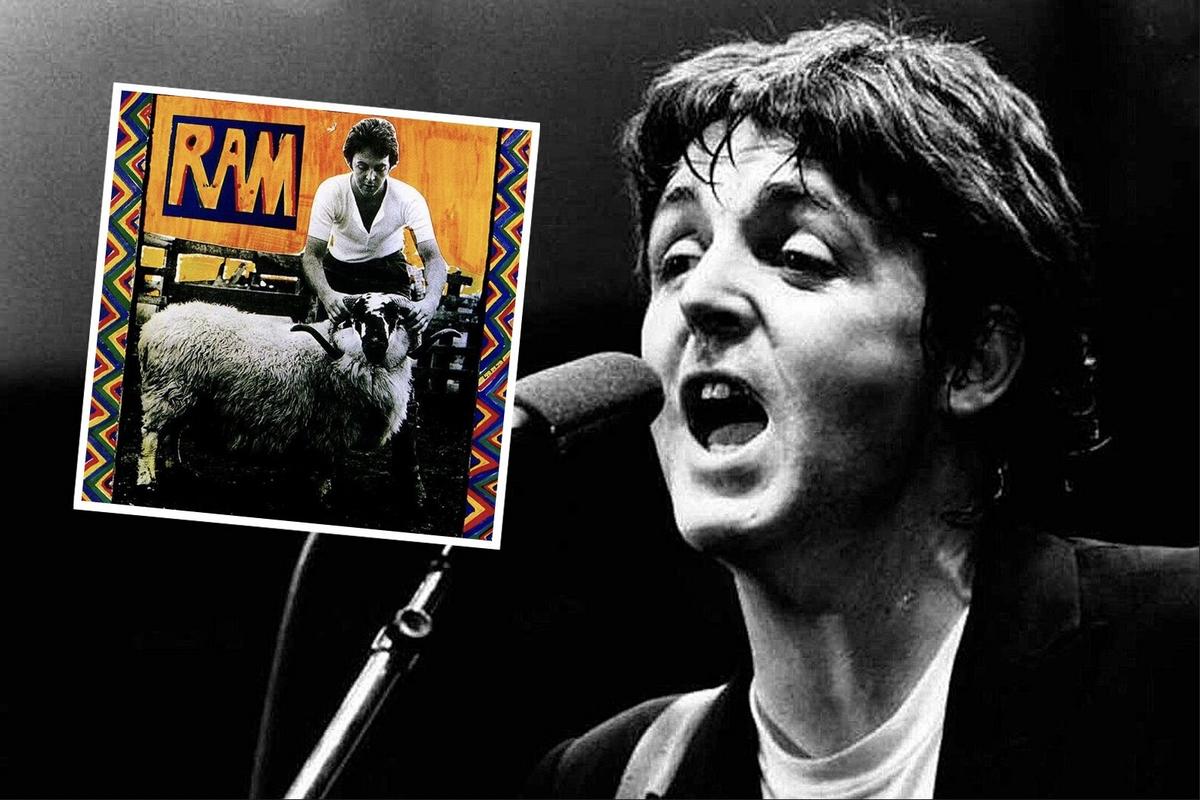
There were two competing storylines running through Paul McCartney’s initially misjudged album Ram.
Released on May 17, 1971, this second post-Beatles LP was presented as a collaboration with his wife Linda McCartney, a professional photographer by trade. McCartney’s songs were always co-credited to John Lennon and Sir Lew Grade had recently purchased their back catalog.
Grade filed a lawsuit claiming that this new partnership with Linda was a sham created only to claw back some publishing revenue. Ram was actually something else: The foundation of McCartney’s next band Wings, who’d go on to issue seven of his nine ’70s albums.
What Was the Best Song on Paul McCartney’s ‘Ram’?
Paul, Linda and Ram drummer Denny Seiwell formed the nucleus of the group – along with Moody Blues alum Denny Laine – on Wings’ 1971 debut Wild Life, 1973’s Red Rose Speedway and a string of early-’70s stand-alone singles including the gold-selling Top 10 smash “Live and Let Die.”
But first, they put out an album with a group of studio aces that was initially criticized for everything that makes it sound so unexpectedly bold and fascinatingly unedited today. Ram can be now understood as a big-bang moment for the next century’s handmade-pop phenomenon.
Denny Seiwell, left, Linda and Paul McCartney formed Wings with Denny Laine after ‘Ram.’ (Evening Standard, Getty Images)
Even though he was focused on his new life at High Peak Farm in Kintyre, Scotland, far away from the fractious ex-bandmates and their rabble of fans, McCartney took a few looks back – but not always nostalgically.
The U.S. chart-topping single “Uncle Albert/Admiral Halsey” and “Long Haired Lady” were edited together in the style that deftly recalled the McCartney-led medley on Side 2 of of the Beatles’ Abbey Road. But he was also in the midst of a nasty quarrel with Lennon and they both let that seep into their material.
READ MORE: Ranking Every Beatles Solo Album
McCartney’s Ram, like Lennon’s contemporary Imagine LP, survived those frankly diminishing missteps by sheer force of musical will. McCartney was still bursting with after-breakup ideas — and that gives Ram a dizzying momentum. Its essential pop magnetism — its compulsive listenability — simply can’t be denied.
Here’s a ranked song-by-song look back at the platinum-selling, international Top 5 smash Ram:
No. 11. “Ram On”/ “Ram On (Reprise)”
Though it has a few embellishments, “Ram On” was really just a slight ukulele song made more interesting in the editing process. Engineer Eirik Wangberg suggested splitting the song in two. During the second-half “reprise,” a foreshadowing McCartney sings, “Who’s that coming round that corner? Who’s that coming round that bend?” The first song on Wings’ second album (1973’s Red Rose Speedway) began with the same line, connecting “Big Barn Red” back to Ram sessions that included three of the founding members of the group.
No. 10. “Eat at Home”
On second thought, this song’s working title (“Come On Little Lady”) makes perfect sense. “Eat at Home” was ostensibly one of five songs co-written with Linda, but feels all Paul. He turns a cozy lyric on its ear by offering winky solicitations through a series of boyhood hero Buddy Holly-isms. Now relegated to deep-cut status, “Eat at Home” was actually issued as a single in Europe and performed on Wings’ 1972 tour.
No. 9. “Smile Away”
McCartney counted off on an official release – “1, 2, 3, 4!” – for the first time since 1963’s “I Saw Her Standing There.” “Of course, I left the bit in,” engineer Eirik Wangberg later said, “and it’s so great to hear that kind of thing.” In another call back, McCartney’s vocal then nods to early influence Jerry Lee Lewis. But the rest of the process was quite modern, with a series of overdubs including no fewer than eight bass tracks.
No. 8. “3 Legs”
The other Beatles were discussing their breakup quite openly in song, so many assumed McCartney was venting too. In truth, “3 Legs” reflected his bucolic new life with Linda. He began “jamming around with a blues idea,” McCartney later revealed, “and then with no particular relevance I sang: ‘my dog, he got three legs, but he can run,’ meaning that everything doesn’t have to be perfect. It can still work.” An accompanying video, completed with Magical Mystery Tour editor Ray Benson, finds the McCartneys on horseback.
READ MORE: Top 10 Paul McCartney Songs
No. 7. “Monkberry Moon Delight”
John Lennon’s primal screams defined his post-Beatles pain, but McCartney – as heard on this howling lysergic nightmare – was no stranger to an eruptive vocal. (See “Oh! Darling” or, much earlier, “Long Tall Sally.”) Thing is, Lennon drew a straight line through his emotions. “Monkberry Moon Delight” seems to be simply tossing a word salad. If it all seemed perfect for “I Put a Spell on You” hitmaker Screamin’ Jay Hawkins, well, he agreed. Hawkins covered “Monkberry Moon Delight” on 1979’s Screamin’ the Blues.
No. 6. “Long Haired Lady”
The LP’s longest song joined two fragments, with the soaring “Love Is Long” attached as a finale. George Martin wrote an uncredited orchestral score, but more interesting is the way engineer Eirik Wangberg slowly added instruments to Paul and Linda McCartney’s lovely interwining vocals. “I wanted the listener to feel and hear the same as I, a growing magic until all the instruments are back – a great climax before the song ends, Wangberg said in The McCartney Legacy: Volume 1: 1969-73.
No. 5. “Heart of the Country”
The opening song on Side Two of Ram sounds like it burst from an idyllic rural hillside, and it did. “Heart of the Country” once again celebrated the country life McCartney made for himself with Linda McCartney – and it did so in an appropriately simple way: McCartney only used six of the available 16 tracks at CBS Studios in New York, with future Wings co-founder Denny Seiwell playing a homemade drumkit constructed from a nearby plastic trashcan.
No. 4. “Dear Boy”
At this point in his disintegrating relationship with Lennon, fans could be forgiven for assuming McCartney was directing “Dear Boy” at his former bandmate. Instead, the song referenced Linda McCartney’s first marriage to Joseph Melvin See Jr., with whom she had a daughter, Heather. They divorced in 1965 and See later died by suicide in 2000. “‘Dear Boy’ wasn’t getting at John,” McCartney confirmed years later. “‘Dear Boy’ was actually a song to Linda’s ex-husband: ‘I guess you never knew what you had missed.'”
READ MORE: Top 10 Wings Songs
No. 3. “Too Many People”
Ram arrived amid a period of very public sniping between McCartney and Lennon. The LP included an utterly unsubtle cover image of two beetles copulating – and the rather silly conceit that his photographer wife was somehow stepping in as a songwriting equal. Then McCartney opened with “Too Many People,” a song clearly directed at his former bandmate that risked immediately tanking the whole project with haughty sermonizing. But “Too Many People” rises above that fractious moment, catching a tough groove. It’s helped along by two electric guitar solos that McCartney completed in one take.
No. 2. “Back Seat of My Car”
To be honest, “Back Seat of My Car” is pretty unfocused: It’s too overstuffed with ideas, too reliant on multi-tracked McCartneys, not as rustic as his solo debut and somehow tossed-off sounding anyway, and simply too long. Yet this song still underscores what makes Ram such a wildly inventive gem. It’s gutsy and un-precious at one point and then a testament to McCartney’s enduring pop sensibilities at others. As he bolts from ’50s-era rock to cocktail-lounge crooning to swooning violins, and back again – all inside of this one final track, mind you – there is a sense of limitless possibility.
No. 1. “Uncle Albert/Admiral Halsey”
Paul McCartney’s first solo U.S. No. 1 single harkened back to the way he worked with the Beatles at the end. He’d been the principal architect of a medley that dominated the second side of Abbey Road, joining a series of song snippets. Lennon later trashed the concept as a desk-clearing exercise, but something sparked creatively for McCartney. After following a more stripped-down, personal path on McCartney, “Uncle Albert/Admiral Halsey” became a a technicolor outburst of with ever-shifting cadences, styles, collaborators and melodies. This was the Abbey Road assemblage, taken to a fizzy kitchen-sink zenith.
Paul McCartney Albums Ranked
The Beatles always defined him, but McCartney’s story didn’t end there.
Gallery Credit: Nick DeRiso
See Paul McCartney in Rock’s Craziest Conspiracy Theories



Leave a comment