



Sounds From The Other City Festival
Various venues across Salford
4th May 2026
Bank holiday Sunday, Salford. Over a hundred artists, seventeen stages, and one very ambitious attempt to catch as much of it as possible. Sounds From The Other City has been one of the UK’s most vital independent festivals for over two decades, and the 2026 edition showed exactly why. Here’s what Thomas Sidwell saw.
Sounds From The other City is all about celebrating Manchester’s chaotic good twin. Louder, weirder, rougher-round-the-edges (but rapidly gentrifying), less interested in its own mythology, and almost certainly up to something more interesting on a Sunday night. Salford doesn’t get the credit it deserves, but once a year on the early May bank holiday it makes its case in the most compelling way possible.
Sounds From The Other City turns twenty in 2026, and the anniversary edition is typically, defiantly itself: over a hundred artists, seventeen stages, spread across the nooks and crannies of Chapel Street and The Crescent. A Victorian concert hall. A church. A museum. A pub with two rooms doing completely different things simultaneously. A notorious nightclub that won’t stop until Sunday becomes Monday becomes Tuesday.
What makes it work, what has always made it work, is that it isn’t imported. The tastemakers shaping the programme are the same people running the grassroots venues, the community radio stations, the DIY promoter nights that have been keeping Greater Manchester’s music scene honest long before anyone was paying attention. Now Wave, Band on the Wall, Reform Radio, FaT OuT, Hey Manchester. These names have fast become the infrastructure of North West that our new musical scene is being built on. SFTOC gives them the stage, or seventeen of them, and gets out of the way.

It would be reductive to call SFTOC only a music festival. Tucked into the University of Salford’s Newton Building, Lola De La Mata’s Our Ears Sometimes Sing To Us invites audiences of twenty into three acoustic chambers to imagine themselves inside the cochlea of a human ear. At the New Adelphi’s Band Room, Simon Connor and Andrew Brooks’ From The Edges pulls you through the woodlands and waterways on the city’s outskirts via multi-camera systems and spatial field recording. Meanwhile the Working Class Movement Library, one of Salford’s great institutions, hosts a General Strike centenary exhibition alongside a conversation on art as resistance. This is a festival that thinks music sounds better when it has something to say. Families wander between stages, kids in tow, while seasoned festival goers dart between venues clutching programmes and making impossible decisions. It’s that kind of day.
The venues themselves are half the story. Peel Hall, the Grade II-listed Victorian concert hall on the university campus, is one of SFTOC’s secret weapons, 300 capacity, ornate and intimate. St Philips Church on Wilton Place offers something different again: high ceilings, stained light, a setting that lends even the most abrasive art-rock a certain gravity. And presiding over everything, as it always has, is Islington Mill, the festival’s spiritual home, humming across multiple floors from mid-afternoon until the early hours, its courtyard, gallery and events space each doing their own thing simultaneously. The beauty of SFTOC is that you can stumble into any one of these spaces on a whim and walk out having just met your new favourite band. That’s not a happy accident. That’s the whole point.
Things get underway on a humid afternoon at The Green, where Me Gusta open proceedings with tribal drumming that pulls people out of their bank holiday stupor and onto their feet. Heavy, hedonistic beats shake off the rust nicely – exactly what a festival needs at 14:00. Iris follow with guitar-driven funky lines that bring a heavier Santana to mind, their groovy, expansive guitar and bass work given an extra jolt by a drummer absolutely refusing to be ignored. By the time the queue for Maxwell Hall starts snaking around the university campus ahead of jasmine.4.t, it’s clear this is going to be a very good day indeed.

BBC 6 Music’s Artist of the Year and one of the Guardian’s ones to watch for 2025, jasmine.4.t, arrives trailing considerable hype – a debut album produced by Boygenius will do that. The beautiful, ethereal tunes she delivers inside Maxwell Hall justify every word of it.
She’s the kind of artist you spend the whole set wondering how they aren’t massive yet, and the answer, watching the crowd hang on every note, is that it’s only a matter of time.
A short walk back to The Green for Hater, whose clean chiming indie pop and glorious vocal lines, shades of Deerhunter in the big, open verses, feel perfectly suited to the late afternoon outdoor setting. Then it’s five minutes up the road to Peel Hall for CUSK, whose ethereal, violin-led songs carry the ghostly weight of Venus in Furs-era Velvet Underground, the lead singer’s haunting vocals filling every corner of the ornate hall. They debut new single Blue Tak and a handful of tracks due for release this summer, a reminder that Peel Hall, curated by the legendary Now Wave, has a knack for putting you in the room for something you’ll be talking about later.
SLAG follow at Peel Hall and provide one of the day’s more exhilarating gear changes: a mathy, energetic five-piece with incredible vocals and rhythmic breakdowns that shake the Victorian plasterwork. Then it’s across to St Philips Church for Ashnymph, whose hypnotic, driving rhythms feel completely at home beneath the high ceilings and stained glass. Part Chemical Brothers, part King Gizzard and the Lizard Wizard, with a touch of nu-rave thrown in for good measure, unique, psychedelic and genuinely thrilling.
A detour to the Old Pint Pot for The Manifestation Group provides a moment of unexpected tenderness amid the day’s more visceral pleasures. Acoustic ballads with beautiful lyrics and gorgeous backing singing, a touch of The Coral about them, the kind of discovery that only happens when a festival is spread across enough venues to reward the curious. This is SFTOC doing what it does best.
Back to St Philips for Blue Bendy, who deliver exactly what the NME hype promises, classic indie rock with some daring harmonic diversions, experimental guitar pop that feels both confident and assured. The church is filling up now, the crowd sensing something special is building.

They’re right. Pyncher close out St Philips at 21:30 and the room is electric. Funk-driven guitar riffs, indie rock galore, a band clearly making a name for themselves in Manchester and beyond, they’ve legged it back from Europe to be here tonight, and you feel it in every note. When the lead singer steps up to deliver a tune from the pulpit, St Philips earns its place as the venue of the day without question.
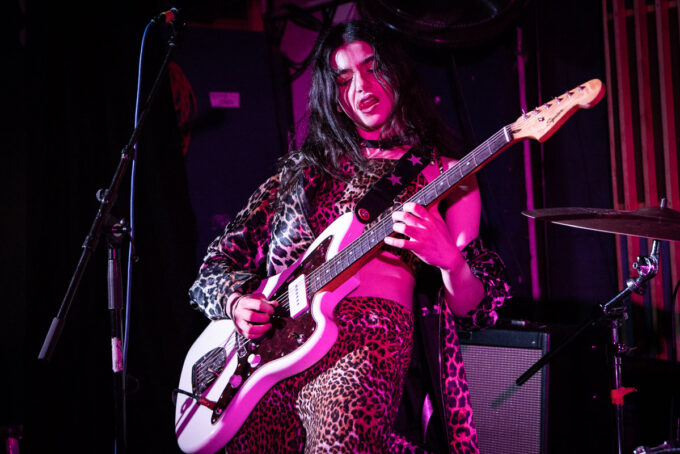
If you ever needed a second wind (as I do now I’m in my thirties) The walk back to Maxwell Hall for Lynks will get you up for it. Arriving in full leopard-skin outfit, the self-styled merchant of pure gay chaos delivers high-energy hyperpop with incredible dance moves, an absolutely adoring crowd, and, inevitably, a full crowd surf that brings the night to a fittingly euphoric close.
One of the clear favourites of the day, and not hard to see why.
Twenty years in, Sounds From The Other City remained one of the most vital days in the UK festival calendar. Elsewhere on the night, Moonchild Sanelly brought future ghetto funk to Maxwell Hall, Chimpo did his thing in the Islington Mill courtyard, and PINS closed out The Green. We couldn’t be everywhere at once, nobody could, that’s the deal, but the bits we missed only made us hungrier for next year.
And for those whose appetite for the night hadn’t been satisfied, Islington Mill kept the party going until 3am, while the notorious White Hotel, Salford’s temple of experimental nightlife, didn’t call it quits until 7am, with Rainy Miller closing things out at 5.
Salford’s chaotic good twin, still at it long after Manchester had gone to bed. Roll on 2027.
~
Words by Thomas Sidwell, writer for Louder Than War. His author profile is here – find him on Instagram here
Photos by Breige Cobane supplied
A Plea From Louder Than War
Louder Than War is run by a small but dedicated independent team, and we rely on the small amount of money we generate to keep the site running smoothly. Any money we do get is not lining the pockets of oligarchs or mad-cap billionaires dictating what our journalists are allowed to think and write, or hungry shareholders. We know times are tough, and we want to continue bringing you news on the most interesting releases, the latest gigs and anything else that tickles our fancy. We are not driven by profit, just pure enthusiasm for a scene that each and every one of us is passionate about.
To us, music and culture are eveything, without them, our very souls shrivel and die. We do not charge artists for the exposure we give them and to many, what we do is absolutely vital. Subscribing to one of our paid tiers takes just a minute, and each sign-up makes a huge impact, helping to keep the flame of independent music burning! Please click the button below to help.
John Robb – Editor in Chief
PLEASE SUBSCRIBE TO LTW




Leave a comment