

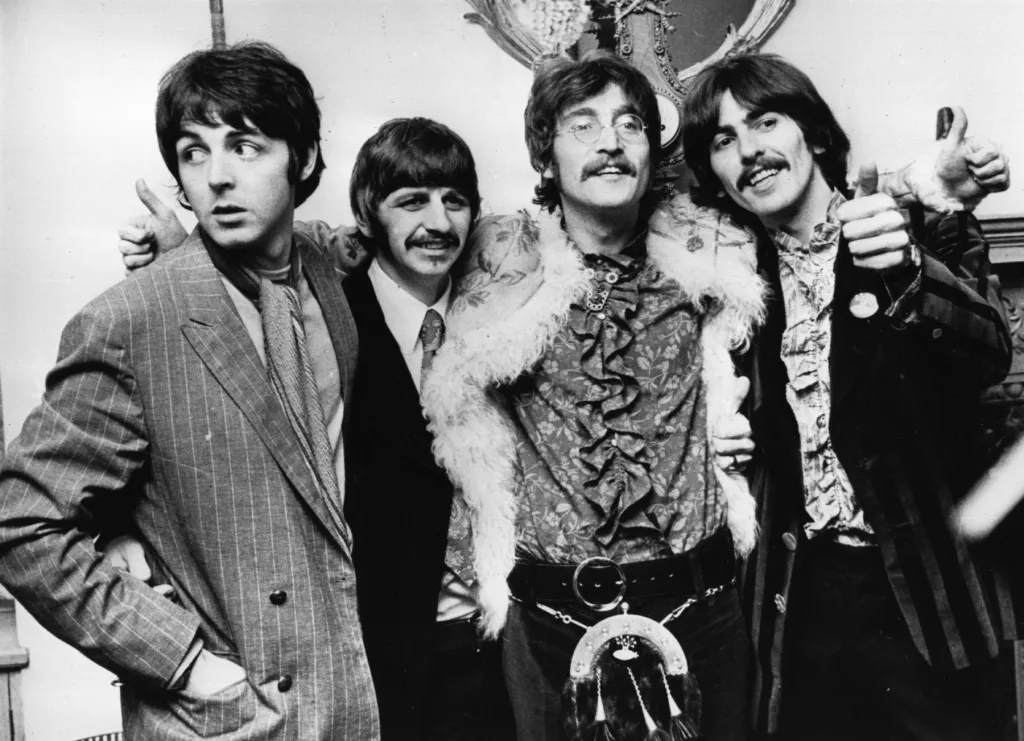
The Beatles were the biggest and most important act of the 1960s, but you’d never know it by looking at Billboard’s Easy Listening chart (now called Adult Contemporary). Easy listening stations wanted to have a distinct identity from pop stations in the 1960s. Some artists did well in both formats, including Frank Sinatra, Petula Clark and Glen Campbell. But many artists fared much better on the Easy Listening chart than they did on the Hot 100. Among them: Jack Jones, Al Martino, Andy Williams, Perry Como, Vikki Carr, The Lettermen, Tony Bennett, Barbra Streisand, Eddy Arnold, Jerry Vale and Ed Ames.
Even “Yesterday,” one of the most classic (and oft-recorded) ballads in music history, failed to crack the Easy Listening chart. The 1965 single logged four weeks atop the Billboard Hot 100, but it went nowhere (man) on Easy Listening. Those adult-skewing stations were more inclined to play the schmaltzy “Red Roses for a Blue Lady,” which was a top 10 Easy Listening hit for three artists that year — Vic Dana, Bert Kaempfert & His Orchestra and Wayne Newton.
The Beatles didn’t crack the AC chart until November 1969, with George Harrison’s ballad “Something,” which reached No. 17. That was a song so undeniable that genre GOAT Frank Sinatra often introduced it in concert, as he did here, by saying: “It’s one of the best love songs, I believe, to be written in 50 or 100 years.”
The Beatles finally broke through at AC in 1970, just as they were calling it quits. “Let It Be” logged four weeks at No. 1 that spring; “The Long and Winding Road” peaked at No. 2. In the 1970s, the gap between what pop and AC stations played narrowed considerably, as such acts as Carpenters (whose first single was a ballad remake of the Beatles’ 1965 smash “Ticket to Ride”), Neil Diamond, John Denver, Olivia Newton-John and Helen Reddy regularly climbed high on both charts. Bee Gees, Chicago and Elton John, who, like the Beatles a decade earlier, bridged pop and rock, became AC mainstays in the 1970s.
By 1976, when The Beatles’ 1966 track “Got To Get You Into My Life” was belatedly released as a single (to promote the then-current Rock’n’ Roll Music compilation), it made the top 10 on both the Hot 100 and the AC chart. Easy listening stations that wouldn’t even play an exquisite ballad like “Yesterday” in 1965 now hopped on a vibrant pop/rock track. AC radio had gotten hipper and more contemporary over the preceding 11 years, thanks in large to The Beatles and the generation of acts they influenced.
All of the ex-Beatles except John Lennon have topped the AC chart on their own. Paul McCartney was the first to do so with “My Love,” which he recorded in 1973 with his band Wings. Ringo Starr scored in 1975 with a cover of The Platters’ 1955 classic “Only You.” Harrison made it in 1981 with “All Those Years Ago,” a tribute to the recently-slain John Lennon which featured McCartney and Starr. Lennon’s highest-charting AC hit, “Woman,” reached No. 4 in 1981 following his death.
Billboard‘s Gary Trust reported on Friday (April 10) that “Paul McCartney has furthered his legacy on Billboard’s Adult Contemporary radio airplay chart as ‘Days We Left Behind’ debuts at No. 22 on the list dated April 18.”
That news item prompted a deep dive into The Beatles’ legacy on the AC chart, which originated in July 1961 as Easy Listening. (The name changed to Middle-Road singles and Pop-Standard Singles before reverting to Easy Listening in 1965. In 1969, it became Adult Contemporary, which has been the name ever since).
Even though no Beatles recordings made the top 10 on Easy Listening in the 1960s, five Beatles songs – songs the Fab Four had recorded – scored for other artists. We’re not including Mary Hopkin’s “Goodbye,” written by McCartney, but credited to Lennon/McCartney, because The Beatles never recorded it. The song, Hopkin’s follow-up to the smash “Those Were the Days” (which McCartney produced but did not write), reached No. 6 on the AC chart in 1969.
More Beatles songs made the top 10 on the AC chart in the 1970s, after The Beatles disbanded in April of that year. They included Shirley Bassey’s version of “Something” (No. 6 in 1970) and Joan Baez’s “Let It Be” (No. 5 in 1971).
Here are the five Beatles songs to make the top 10 on what is now called Adult Contemporary in the 1960s. These renditions show another side to the act you’ve known for all these years. All are credited to Lennon and McCartney except for “Something,” which was written by Harrison.
-
Boston Pops Orchestra, “I Want To Hold Your Hand” (1964)
AC peak: No. 10
Hot 100 peak: No. 55
Producer: Peter Dellheim
Notes: Arthur Fielder, the legendary conductor of the Boston Pops Orchestra, conducted this spirited instrumental version of the song that started it all for The Beatles in the U.S. A comment on YouTube says, “Sounds like halftime at a high school football game.” That’s fair, but it’s guaranteed to raise a smile. The song was featured on the ensemble’s album Arthur Fielder and the Boston Pops Play the Beatles. Fiedler served as conductor of The Boston Pops Orchestra from 1930 until his death in 1979.
The Beatles’ electrifying original appeared on Meet the Beatles!, which topped the Billboard 200 for 11 weeks in 1964. The song ruled the Hot 100 for seven weeks and received a Grammy nod for record of the year.
-
George Martin and His Orchestra, “Ringo’s Theme (This Boy)” (1964)
AC peak: No. 7
Hot 100 peak: No. 53
Producer: George Martin
Notes: This pretty instrumental version of the Beatles song was one of four instrumentals by Martin on the North American edition of the A Hard Day’s Night soundtrack, along with “And I Love Her,” “I Should Have Known Better” and “A Hard Day’s Night.” Martin received an Oscar nod for scoring of music — adaptation or treatment for his work on the film. “Ringo’s Theme” (This Boy)” and “A Hard Day’s Night” also appeared on Martin’s album Off the Beatle Track, which reached No. 111 on the Billboard 200 in 1964. Martin was knighted in 1996 and died in 2016 at age 90.
The Beatles’ original, titled “This Boy,” appeared on Meet the Beatles!, which topped the Billboard 200 for 11 weeks in 1964. It made the Hot 100 in June 1964 as part of a four-song EP, Four by The Beatles, which also included “All My Loving,” “Roll Over Beethoven” and “Please Mr. Postman.”
-
David & Jonathan, “Michelle” (1966)
AC peak: No. 3
Hot 100 peak: No. 18
Producer: George Martin
Notes: The Beatles didn’t release this ballad from their 1965 album Rubber Soul as a single, which created an opportunity for David & Jonathan, which consisted of songwriters Roger Cook and Roger Greenaway. Their hits as songwriters (sometimes with additional collaborators) include The Fortunes’ “You’ve Got Your Troubles,” The New Seekers’ “I’d Like to Teach the World To Sing (In Perfect Harmony)” and The Hollies’ “Long Cool Woman (in a Black Dress)” (all of which made the top 10 on the Hot 100. Cook, now 85, and Greenaway, now 87, were inducted into the Songwriters Hall of Fame in 2009.
The Beatles’ original appeared on Rubber Soul, which topped the Billboard 200 for six weeks in 1966. “Michelle” is a trifle compared to such other Rubber Soul tracks as Lennon’s “In My Life.” Nonetheless, “Michelle” is the only Beatles song (or song by any of the four Beatles) to win a Grammy for song of the year.
-
Ramsey Lewis Trio, “A Hard Day’s Night” (1966)
AC peak: No. 10
Hot 100 peak: No. 29
Producer: Esmond Edwards
Notes: Lewis followed “Hang on Sloopy,” his hit instrumental remake of The McCoys’ 1965 No. 1 Hot 100 smash, with this mostly instrumental remake of The Beatles’ 1964 Hot 100 topper. The track here sounds like it was recorded at a party, with talking and singing heard in the background. Lewis went on to have two more Hot 100 hits with Beatles songs: “Day Tripper” and “Julia.” “A Hard Day’s Night” appeared on the ensemble’s live album, Hang on Ramsey! Lewis died in 2022 at age 87.
The Beatles’ original appeared on the A Hard Day’s Night soundtrack, which topped the Billboard 200 for 14 weeks in 1964. The song led the Hot 100 for two weeks and won a Grammy for best performance by a vocal group. It was also nominated for song of the year (the first rock song ever nominated for that accolade) and best rock & roll recording.
-
Sergio Mendes & Brasil 66, “The Fool on the Hill” (1968)
AC peak: No. 1 (six weeks)
Hot 100 peak: No. 6
Producer: Sergio Mendes, Herb Alpert, Jerry Moss
Notes: This song had the longest run at No. 1 on the AC chart of any Beatles song, cover of a Beatles song or song by a former Beatle. It’s easy to see why. Mendes and his co-producers, A&M founders Herb Alpert & Jerry Moss, came up with a fresh take on the song, one imbued with smooth jazz and bossa nova. Dave Grusin wrote the superb arrangement. Mendes’ version, which spotlights vocalists Lani Hall and Karen Philipp, received a Grammy nod for best contemporary-pop performance, vocal duo or group. It competed with The Beatles’ “Hey Jude” in that category; they both lost to Simon & Garfunkel’s “Mrs. Robinson.” This smash was the title song of the ensemble’s Fool on the Hill album, which reached No. 3 on the Billboard 200, the act’s best showing on that chart.
Mendes had reached No. 31 on the AC chart earlier in 1968 with a previous Beatles cover, “With a Little Help From My Friends,” and would score a third AC hit in 1970 with a cover of yet another Beatles song, “Norwegian Wood.” Mendes, an influential figure in global pop music, died in 2024 at age 83. Alpert and Hall married in 1974. They’re still married today.
The Beatles’ original appeared on Magical Mystery Tour, which topped the Billboard 200 for eight weeks in 1968. Like “Michelle,” it was never released as a single, which created an opening for Mendes.






Leave a comment