
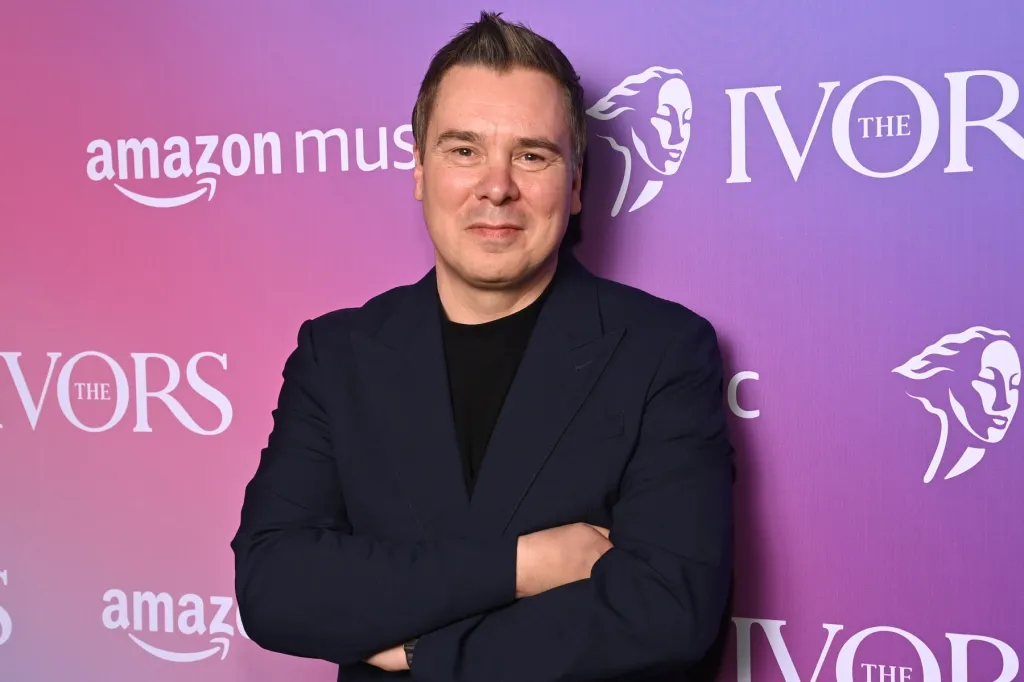
Planning awards shows is no simple task, not least when you run the U.K.’s Ivor Novello Awards, which Robert Neri, the Ivors Academy CEO, posits is music’s “Oscar-equivalent” ceremony. When Billboard U.K. speaks with Neri a fortnight out from the big night (May 21), he’s in the process liaising with artists, attendees, and sponsors to ensure a smooth planning process and happy faces when the ceremony kicks off. “It feels like a wedding day,” he laughs.
First held in 1956, the Ivor Novello Awards honor the art of songwriting and composers for both U.K. and international artists. The roll call for acts to have been honored is full of music’s elite (The Beatles, Stevie Wonder, Brian Wilson, David Bowie, to name a few) and the intimate ceremony frequently brings together superstars to honor each other’s work. In 2024, Paul McCartney toasted the work of Bruce Springsteen when he was honored with an Academy Fellowship. Last year, The Boss returned to celebrate the work of The Killers’ Brandon Flowers.
Related

Neri says that the event has fostered a celebratory spirit despite the fact some artists are competing for prizes. The fact that the ceremony is not broadcast, he says, is part of its appeal, as is the prize’s prestige. “The whole intention of the Ivors, really, is that they’re the crown jewels of the music industry,” he says. “Who says no to an Ivor Novello Award?”
This year’s event, held at London’s Grosvenor House Hotel on May 21, will see Olivia Dean, Self Esteem, Wolf Alice and Lily Allen compete across an array of categories. An honorary award will be given to Rosalía in recognition of her boundary-smashing LUX, while Linda Perry will be collecting the special international songwriter prize in honor of her work with the 4 Non Blondes and as a songwriter for several major artists such as Adele and Christina Aguilera.
Bringing together large swathes of the music industry, from performers and publishers to record labels and media, also provides a moment for Neri and its members to tackle prescient issues for the Academy. In 2025, RAYE used a winning speech to challenge label executives in the room to offer royalty points on the master for songwriters. This year Neri — who has held senior roles in music publishing at PRS For Music, Downtown and Believe — is increasingly concerned about AI and protecting songwriters, and how U.K. music can use a recent boost for some of its artists in the long-term. Here’s what’s on the agenda for 2026’s ceremony.
What makes the Ivor Novello Awards such an unmissable moment for musicians?
It’s the fact that they’re being recognized for their craft and songwriting; some of these people are seen as artists, but behind that is the creativity and the craft of creating the songs in the first place. Without that, there’s no song in the first place and to perform and make a recording of. The song is the most important ingredient and it’s not always appreciated, but for over 80 years the Ivors Academy has been elevating songwriters and composers. The awards allow us to showcase that on a very important day for songwriters.
Those magic moments between honorees — like Paul McCartney and Bruce Springsteen — make headlines around the world. Are you involved in creating those, or do songwriters know the assignment?
It’s a mix of the two. The most important thing is the individual picking up the award. They obviously want someone to talk about them in the best possible light but someone who understands the person and can talk about them in that way, rather than some random person who we could bring in and is a big name. There’s chemistry that needs to be there.
Related

Rosalía is being honored at the upcoming ceremony with the international songwriter of the year prize. Why did she stand out as an honoree?
It’s a no-brainer. It took her three years to pull that album [LUX] together and it’s an incredible body of work. It shows in a world where there is a threat like AI, human creativity can be so vast and extreme. To have the audacity to speak in 13 languages on your album and expect the Western community to embrace it in the way that it has… I think it’s genius on many levels. That category didn’t exist before, and for the first time we’ve brought in a second international award and she is the best person to be the first recipient of that.
It goes to show how far music can travel, especially when language barriers are no longer an issue for listeners…
An album like that can travel the globe. Olivia Dean is someone who can do that, but unfortunately you can count on one hand the amount of U.K. acts who are travelling on that scale. We need to do more here in the U.K.
I’m on the board of [industry association] U.K. Music and we’re trying to push for better awareness; we have some incredible songwriters and rising stars, but how can we have a better route to market, and how can we showcase better in the U.K.? Broadcast TV isn’t what it used to be, so there are very small windows for them to appear on [BBC chat show] Graham Norton Show or whatever — there just isn’t that showcase. The work is out there and the creativity is out there, but we need to do better at supporting the big names and also the emerging rising stars.
What can you do in your role to influence these changes?
I’m on the board of U.K Music and have been talking about that at the last two meetings alongside the MMF [Music Managers Forum]. We’re the loudest voices on that particular subject, because we have to see some change. There wasn’t a U.K. artist in the top 10 of any of Spotify’s year-end last year… these are real stats. If you break down the biggest albums and singles from last year’s U.K. charts, it’s largely catalog with a few exceptions.
We need to look at having a U.K.-only chart alongside the wider Official Charts with international artists. There’s an appetite for listeners to know more about music, so let’s showcase the incredible artists we have.
Does that feel like it could happen?
It’s going to need everyone to come together to agree to that, but it’s a work in progress. I think it is a necessity. If you look at the charts in other territories, it’s probably around 80-90% domestic music, whereas if you look in the U.K. it’s more like 30%. We need that to grow.
The other thing that has been a long time coming is a songwriter chart as well. Someone like Linda Perry, an exceptional artist, just think about the songs that she’s written for other exceptional artists. She created songs that were born to be sung by the greatest artists on the planet. There are a lot of consumers who love the songwriter’s output. We’re seeing Spotify finally trying to be more transparent as it relates to credits, but I think we need to do better and make that easier for consumers for people to fully appreciate the songwriter. That’s going to be a big lift, but something I’m very keen to see happen.
Related

Speaking of Linda Perry, did now just feel like the right time to honor her in this way?
She’s a total powerhouse, you almost wonder, ‘Why has it not happened before?’ She needs to have an Ivor Novello in her hand. This is her Oscar moment. Just think about what she’s done with her own output with 4 Non Blondes, solo work, but also soundtracking these incredible artists and allowing these songs to breathe via Alicia Keys, Adele, Pink, Gwen Stefani — you name it, she’s written these songs for other incredible women.
There must be some big names flying around to hand her that award…
You know… [laughs] She’s picked an incredible person and I’m sure that’s going to be a great moment.
Why do you think the songs by U.K. artists — such as Olivia Dean’s “Man I Need” or PinkPantheress’ “Stateside” — have cut through so successfully in the past year?
We’ve seen such brilliant albums from Olivia Dean, RAYE, Sam Fender. People say they ‘punch above their weight’ and I really hate that expression — they deserve to be on the Billboard charts all around the globe. I’m not surprised Olivia Dean is smashing it in America, same with RAYE and her sisters. CMAT, too. I want a pathway for the many others that really deserve a platform. Incredible art and the songwriters behind those albums are brilliant and we look forward to welcoming them to the ceremony.
Related

RAYE’s songwriting, in particular, is bringing something new to the landscape…
She’s been so open to the world discussing what went into that album. She made it known that she was working incredibly hard against deadlines to see it through, but look at the result: an incredible body of work again. She’s been given this creative freedom and she worked hard to be where she is. We all know her story, so to allow that independence to shine through and allow to create what she wanted to create and not to just confirm and go with what’s out there. It’s a testament to who she is and what she stands for.
We’re seeing rapid, daily changes with how the industry utilizes AI. How are you and your members feeling about the rate of change?
We’ve been lobbying hard on AI behind closed doors and openly, to MPs [Members of Parliament], peers [in the House of Lords] and other stakeholders around the world. Day-to-day you’re hearing new stories, and it was nice to see the likes of Believe and TuneCore blocking 99% of AI coming through their distribution channels. The government in the U.K. is no longer advocating for their exception rule which was a big win for us. They haven’t ruled it out entirely so we’ll still continue to hold them to account moving forward. With AI, songwriters have always been suppressed in a way, so we really need to ensure that their voices are heard.
What about the licensing deals that are happening between the labels and AI firms?
The deals are happening and they’re very opaque; we’d like to know the finer details, particularly around the very important ingredient of composition in the training program and that needs to be reflected in how these payouts happen. We’ll be calling out any misbehavior where necessary, but the reality is that we’re pretty in the dark to those negotiations. It remains a major concern for our members and media composers who have been soundtracking all these incredible films, TV shows that we all love. It’s an area where some people take it for granted and it’s an afterthought, but music is what makes these incredible motion pictures.
The Ivors was recently among the members of the Council of Music Makers to stand by the blanket license fee that music venues in the U.K. must hold, but also to call on PRS For Music to improve data inefficiency. Are you confident that could happen?
On that particular issue, these live environments where these smaller venues have struggles, PRS and PPL have been very sympathetic to that… but there has to be a license and I believe in the blanket license to ensure that there’s money paid through. A lot of emerging songwriters and musicians rely on that.
So as the [Council] said, while the data isn’t perfect for PRS, we believe in the blanket license and there needs to be one in place because emerging performers who are songwriters survive. The rate that’s applicable in the U.K. is actually way lower than it is across Europe. It’s around 3-4% whereas more like 6-7% elsewhere, so actually the license fee payable in the U.K. actually isn’t that bad. But of course we speak to PRS and want to increase and ensure every single play that happens in those environments equate to the appropriate payment to the right songwriter.
Related

What are your members concerned about and calling on the Ivors to back them on?
They’re wondering how they can be creative and have the space to be creative in the way that RAYE has. That’s the biggest thing. How can they be better supported? We’re looking at various ways to help, but there’s a big issue out there. The cost of living is bad for everyone, but these people are working several jobs and trying to tour and to go to festivals, it’s quite alarming.
My particular thing I want addressed is the lyric and the adequate value attached to lyrics. From a consumer perspective it’s very important, as you engage with music on streaming services the lyrics automatically come up. Rosalia is a great example of live translation – both live and on streaming services – to be used to understand what she’s saying in other languages, but the value attached to that is very small.
Last year, 1% of music publishers’ revenue last year was for the lyrics. How is that possible? It’s completely wrong. They make up half of a song: its 50% lyrics and 50% music, that’s traditionally what it was. Of course people determine their own splits, but the value attached to the lyrics is not just 1%. That’s certainly something I want addressed.





Leave a comment