
As music festival-related social channels vie for followers, likes and influence, there’s one that’s soaring above many of the rest, and it’s run by an anthropomorphized owl.
Explore

See latest videos, charts and news
In its 13 years of existence, The Festive Owl (say it out loud) has become a leading source for festival-related news and scuttlebutt and – as is the case for many IG comment sections – functions as a sort of Roman Forum for fans and industry folks to gather and debate. The channel regularly breaks news, has passionate engagement, and is, as such, a place where festival reps and artists aspire for their events to be covered.
But despite The Festive Owl’s prestige standing, the person behind the account — which encompasses Instagram, X, Facebook, TikTok, Threads, Reddit and Bluesky – remains anonymous, with many posts and captions simply signed “Owl.” So how did a social channel run by a cartoon bird become a leading news source for the dance festival scene?
Speaking to Billboard over Zoom with the camera off, the man behind the owl provides a few clues. He advises that The Festive Owl is not his full-time job, and that he doesn’t make a lot of money from it. He speaks with a thick Southern accent but advises that he does not currently live in the south. (Rumors point to him living in Denver, although he says he’s lived all over the world, as “owls have wings and can move around.”)
He says concerts weren’t common in his hometown and that it wasn’t until high school in that he saw his first show, a 2004 shared billing by Y2K-era rock bands 3 Doors Down and Breaking Benjamin. (“That probably ages me a little bit,” he says.) He was soon attending metal and hardcore shows and roadtripping to Warped Tour.
“There was a natural transition from that music into the EDM scene, and especially into the harder dubstep and bass music scenes,” he says. With that, an electronic music fan was born. As a broke college kid, he handed out flyers in exchange for free tickets and volunteered on trash pickup teams at festivals like Bonnaroo and Electric Forest to get free entry. Here, he had the seed of an idea.
“I don’t know if you’ve ever picked up trash in 100-degree heat after five days at a festival, but I have, and it changes your perspective on these events in ways that stick with you,” he says. “You have so many hard-working stagehands, riggers, bartenders — the people who actually make these events happen. They’re the lifeblood of the festival world.”
He envisioned a place that would give voice to these workers, and would also cover festival culture “in a way that I’d actually want to follow.” This sentiment felt particularly true in the early 2010s, before many festivals received widespread media coverage, and before forums like Reddit became destinations for news and conversation about the culture.
The first Festive Owl post went live on February 13, 2013, when Owl put a status update on Facebook listing that year’s phase one lineup for Alabama’s Hangout festival. “My mom was probably my first follower,” says Owl.
Festive Owl has since grown to approximately 674,000 followers across social media. These numbers aren’t massive compared to the millions of followers boasted by some of today’s biggest influencers, but the audience is engaged and includes not only fest enthusiasts, but many agents, artists, publicists, journalists, event producers and others in the industry.
“I get told so often, ‘I’m in this world, and I don’t follow a single festival account. I only follow Festive Owl because I know if it’s there, it might be relevant to me,’” says Owl. “That industry element isn’t something I ever thought about or could have predicted.”
A key to the channel’s success is its simplicity, with information presented via photos, lineup posters, text screenshots and short captions. The Festive Owl does not exist as a standalone site (beyond a landing page that links out to the all platforms sells merch and offers a sign-up to his newsletter) and is intentionally designed so that it’s never necessary to leave social media to get more information. In what’s perhaps another clue about his background, Owl had the prescience to see how social media would eventually operate — and how the platforms would, for better or worse, become news sites in and of themselves.
“When I made the Facebook page, I remember thinking there was no way these platforms would keep allowing users to post links and send traffic off the platform itself.” As such, his goal became to build a community on social platforms rather than a standalone site. “The goal was then the same as it is today,” he says. “To share news in a way that’s simple, digestible and makes sense for the average person.”
Posting such quick content makes it possible for him to get news up fast and share updates in real time, with this speed fostering engagement. For example, when Anyma’s set at Coachella 2026 was cancelled due to wind, the account had the news up minutes after it broke, posting the festival’s own announcement with a caption reading, “If you’re still up waiting for Anyma on the Coachella livestream tonight, unfortunately that’s been canceled.”
Having become a go-to news source, Owl is often barraged with DMs when things go wrong at a fest. The channel commonly addresses issues like weather interruptions, cancellations, ticket refund issues, long lines and unpaid workers and even lost and find items, creating a forum for people to discuss and sometimes insinuating that he’s in communication with both attendees and event staff. A March post about long entry lines at Florida’s Okeechobee post noted that “I’ve been working through my best channels over the past couple of hours to help address those. Some good news: Festival sources are aware and actively working to speed things up.”
The communication style is direct, breaking situations down to their simplest elements. To wit, the April Live Nation ruling was presented as a screenshot from the New York Times with a two-paragraph caption about the news, then a follow-up post with eight short bullet points about what had happened.
“I’m not a journalist,” says Owl. “I have no interest in being called that, because I don’t feel like I’ve earned it.” He does still have an ethical framework to his posting, saying he aims for “truth and transparency” and is committed to identity protection. “If somebody reaches out with information or something they want to talk about, I’m never going to sell someone out, ever. There needs to be trust that they can come here if they want to discuss something, whether it’s good or bad.”
Last August, he received a DM from a woman who was filmed being assaulted by an unknown man in the crowd at a Rüfüs du Sol show at the Rose Bowl Los Angeles. She had posted the video on her own socials but was looking for amplification to help identify the man who’d assaulted her.
“My gut was telling me, ‘You need to help with this. This is not right,’” says Owl. While it was “absolutely not my normal kind of content,” he told her he’d post it along with his caption and a message from her. “I compiled and wrote that post in a gas station parking lot… Next thing I know, that story is literally moving around the world. It was on Sky News and every new segment around LA. That’s why you have to be clear and concise, because I know the weight of the voice.” (The man was eventually arrested and charged for the attack.)
Owl also remains committed to festival workers, posting about things like unpaid wages and tough working conditions. “Everybody deserves to be heard, and everything deserves to be given fair weight,” he says. This rooting for the little guy extends to his strong support of independent festivals, which has become even more of a priority after the pandemic.
Creating a platform where all voices are treated equally is one reason he remains anonymous, “because my view is just one view. I’m not the view. I always try to frame things in a way where it’s like ‘What do you think about this?’” Comments sections are always open, as he feels “the community has the right to celebrate or criticize. There are plenty of things that get shared, or stories I don’t agree with or lineups that aren’t for me, but that’s not the point.”
In terms of brand partnerships, often lifeblood for social channels, he only works with brands he believes are either solving a problem within the festival space or doing something to enhance the experience. “Brands are like, ‘We’d love to get in front of these people,’” he says, “and the first thing I tell them is that I’m not going to sell the audience or the voice out. Anything that happens is directly signed off by me, and I’m not just posting some ad. You’ve got to be a solver or enhancer.”
Similarly, he says only 10-15% of what he’s asked to post actually makes it up. He advises prospective subjects that while they’re welcome to be part of the page, “it’s not my job to sell tickets. That’s not what I do.” While he sometimes gets festival access from certain events, he often buys his own passes. “I was fighting in the AXS queue trying my hardest to buy Coachella tickets for next year just like everyone else,” he says. “Luckily, I was able to snag a couple of GA wristbands at the last second. I think it’s important to always keep that perspective.”
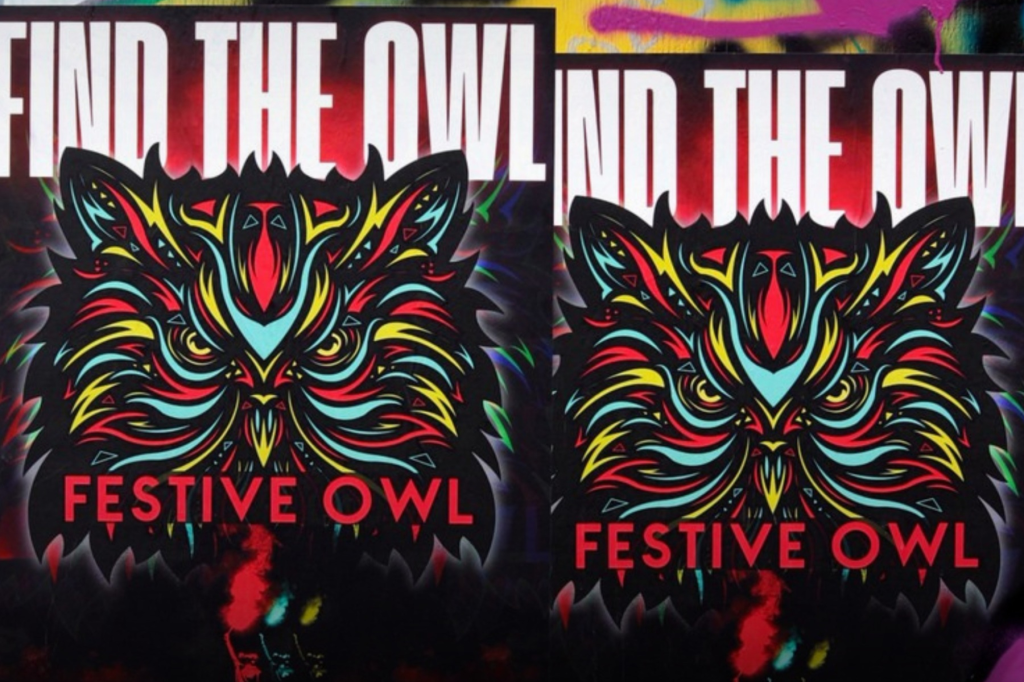
He himself works on the solving/enhancing front through his own Find the Owl program, which he’s done in partnership with festivals like Bonnaroo and Atlanta’s Shaky Knees. It works by him announcing which fest he’s going to be at, then placing toy owls around the site. (He personally decorates and hides each one.) When an attendee finds an owl, they get prizes, such as VIP upgrades.
Whoever he actually is, the Owl clearly believes that music festivals have tremendous power to enhance and evolve people’s lives through music, friendship and adventure, and that there’s responsibility in that. Near the end of our interview, I ask him if there’s anything else he’d like to say; he says he’s prepared a statement.
“For promoters and marketers and the people throwing these events, I think one of the things that’s important for people to understand, and especially people who are taking the money that people spend on their events — there are people out there who’ve traveled two or 10 or 20 hours to be part of these experiences. They’ve picked up double shifts. They’ve saved for months. They poured their blood, sweat and tears into making it happen. They’re camping in the heat, eating peanut butter sandwiches to afford a ticket… I think as an event organizer, you owe them something. They’ve shown up for you. You owe them transparency and a purposeful experience. Ultimately that’s what it’s all about and what The Festive Owl is built on. It’s about providing more value to the people consuming news and content and experiences than you’ll ever get in return.”
This summer, Owl will pursue this mission at festivals including Bonnaroo, Electric Forest Alaska’s Sacred Acre. And as his channel grows, so does his authority. Last June, he was invited to speak on a panel at NIVA, the National Independent Venue Association, about festivals and independent venues. (He joined the conversation virtually, using a voice changer.) “That was really special moment to me,” he says, “to be invited to participate in that.”
But despite all the eyes on Festive Owl, the guy who runs it is perfectly happy staying incognito.
“I like being out there hot and sweaty in the fray and having fun with everybody. I’ve never had any interest in tying my identity to the channel in a way where somebody’s going to stop me on my way to the porta-potty.”
T


Leave a comment