

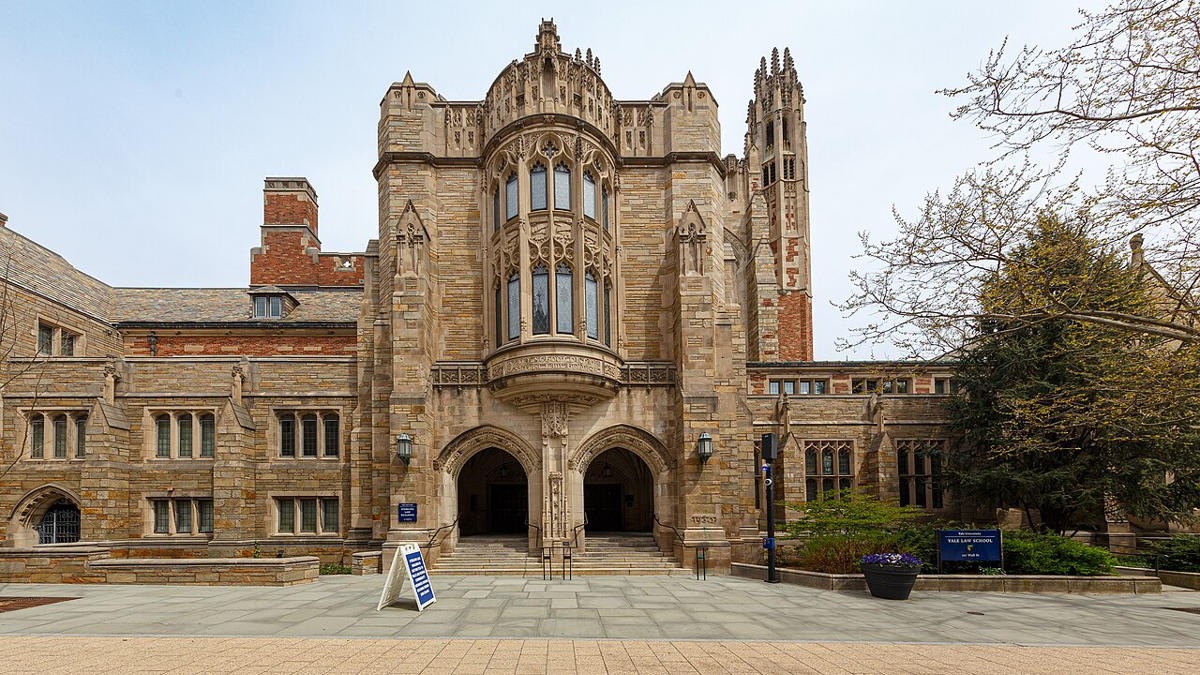

Photo Credit: Sterling Law Building, Yale University by Kenneth C. Zirkel / CC by 4.0
Law scholars have filed two amicus briefs siding with UMG following Drake’s appeal in his defamation lawsuit over Kendrick Lamar’s “Not Like Us.”
On Friday (April 3), two amicus briefs filed in the United States Court of Appeals for the Second Circuit voice support for Universal Music Group (UMG), following Drake’s appeal in his defamation lawsuit over Kendrick Lamar’s “Not Like Us.”
Law scholars from institutions across the country filed both and support the dismissal of Drake’s lawsuit. They urged the appeals court to affirm the judge’s ruling that the diss track does not constitute “actionable defamation.”
The first brief was submitted by the Floyd Abrams Institute for Freedom of Expression at Yale Law School, and Professor Lyrissa Lidsky, who is described as one of the country’s leading defamation scholars. Lidsky also holds the Raymond & Miriam Ehrlich Chair in U.S. Constitutional Law at the University of Florida’s Levin College of Law.
This brief makes an observation that wasn’t a central argument in the case previously, but that turns Drake’s allegations on their heads: Drake actually consented to the statements that he claims are defamatory.
His “Taylor Made Freestyle” includes lyrics encouraging Kendrick to continue their rap battle, and “specifically encouraged Lamar to ‘talk about him [Drake] likin’ young girls.’” Kendrick Lamar’s “Not Like Us” came out only days later, containing the lyrics that Drake now objects to, which call him a “certified pedophile.”
“By urging Lamar to respond in a diss track and specifically inviting Lamar to put allegedly defamatory lyrics in that diss track, Drake cannot now escape the applicability of a consent defense by suing the record company that published that track and challenging a scale-of-dissemination he had every reason to anticipate,” the brief reads.
The second amicus brief was submitted on behalf of a group of social scientists and legal scholars from institutions including Howard University, the University of Richmond, Virginia Polytechnic Institute, and Tulane University, among others. They were represented by Jack I. Lerner of the UCI Intellectual Property, Arts, and Technology Clinic at the University of California, Irvine School of Law.
This brief argues that rap lyrics, and particularly those in diss tracks, should not be treated as factual statements. The filing includes an account of the history and cultural context of rap music, and describes diss tracks as an “emblematic and long-standing feature of the history” of the genre.
Further, they are “understood by audiences not to represent factual assertions about the opposing artist, but rather to demonstrate skill and dominance meant to build allegiance and win competitions through clever wordplay, hyperbole, bluster, and demonstrations of disrespect.”
Treating rap lyrics as factual statements, the brief argues, threatens First Amendment rights and risks introducing racial bias in judicial proceedings. The scholars cite three decades of research on the matter, including studies that have shown that violent lyrics labeled as “rap” are typically “interpreted as more literal and more threatening than identical lyrics represented by a different genre.”
The brief also notes that Drake previously endorsed a “Protect Black Art” campaign that criticized the use of rap lyrics as evidence in court. “Though Drake has previously acknowledged this danger publicly, he now paradoxically and problematically embraces it,” the filing reads.
Both amici urge the appeals court to establish a presumption that “artistic expression is not a factual admission.”
Drake filed his defamation lawsuit against UMG in January last year, and it was dismissed by Judge Jeannette Vargas in October. This past January, Drake appealed the ruling, and UMG filed a response brief last month.






Leave a comment