
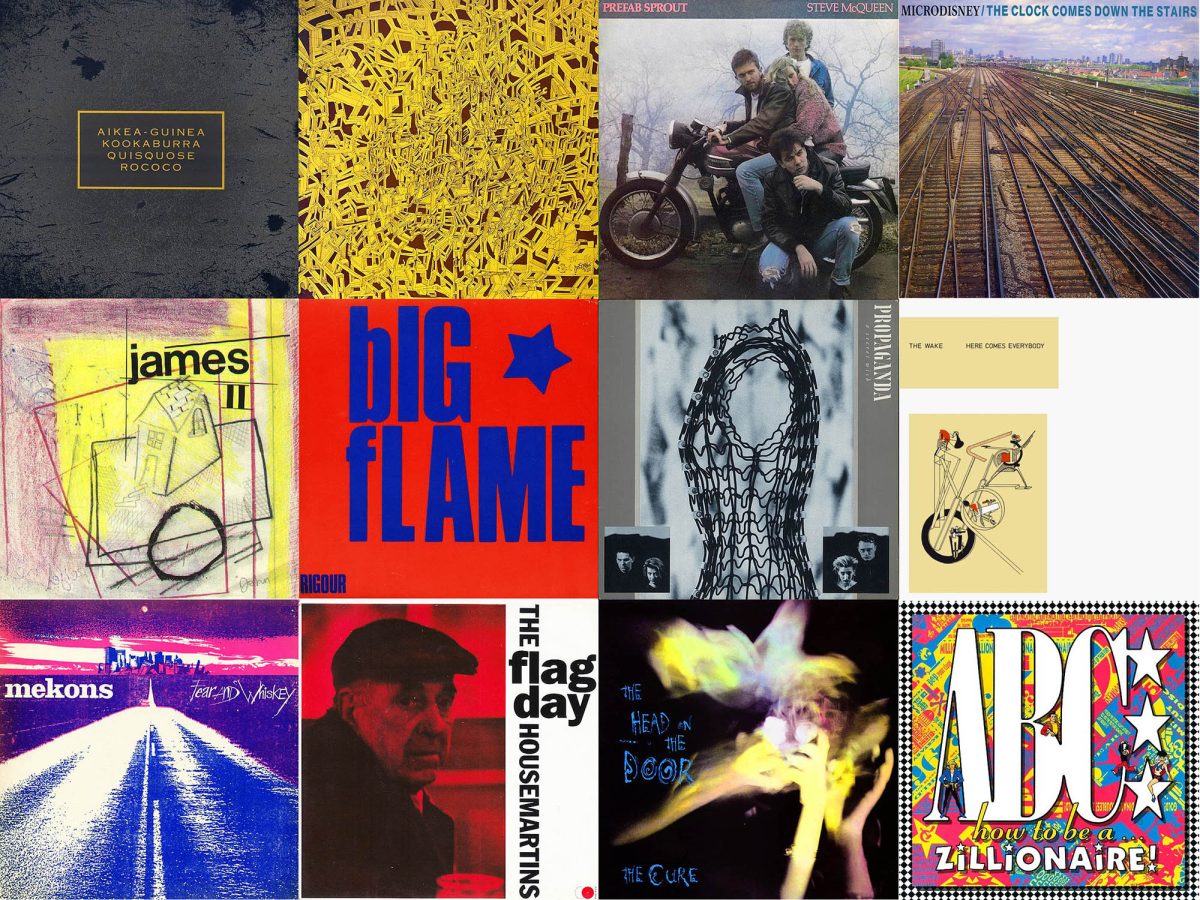
Martin Gray revisits a few other of his own personal best albums and singles released in the year 1985 to bring the curtain down on the 40th anniversary round ups.

(in March 2026 Louder Than War are putting on our first festival in 2026 – with Sea Power, Pale Blue Eyes, Benefits, Evil Blizzard and more and you must come! tickets and details here)
1985 is often regarded by some music critics as ‘the year that music died’ – in that a lot of the pop aristocracy dominated the charts and record sales with their bland offerings that sold by the truckload thanks to the twin effects of MTV and, of course, the overwrought extravaganza that was Live Aid (not my cup of tea to be perfectly honest – I found it a total yawn, even if the original cause was a noble one).
Whilst there may be some truth in this – as far as the commercial hit parade was concerned – it was a different story on the fringes where the independent scene was starting to go from strength to strength.
The irony is that, whilst all those huge commercial / major label acts were churning out stultifyingly pedestrian albums (one of the worst offenders being Simple Minds with their pompously bloated stadium-filling set Once Upon A Time), there were great numbers of really strong albums released in 1985 by countless other bands, with some genuinely impressive debuts among them.
It wasn’t just albums either – for 1985 also saw some exceptionally brilliant singles by a lot of bands that were either on the independent labels or just operating left of the mainstream (some on major labels but just not afforded the big promotional push that would have given them higher sales and recognition).
Before the 40th anniversary of 1985 comes to an end, I thought it would be a good opportunity to touch on a few of those other artists who came up with some of my personal best records of that year. They’re reviewed in roughly chronological order according to the time of release.
JAMES : James II (aka Hymn From A Village) (single originally released February 1985 on Factory)
James were hailed as the heirs to The Smiths’ throne when they first emerged in 1983 as support band to Moz and co., and they have since outlasted their contemporaries’ mere five years of commercial success to continue recording and releasing records more than 40 years later.
Their second single for Factory Records, however, was an absolute gem – the A-side Hymn From A Village was a restless, cowbell driven jangle pop nugget possessed with all the whirling dervish energy that Tim Booth at the time so brazenly displayed at their live performances where he would render the audience dizzy just watching him flailing and pirouetting around the stage in that madcap staccato dance of his – making out like a totally unhinged flowerpot puppet trying to break free from his strings. The flip-side If Things Were Perfect possessed a curiously endearing Trumpton / Camberwick Green-esque charm in its intro and the whimsical wide-eyed words of Booth at the initial outset before the tempo picks up and so does the intensity and then….the track climaxes with a repeated demand of “When I cry stop stop stop stop stop stop stop……STOP!!” At which point it does. Indeed, things were pretty much perfect with this single.
COCTEAU TWINS : Aikea-Guinea (single originally released March 1985 on 4AD)
1984’s Treasure was a high water mark and one of the most exquisitely spellbinding albums of that year. Where would the Cocteau Twins go from there I wondered? They partly eclipsed that achievement, that’s where! 1985’s Aikea-Guinea is truly immense – the title track of this stand-alone EP surpassed even my own expectations. Truly skyscraping in every way, I am sure that almost every superlative adjective that has been brandished about by journalists and music fans alike (like me) will fail to do this song justice.
All I can resort to in this instance when words fail me – as they occasionally do – is to appropriate and paraphrase a truly cliched ad slogan that everybody already knows from aeons ago – in this case for Heineken Beer. Aikea-Guinea stimulates the synapses that other songs cannot reach. There. I said it. And then you still have the entrancing Kookaburra and Quisquose to deal with. Plus the final rousing sign off that is the stupendously boisterous Rococo. If this last instrumental sees the perceived image of Robin Guthrie as a tantalising dreamweaving alchemist transformed into that of a grinning chainsaw-wielding devil stampeding his way into your cranium on cloven hooves, then I can safely say that his mission to stun you senseless with one final twist has paid off handsomely.
MEKONS : Fear And Whiskey (album originally released June 1985 on Sin Record Company)
Mekons were mainstays of the John Peel music scene of the late 70s and I was aware of them but never really paid much attention as their rudimentary early records sounded pretty much like any other post-punk act of that era. What did it for me was hearing their later mid-1980s output as regularly featured on the Andy Kershaw radio show. Being a self confessed huge fan of the Mekons, Kershaw would often playlist their records and album tracks, and this was where I came in for Fear And Whiskey – their inaugural release for their own SIN imprint and the first to showcase a completely different sound from the messy post-punk of yore.
Given the long gap between their second album and this one (around five years), they’d shed members and reconfigured their line up – with Jon Langford moving off drums to guitar and vocals – and discovered Americana, thus this informed their shift into a more alt-country direction whilst still retaining the elements and attitudes of urban punks particularly in the resolutely socialist and anti-authoritarian lyrics.
Their 1985 offering Fear And Whiskey is blessed with some great rousing songs – e.g. the anthemic (no other word) Hard To Be Human Again with Tom Greenhalgh and Langford’s truly stirring vocals belting out the words, but what grabs me the most about it is how seemingly carefree and spontaneous most of these irresistible punk-folk-country jams come across sounding like – there is a real communal spirit heard in the singalong choruses and passionate delivery. It was effectively my introduction to the Mekons universe – and forty years later, I am still equally in rapt to whatever new record they put out, defying the ravages of time.
Opener Chivalry sounds like it could be a familiar song from somewhere else until the moment when Greenhalgh narrates his tale of drink infused stupor and disorientation. It leads some less enlightened sorts to assume that (part thanks to its title) this is another drinking album – it’s not: the Mekons are not The Pogues! Even at this early stage, Mekons albums are not predictable affairs – they thrive on veering off into tangents that defy expectations and nowhere is this more noticeable than on the disquieting narrative of second track Trouble Down South – set to skittering drum machine, violin and accordion with operatic wailing vocals recalling a bizarre spaghetti western scenario, albeit with twanging guitars distinctly absent. THAT is how strange and unconventional this track is.
Darkness And Doubt pre-empts much of the Cajun-influenced material the band would later explore to great effect on later albums (notably 1988’s masterpiece So Good It Hurts), Psycho Cupid is another narrative (from guest Shelagh Quinn) set to a curious backing featuring tinny drums, bar room piano and squawking freeform jazz sax – all very oblique and decidedly left field. Elsewhere, the Mekons maintain the tempo and quality for the final third of the album: the impassioned waltz of Abernant 1984/5, the gorgeous immediacy of the violin-driven Last Dance, surely one of their best pop songs and one which they still happily play live to this day.
Finishing with a sweetly reverent cover of a Hank Williams song Lost Highway is of course an inspired nod to a kindred spirit, but the most pleasing thing about Mekons is that they always deliver the goods. The following year in 1986, their next album The Edge Of The World would be the first one where they would be joined by one of the most integral components of the band, Sally Timms, and effectively began a stunning run of albums with a constant (and relatively stable) line up that would take them right through the 1990s, the 2000s, the 2010s and the present. A truly exceptional and special band indeed.
PREFAB SPROUT – Steve McQueen (album originally released June 1985 on Kitchenware)
Ask any younger 30-something person about the band Prefab Sprout and they will probably remember the insidiously nagging – and throwaway – chorus to their most well known hit of 1988: The King Of Rock ‘n’ Roll. That said, there is far more to the band than flaming hot dogs, jumping frogs and Albert’s Cookies [sic – mondegreen alert!]. 1983-1985 was their early period and the era when their entire output was at its most enigmatic. When they emerged in 1983, they sounded like nobody else around – so unique was the songwriting quality of main man Paddy McAloon. Lions In My Own Garden (Exit Someone) came across like a County Durham cousin of the Edinburgh Postcard jangle sound, but was still nevertheless quite distinct and possessed of a character of its own. Most of this is entirely down to the decidedly unorthodox musical phrases, arpeggios and cadences that comprised Paddy’s melodies.
Their 1984 debut album Swoon contained even more of these oblique melodies that set them apart from all other bands around at the time. Taken with the cryptic and often erudite lyricism of McAloon, this was a kind of cerebral indie pop that had never been heard before, or since. Second album Steve McQueen then, arriving in the summer of 1985, was a distillation of that adept musicality and some truly gorgeous ethereal harmonies from Paddy’s muse and partner at the time Wendy Smith, to create the finest left field pop album of the year which was also a big commercial success. That wasn’t something we came across often in 1985, but a success it was. An album stuffed with highlights, killer tunes, and some utterly beatific gossamer moments (Desire As, Bonny, Appetite) as well as some irresistible and impeccable driving pop (Faron Young, When The Angels, Moving The River). It was hard to fault.
Paddy then hit upon the idea of releasing another album in swift succession as a companion piece to this slick Thomas Dolby-produced set that was delivered here. This album would be titled Protest Songs and be recorded swiftly, stripped of any studio gloss and sound more raw, natural and spontaneous. It was every bit as brilliant as Steve McQueen (The World Awake is a killer opener, Life Of Surprises is as big a hit as it should have been, Dublin is just gorgeously pure and stripped down) but, for some strange reason, only surfaced four years later in 1989 – by which time their commercial star had been in the ascendant thanks to their 1988 breakthrough album From Langley Park To Memphis and THAT hit single.
PROPAGANDA : A Secret Wish (album originally released July 1985 on ZTT)
Dusseldorf’s Propaganda came blasting out of the traps the year before – 1984 – with their stunning debut single (The Nine Lives Of) Dr Mabuse. Seen as one of the holy trinity of the first generation of ZTT bands (along with Frankie Goes To Hollywood and The Art Of Noise), it was another of those huge widescreen epics that the label (a vehicle for Paul Morley, Jill Sinclair and producer Trevor Horn) specialised in. Produced by Stephen Lipson under Trevor Horn’s direction, this 1985 debut was – in my view – the best of the three. It is simply colossal – every single track sounds gigantic and almost Wagnerian – with a massive production filled with soaring synths, crashing percussion, impassioned often Stentorian vocals and a real stirring sense of drama and grandiosity. Whereas big 80s production values can often render an album overwrought and even dated and of its time, in the case of A Secret Wish it actually works in its favour.
Vast cinematic opening tracks like Dream Within A Dream (its lyrics quoting Edgar Allen Poe) for example, may clock up 8 minutes of atmospheric spaghetti western splendour – with trumpets! – but it never sounds remotely contrived. The twin black/white attack of Jewel/Duel (the former harsh and aggressive, like tectonic – Teutonic! – plates colliding, the latter more composed and sedate by contrast) make for a perfect schizoid face-off right in the middle of the album. The purposeful gallop of P:Machinery possesses a synth/fanfare refrain that can shift mountains; whilst their take on Josef K’s Sorry For Laughing adds industrial menace and sturm and drang to proceedings. Strength To Dream is just beautiful in its overdriven melancholic arrangement and then the monumental Dr. Mabuse (First Life) just throws every kitchen sink into the room and dares to be as persuasive as it can get: ‘sell him your soul! / never look back!’.
Truer words not chanted anywhere else when you consider that Propaganda – in this particular incarnation of Ralf Dörper, Michael Mertens, Claudia Brücken and Susanne Freytag – are often regarded as a Satanic German version of Abba. That is a compliment by the way – even allowing for the fact that there have been endless remixes, outtakes and demos of the tracks on here released over the decades in a bewildering variety of permutations (recently it was issued as a truly exhaustive super deluxe multi-disc version) the original album* is a total masterpiece even 40 years on.
*Interesting side note: the original CD version of this album differed from the vinyl as some tracks were in alternate mixes and lengths and even in sequencing. Propaganda were pioneers in this respect when the CD format was just in its infancy.
bIG *fLAME – Rigour (single originally released mid 1985 on Ron Johnson)
Perhaps the single biggest eye and ear opener was when I first heard these Manchester-based anti-establishment, anarcho-cubist-punk renegades on the John Peel evening show. The first hearing of lead track Debra (from this three-track 7″ – their second release and their first for feted Nottingham indie label Ron Johnson) was like being electrocuted by my own speakers. I could almost see the sparks flying out of my transistor when the manically speedy, demented rush of those trebly garage funk guitars screamed from the airwaves. Man Of Few Syllables and Sargasso were even more exhilarating: the latter sounds like a furiously irate Orange Juice tearing along at 800 mph with several firework rockets strapped to the backsides, all detonating at once!
I couldn’t stop laughing in delirious glee at how mental and superhuman this cataclysmic car crash racket was! I still giggle like a loon listening to this record now and how fucking awesomely out there it is. It’s a glorious melange of clashing, self-asphyxiating rhythms that sound perpetually on the verge of collapse but somehow manage to hold themselves together. I marvel at how just one guitar, one bass and one drum kit could create such an audaciously complex noise at such frenetic tempos, yet still be in perfect syncopation with one another. Pure ragged discipline created from what sounds like total utter chaos: this band are smart! This was what things were like during the second half of 1985 and I don’t think I have recovered since (although I did give up alcohol for good in late 1987 so at least I redeemed myself there).
bIG *fLAME were an absolute revelation to me. I fell in love with this manic threesome shortly thereafter and bought all their records – and also caught them live for the first and only time, by 1986, when I was at my most infatuated with their glorious adrenalised rush. They had already announced they were going to split and call it a day after only just three years and five releases: they would play a final farewell gig at Manchester Boardwalk in October that year, so I travelled all the way down from my then home in Newcastle by coach and caught them in action – stopping and crashing overnight at the singer Alan’s gaff, along with about 30 other fans and music writers who all came along to capture this epochal moment – oh my god what happy times they were!
Burning fiercely and brightly for just such a short time (the band’s philosophy: leave them wanting more, fuck boring old muso-dom!) ensured this trio would forever pass into the annals of legendary status. Just one of many bands lumped in with that whole NME C86 / DIY fanzine scene of the time, it opened my eyes to so much more besides, and by that point my passion for ever more crazy sounds just started to become insatiable from there. And a lot of that I owe decisively to these three lovable gobshites from Manc-Ireland and Doncaster. Were it not for the constraints of space and my own judicious editing, I would happily lavish a few more paragraphs on this seminal band (and their respective post-split endeavours) and why they mattered so much to some of us.
Consider this for a moment: if bIG *fLAME did not exist, there would probably be no Manic Street Preachers, who, as teens, formed the band in 1986 shortly after their heroes split.
THE CURE – The Head On The Door (album originally released late August 1985 on Fiction)
The Cure were of course master architects of their own destiny. Their story has been told a trillion times by everybody and anybody. But in the 1980s, even 1985, they were still pretty much a cult band, domestically successful in UK and Europe, but yet to conquer the US and make huge strides there. In fact, of their contemporaries at that juncture, Depeche Mode were the first to break huge over there, as they would in 1988 when they sold out the Pasadena Rose Bowl and from that point their career went stratospheric. The Cure, on the other hand, took a little longer…. it was the turn of the 1990s when they finally did pretty much the same.
1985 was a transitional period as The Cure were going through their twisted eclectic pop phase. The Top – 1984’s predecessor to this album – was full of psychedelic druggy weirdness and off-kilter tunes – a deliberate antidote to the suffocating and destructive nihilism of the gloomtastic epic Pornography (1982) that almost destroyed the band. But everything would finally coalesce in perfect synchronicity for this album – their first that featured new drummer Boris Williams and a return of errant bassist Simon Gallup. Prefaced by one of their greatest ever pop singles – the audacious New Order-cribbing In Between Days, the album was all killer no filler – 10 brilliant diverse pop tunes of love, heartbreak, doom, angst and all points between served up in consummate fashion.
Impossible to choose one highlight from these other songs – The Blood (furious flamenco stomp), Kyoto Song (more eastern themes), Push (pure power pop blast), The Baby Screams (classic Cure angst), Six Different Ways (louche piano hi-jinks), A Night Like This (majestically moody love song – with sax solo!), Screw (weird scuzzy funk stomper), Close To Me (xylophone/handclap-driven kookiness), Sinking (glorious melancholy album closer). All wildly different from one another, all effortlessly brilliant.
With such a diverse array of styles on this assuredly accessible album, could The Cure be said to be having an identity crisis? Well, contrary to what Robert Smith may think, each time he is press ganged into declaring his favourite albums, he would always cite his latest album as his best ever. So the answer is defiantly no : their collective identity was clear for all to see. But when The Cure were THIS hairy – and just look at the photographs of the band – hairspray central that would even give the early pictures of The Alarm (RIP Mike Peters) palpitations, it was offset by what is arguably their most fun-loving and approachable phase of them all, as every song and B-side from this era was top dollar stuff.
No one will ever forget the video for Close To Me (the band inside a wardrobe which topples off Beachy Head cliff into the sea – with them trapped inside it) – blame Tim Pope for this one – just like no one will ever forget the sheer immediacy of all of the tunes on this, the most concise and definitive POP album The Cure have ever released, and in this aspect alone, one which they have never equalled or surpassed (1987’s double album Kiss Me Kiss Me Kiss Me was twice the length and even more audaciously eclectic but did contain at least four or five fillers by comparison). It’s a true one off and, at just 38 minutes, leaves you wanting more. So you simply play it all over again!
MICRODISNEY – The Clock Comes Down The Stairs (album originally released October 1985 on Rough Trade)
Hailing from Cork, Microdisney were a defiant conundrum and paradox of sorts. The original band were founded in Cork around 1980 by a pair of songwriters, the late great Cathal Coughlan, Irish wordsmith extraordinaire, and Luton-born guitarist Sean O’Hagan, who took care of the music arrangements, and various other musicians from the area which also featured future members of much loved indie oddballs Stump, Mick Lynch and Rob McKahey. Members came and went before the band relocated to London in 1983 and assembled what would be their definitive line up for the next few years before their dissolution in 1988.
They were a spiky proposition who cloaked their radio-friendly and deceptively mellow and easy-on-the-ear tunes with some of the most barbed and sardonic lyrics imaginable. Such a winning combination was of course to condemn them to decidedly mixed fortunes for the near entirety of their career, as record companies didn’t really know what to make of them, try as they might have done to market them as a genuine chart contender.
For this second studio album (third counting an interim compilation), released on Rough Trade in autumn 1985, they delivered arguably their masterpiece – which combined the spit and bile of Coughlan’s astutely-observed worldview with O’Hagan’s polished melodic prowess. Produced by Jamie Laine, the album was a bold stride towards a more streamlined sound and indeed featured a killer pop single Birthday Girl which was an indie hit and a John Peel favourite, as well as several other tracks which are in some ways the equal (outstanding opener Horse Overboard curiously has an intro that subconsciously recalls Todd Rundgren’s Zen Archer from his 1973 opus A Wizard, A True Star).
Genius – another aptly titled highlight – juxtaposes some genuinely attractive melodies with Coughlan’s snarky asides and an outro where he hilariously intones at the fade: ‘I’m God! And I bring you…Picnic! Picnic! Picnic!’ completely out of context to the rest of the song. This would of course foreshadow his even more twisted sadistic sense of humour in the years to come.
There is little need to touch upon the rest of the songs, they are all top quality tunes…..suffice to say, this is a great album but the band would leave Rough Trade and sign to Virgin for their next (final) two albums and score one hit in the process (the gorgeous uptempo ballad Town To Town – a number 55 UK hit). Eventually the factions would split and both songwriters would pursue wildly divergent paths as The Fatima Mansions (Coughlan) and High Llamas (O’Hagan). Microdisney did regroup for a series of well received shows in Ireland and London to mark the 35th anniversary of this album in 2018, when they were also presented with the IMRO / NCH Trailblazer Award (Irish Music Rights Organisation / National Concert Hall) to celebrate seminal albums by iconic Irish musicians – an accolade that is of course well deserved.
THE DEEP FREEZE MICE – Hang On Constance, Let Me Hear The News (album originally released late 1985 on Cordelia Records)
Leicester’s best-kept psych-weird-pop secret The Deep Freeze Mice are a true anomaly – they’re one of the strangest bands you might ever come across. Known only to those who are aware of their existence, they operated on the very far fringes of what could be loosely termed as post-punk-garage-prog-psych-experimental-indie-pop, but in the ten years of their existence, they released an equal number of intriguingly surreal and lyrically oddball albums that defied all classification and existed purely in their own curious space / time continuum. The mastermind behind all of these is a certain Alan Jenkins, celebrated writer, producer, record label boss (he conceived and still runs indie label Cordelia Records), surrealist, surf music obsessive and creative free spirit.
1985’s Hang On Constance Let Me Hear The News is their sixth album, and followed on from their audaciously sprawling double album of 1984 I Love You Little Bo Bo With Your Delicate Golden Lions – another release that is in keeping with Jenkins’ predilection for extremely long and ridiculously ungainly titles (indeed one of the later Deep Freeze Mice titles – on their final album in 1989 – consisted of an entire paragraph as a song title, but written as a limerick and with everything excepting the first letter in parentheses!). This one was, by contrast, so succinct and to the point that its 17 tracks clock in at just over 30 minutes or so.
This album is as one would expect from the band – eccentrically all over the shop! All the tracks abut into one another so there are no gaps between them. The opening intro number Green Side Up is backwards studio messing about before ploughing into the first instrumental Number Five which dares to crib from the Phantom Of The Opera (the opening descending and ascending motif), but even here there are metre shifts and time signature changes – and a daft phased drum solo 1.32 minutes in! Nevertheless, the first killer track soon arrives with The Disappearance Of The Guard Dog – a fast organ paced ditty where the deadpan drawl of Alan narrates his usual (in his own self-effacing words) ‘meaningless drivel’ amid some backing harmonies to create a curiously infectious pop tune.
This then crashes into The Best Thing In The Entire World, which dispenses with any lyric structure at all and features atop a brisk guitar, bass, drum and organ backing all manner of radio dialogue spliced and cross-panning and duelling with one another before it ends with John Peel stating the title! Listen to it on headphones and feel your head about to explode! Transparent Evil Plays features another disorientating Jenkins monologue (heavy on reverb and different on each channel) alternating with cryptic choruses : ‘here we find the distraction of trivia, like necrophilia, from the horse’s mouth, our dear prime minister’. I mean, seriously – what the fuck is that all about? But before you hear that there’s the small matter of this killer line: ‘And I watched Breakfast TV for an hour / If Selina Scott’s an interviewer then I’m Fidel Castro.’
For such a short album to feature so many gems compressed within its brief running time is nothing less than astonishing. When Alan isn’t on the lead vocal, the band’s organist Sheree Lawrence takes over – as she does on Irresistable [sic] Moral Force, a slower waltz number which then cross-fades into more musical insanity: Ahimperu-hissus – just a bass line and burbling synth topped with more reverb-ed and cut up voices ebbing and flowing in a bizarre almost trance like incantation.
The next pairing of tracks, Is It Safe? and Neuron Music, are as close to cerebral / surreal pop as the band are to get on here – both really great tunes too but the latter has some truly hilarious couplets about Otis Redding and James Brown and their respective relationships with the metaphysical universe. More strange counter-panning between left and right speakers ensue on the next track The Hero May As Well Be Jerry where both Alan and Sheree share lead vocals – but singing completely different verses simultaneously. This is head-fuck music more like! But it gets still more delirious and enjoyable so you have been warned. Cross-fading into the cacophonous commotion of guitars, cut-up tumbling drums and organ, making out like they are impersonating squabbling birds, the almost onomatopoeic Colony Of Sea Birds is just goofy in the extreme.
An almost straight cover of The Zombies’ What More Can I Do? comes next, followed by Diagonally – another skewed and oddball pop tune with a guitar riff which sounds like it’s written backwards (but isn’t), and features a truly chucklesome pay-off line right at the death: ‘Good news Robert, they made you bishop today, congratulations / but now you can only move diagonally!’. Wilful avant garde experimentation returns with the next pairing of Floccinaucinihilipilification (oh god how I love that word!) and One Of The People In This Room Is An Animal (a sound collage that reprises cross-faded extracts from many of the preceding tracks!) before the album signs off with another brisk pop tune The Unpronounceable Finn. And there you have it….the strangest and most delightfully bonkers record released in 1985 – arguably.
ABC – How To Be A Zillionaire! (album originally released October 1985 on Neutron)
ABC were a surprisingly shape-shifting entity for their first three albums. This makes them more interesting than many of their contemporaries at the time. We all know how luscious and opulent The Lexicon Of Love was when released in 1982 – surpassing nearly all other records released that year when Big Glossy Pop was at its most ubiquitous. They then followed it up with a truly astonishing and mind bogglingly brilliant kick-ass ROCK album Beauty Stab in 1983 (see review of it here).
As if that wasn’t taking enough risks, for their third 1985 album How To Be A Zillionaire!, they hooked up with the likes of Tackhead musicians Skip McDonald on guitar and Keith Le Blanc on drum programming to bring out this equally head turning electropop dance album, whilst at the same time reinventing themselves as cartoon characters in the style of Hanna-Barbera.
Accompanying Martin Fry and Mark White – the only two remaining of the original band – on TV appearances and promotional videos only – were two non-performing members: Fiona Russell Powell aka Eden, a former journalist for The Face, and David Yarritu, a New York photographer and musician also known for having connections with Andy Warhol.
Hearing the beat boxes that kick off wonderful opener Fear Of The World, it’s as far a cry from Poison Arrow and The Look Of Love as one can possibly get. There are other corkers on here – the title track (near enough – How To Be A Millionaire!), the gloriously swoonsome electronic ballads Ocean Blue and Between You And Me, the mental rabble-rousing 15 Storey Halo which sounds like a synth version of Adam Ant, plus stately pop dance tracks Be Near Me, Vanity Kills, Towers Of London, together with the self-name-checking instrumental A To Z where each member gets to introduce themselves. In the case of the latter, god only knows how Eden got away with cooing sweetly ‘I want you to…kiss my snatch! M-wah!’ but she did!
Synthetic and superficial the band image may have appeared with this third album, but that would be to do the quality of the songs a disservice. Ironically, it was this album which gained them more lasting success Stateside (Be Near Me was a huge Billboard top 10 hit) and helped further their profile. By autumn 1987 the chameleonic duo of Fry and White then reunited with David Palmer on drums and released their fourth album Alphabet City – trailed by Motown tribute hit single When Smokey Sings – and a return to the more opulent soul-influenced sounds of Lexicon, thus turning full circle.
THE HOUSEMARTINS : Flag Day (single originally released October 1985 on Go! Discs)
I first heard this song on the John Peel show (of course) in late 1985 as I was sat in my flat lamenting the fact that I would be stranded by the pesky snowfall again that had decided to start up once more during a particularly cold winter snap up in Newcastle where I was living for half of the 1980s. It was a slow burner which started quietly and pensively with the opening lines ‘Too many Florence Nightingales / not enough Robin Hoods’ before later bursting into an impassioned chorus that made my neck hairs stand on end: ‘Well it’s a waste of time if you know what they mean / try shaking a box in front of the queen / cos her purse is fat and bursting at the seams / it’s a waste of time if you know what they mean?’
My initial reaction was ‘wow! what a tune!’. On finding out the name of the band was The Housemartins, I then realised that the recent reviews in Record Mirror and the Melody Maker had a point in saying that this quartet were one to watch. Quickly picking up said single (7 inch only initially as the shop where I purchased it didn’t have the four track 12 inch) I signed up to their mailing list and – effectively – became a new fan. Being on Go! Discs – home of Billy Bragg – was another reason to link up in support. So that was it. Brilliant debut single – one of the finest from any band. Even John Peel had this single featured in his end of year Festive Fifty for 1985. But they were still only the ‘Fourth Best Band In Hull’. I became a huge fan nevertheless and followed them over the next couple of years, purchasing all their records and catching them live every time they played Newcastle throughout 1986 (three times alone!).
How was I to know that The Housemartins would become so big so soon afterwards? That’s just the way some things transpire, I guess. But heck, what a great little band they were. With that undisputed knack of combining stark socialist and anti-Royalist diatribes with harmoniously catchy indie pop tunes that everybody could whistle to, no wonder people fell for their gawky charms.
THE WAKE : Here Comes Everybody (album originally released November 1985 on Factory)
Glasgow’s post-punk contenders The Wake have always been that most unfairly maligned of bands during their 1980s incarnation – just check a lot of the music press reviews and critical dismissals they have endured around that time between 1982-1985 simply because they were on Factory Records and supported New Order and of course took a lot of their sonic cues from the JD/NO textbook – even down to having a female keyboard player (Carolyn Allen) and a drummer (Steven Allen) who were related. The band’s founder Gerard ‘Caesar’ McInulty was once the guitarist for Altered Images and they supported Siouxsie and The Banshees in 1980 before being produced by Steven Severin for their first single Dead Pop Stars (which Caesar helped co-write). Caesar then quit the band as they were on the cusp of huge pop success, to form The Wake, citing influences such as The Fall, Josef K, Joy Division and others as a reason to explore different avenues.
Their first records (1982-1983) owed a huge debt of course to the sound of Joy Division and New Order. Even with bass player Bobby Gillespie in tow (who was with the band for the first 1982 mini-album Harmony and single b-side Give Up before moving on to form Primal Scream and also drum with Jesus and Mary Chain), they still sounded not too far removed from their more celebrated Factory peers. After two more singles (1983’s Something Outside and 1984’s indie hit Talk About The Past – featuring Durutti Column’s Vini Reilly on piano), they issued one further standalone single in 1985, Of The Matter – an wistful synth pop gem which trailed the release of their second, greatest, album Here Comes Everybody at the tail end of 1985 – eight ravishingly glacial, synth-heavy tracks of melancholic dream pop that may still owe a lot to New Order in the sound, but also tipped its hat towards influences such as The Moody Blues, prime era Korgis, and even foretold the arrival of Pet Shop Boys.
It really is a beautiful set of songs. O Pamela is the gorgeous 6 minute opener and is so lovelorn and drenched with longing and sadness that it evokes lonely walks outdoors in the crisp winter sunshine (the upfront synths throughout do their utmost to create such an impression). In fact this aura of sun-kissed wintry ambience pervades the entire album. Other numbers like the ethereal Send Them Away and the poppy World Of Her Own (virtually a companion piece to Of The Matter by virtue of its identical running time 2:54 mins) conjure up the same sort of imagery : rather like bright sun rays abruptly bursting through banks of cloud.
Side one’s lengthy closer Melancholy Man (the title could only fit this album!) is the sort of bittersweet but self-deprecating tale of a downtrodden soul who likes to disappear in the crowd and remain unobtrusive, but then ends with a direct lyrical quote of Don McLean’s Vincent. In fact if the legendary Van Gogh painting Starry Night could also serve as a visual metaphor for any song, it would be with this track.
More crepuscular moods pervade Torn Calendar (featuring a cameo from A Certain Ratio’s Simon Topping on percussion) and the title track which is more Postcard jangle than synth-dominated. All in all this is an unsung masterpiece which was only finally given its long belated due some decades later when it was reissued a number of times in 2002, then 2012, 2015 and 2023 as expanded or special commemorative RSD editions to mark various anniversaries. It’s gratifying to now see that 40 years on from its original release, when most of the critical reception was lukewarm, this album has since been re-discovered and re-appraised and now heralded as a genuinely lost classic of its era. Many 1990s-2000s indie bands now also openly acknowledge this record as an influence – tellingly a lot of the Sarah Records roster such as The Field Mice, The Orchids, Brighter and others. In fact the first two named bands have shared personnel with The Wake either in songwriting collaboration or as live / recording band members.
How fitting then that eventually The Wake would also end up signed to Sarah Records themselves in the late 1980s when their final release for Factory in 1987 (the wonderful and eclectic Something That No One Else Could Bring EP) slipped out and unceremoniously disappeared off the radar. Their last releases came in 2012 on the LTM label, but Here Comes Everybody has now proved itself to withstand the test of time as well as the vagaries of critics and trends. It’s still a magnificent crowning achievement and still sounds ageless.
all words by Martin Gray
further blogs and in depth reviews by Martin can be found on his profile
A Plea From Louder Than War
Louder Than War is run by a small but dedicated independent team, and we rely on the small amount of money we generate to keep the site running smoothly. Any money we do get is not lining the pockets of oligarchs or mad-cap billionaires dictating what our journalists are allowed to think and write, or hungry shareholders. We know times are tough, and we want to continue bringing you news on the most interesting releases, the latest gigs and anything else that tickles our fancy. We are not driven by profit, just pure enthusiasm for a scene that each and every one of us is passionate about.
To us, music and culture are eveything, without them, our very souls shrivel and die. We do not charge artists for the exposure we give them and to many, what we do is absolutely vital. Subscribing to one of our paid tiers takes just a minute, and each sign-up makes a huge impact, helping to keep the flame of independent music burning! Please click the button below to help.
John Robb – Editor in Chief
PLEASE SUBSCRIBE TO LTW


Leave a comment