
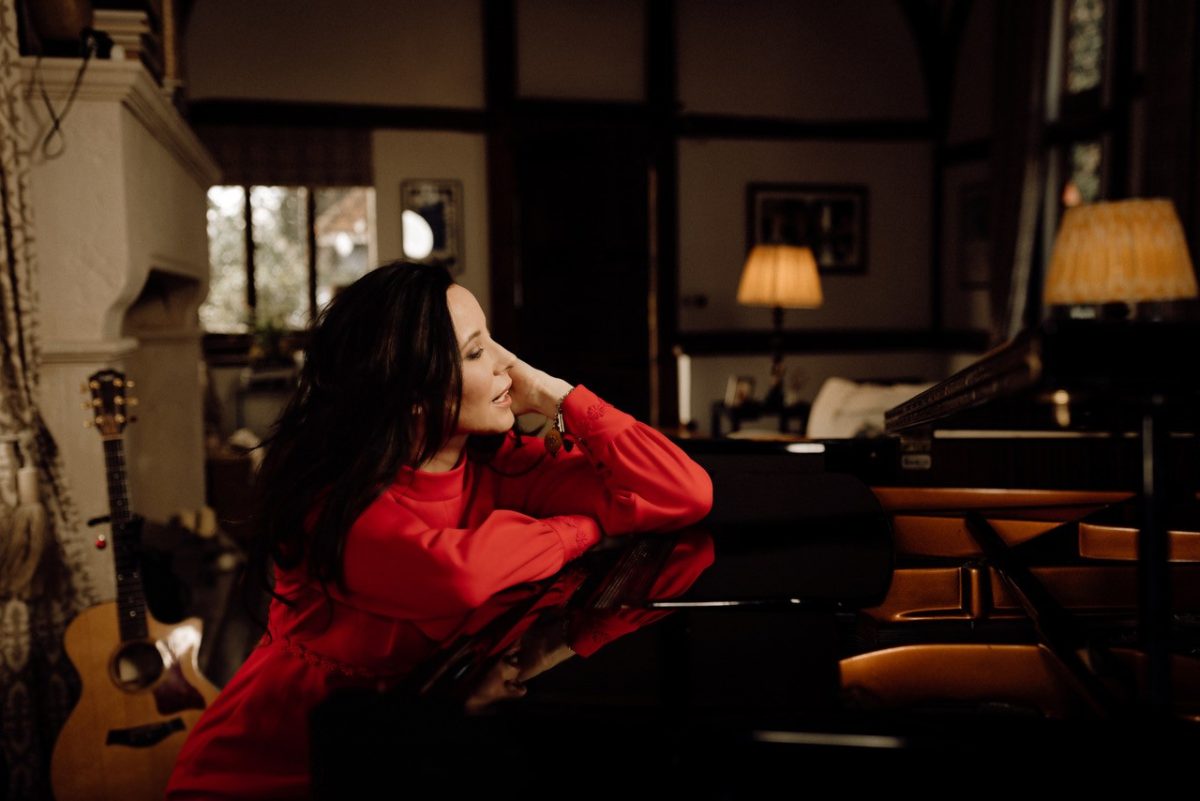

On the eve of a best of collection, Fire Escape Symphonies, Nerina Pallot refelcts on a career that has survived being dropped by a major label, brought her hit singles and developed a fervent following for a quarter of a century. She offers Tim Cooper her thoughts on the music industry, the state of the world today, why music has lost the power to bring social change, and her favourite books. She plays the Royal Albert Hall in London on Monday 31 May – tickets here.
For 25 years Nerina Pallot has hovered just outside the mainstream, making melodic, intelligent, relatable music for a discerning audience who appreciate her ear for a good tune and eye for a poetic lyric. She’s often described as a cult artist but she’s written songs for Kylie Minogue and Diana Vickers, and enjoyed a handful of hits herself, including the Top 20 success of the never-more-timely Everybody’s Gone To War.
Now she celebrates a quarter of a century since the release of her ironically titled debut Dear Frustrated Superstar with Fire Escape Symphonies: a best-of compilation that spans her career to date. And, while Louder Than War has championed her from the start, after listening you might be minded to answer: Why is she not a bigger star?
The answer, my friends, is probably explained by the very diversity of her talent: her ability to dip her toe into different genres rather than to find something that sells and then flog it to death. She’s led not by commercial imperatives but by her own muse, content to explore her artistic creativity to the full. And she’s done it largely by eschewing major labels inflicting their ideas upon her craft and instead connecting directly with her fans.
The collection charts Nerina’s entire career trajectory, from having big dreams but little hope of fulfilling them with Patience from her debut album, to scoring her first big crossover hit with the Everybody’s Gone To War in 2006. She has continued to reach new audiences deep into her career with her take on Joy Division’s Love Will Tear Us Apart – a huge streaming hit after its airing in hit TV show Normal People – and Circus from the Amazon Prime series Modern Love.
Along the way, Nerina revisits all manner of other songs with deep significance. Idaho is a live staple which she later named her own label after, Sophia earned her an Ivor Novello songwriting nomination, and she’s included her own personal favourites This Heart is A Lonely Hunter and Regrets, while newer songs like Madison and (ironically) Only The Old Songs highlight her continued growth as a songwriter. The collection comes to a show-stopping close with a lavishly orchestrated new song called Come Bring The Sun that was written during the pandemic – a call to arms for hope in a messed-up world, showcasing her firm belief that “miraculous things can and do happen.”
To mark the release of the album, which features Nerina’s own artwork and sleeve notes, and her biggest headline show to date at the Royal Albert Hall on Monday 31 May, Tim Cooper caught up with Nerina to ask how she’s done it.

How did you decide which songs to choose for the new ‘best of’ compilation, and what considerations had to be made regarding the sequencing on the album?
I left it up to fans really, we asked them to suggest the songs that were most important to them and picked the most popular ones.
One striking aspect of your career is how you have taken such strong control of most aspects yourself; was that always your plan?
Creative control has always always been incredibly important to me, but sometimes to my detriment. I turned down opportunities to work with some of the biggest names out there because I didn’t want to co-write or collaborate and I think that was combination of fear and stubbornness, and also, weirdly, being quite shy about being in a room with someone else I might not know well when I’m at my most vulnerable – which is songwriting.
To what extent was it a reaction to your early experience with Polydor giving you a big initial push but then dropping you, which must have been dispiriting for a young artist starting out?
Nothing went wrong that doesn’t happen all the time – I made a record, it wasn’t commercially successful, they cut their losses. At the time it was pretty painful but a good thing in the long run. It made me realise I wasn’t in it for the money or fame but because I absolutely had to write songs and release records as that was the most important thing to me.
Was there a positive side to being dropped by a major label? Did that experience shape the direction of your career since then, and when you reflect now, do you feel you gained some benefit from it, however devastating it was at the time?
The positive side is how you have to bounce back from the negative bit – it teaches you to believe in yourself when nobody else will and also to be resourceful and resilient – and those qualities are vital if you’re going to make a success of being an independent artist and label owner.
Obviously the economic landscape of the music world today (and the music biz) has radically changed since you started out – and not for the better. Do you have any thoughts on how the pendulum could swing back towards the artists?
I think it’s already happening. I see more and more artists moving away from the streaming sites and either not bothering with streaming at all, or hosting streaming on their own sites and really making beautiful physical items like vinyl and CDs so fans can have something meaningful that is more than just the music.
Today’s audiences – at least the ones who truly value music and the creators – are phenomenal at supporting their faves. Things like bandcamp and Patreon are testament to that. There will always be a dichotomy between the huge commercial folk like Sheeran and Swift and niche indie artists, and I’d be lying if I said it wasn’t harder than ever to make it work when you aren’t a household name. But the relationship between artist and true audience has never been more meaningful.
And honestly? I think a lot of artists who got lucky commercially with not particularly good music and who also took their fans for granted would get their arses handed to them on a plate today. Also, while music is incredibly important to me, it’s not on a par with being able to perform neurosurgery or control a class of 30 rowdy teenagers for long enough to teach them something that will be valuable their whole life through. So you know, musicians started out as troubadours. It’s what it is. And if you don’t understand that from the outset then you have no business getting into it. It was never going to be easy but it’s not an insanely difficult job like being a paramedic or an undertaker.
You recently launched the new app CHMBR, which provides a platform for artists to reach fans directly given the declining organic reach provided by social media. What advice would you give a young musician starting out today, based on your own experiences (and the aforementioned changing economics); and how has that differed from 20 years ago?
Be as good as you can be. Celebrate every single fan and be incredibly grateful for them. If it becomes more than a side hustle, great. But also, don’t be afraid of ‘selling out’ if economic opportunity comes your way. I came up with a generation of musicians who thought having your music in an ad was selling out. Fuck that. Sell out if it means you can fund an album and a tour and keep going – I had a car ad across Europe one year and that meant I was able to fund a whole new album cycle – recording, live, promotion. It was a Godsend. Just make sure you never ever take your fans for granted and you realise what a privilege it is that a stranger might want to spend their hard earned cash on your music. Also please for the love of God take live performance seriously and don’t half arse it. The world is divided into musicians who can cut it live and the fake ones who can’t. Be the former.
You’ve talked before about the three-album cycle that represents a new artist’s journey: 1. Hello we love you. 2. You’re ok. 3. Please go away now. Does that still hold true?
I think it’s still true even for the biggest artists – fans and the media have boredom thresholds. And we love carving long careers up into eras. It’s why when you look at the longevity of an Elton John or dare I say it, Coldplay, you realise how freakish and unusual they are. They have come back from so many dips in popularity. Same with Fleetwood Mac.
In our streaming age it seems the notion of listening to an entire album, as I certainly did growing up, has become almost a quaint throwback. How has that altered the landscape?
I actually think that’s fine and normal. It would be weird to want to listen to the same thing all the time. I mean, I do miss the sitting down and living with the same album for weeks on end like I did when I was a teenager but honestly that was more to do with economics. I couldn’t afford to buy as many records as I wanted to so had to make do. You’d learn to love an album track that might not have been as good as a single. So maybe we had deeper connections to an artist’s world and that bred a deeper loyalty?
With all of that in mind, how does an artist like you stay connected to their fanbase to ensure they don’t drift away to new artists?
I don’t think it’s a competition. I think we can be loyal to loads of different artists. I don’t listen to one artist instead of another, really, because it’s always a song that draws me to begin with and that’s what I’ll need to hear again. I think you have different levels of fans:
The fans who want to listen to everything you make regardless, they’re just there because they believe in that world. And they’ll not love every album or song but as a whole they love the artist world. They’ll come to every show they can. And then there are fans who pop in from time to time, who might drift for a bit if the latest album doesn’t do it for them but they like you enough to still come and see you live and give the next album a go. And then there are fans who just love one or two things you did and they’re not so fussed about you live but those songs they love, they really love. Doesn’t everybody have that kind of relationship with the artists they like?

Is your blog ( one aspect of keeping in touch by sharing opinions, not just on music but on your life, and current affairs, to ensure your listeners feel they know you, and are more likely to stay loyal?
The Substack is a weird beast. I don’t know what it is. I’ve always, always written – even on my website back in the 00s I had a little essay section. I just write any old thing. I hate newsletters where someone is just selling you stuff. If I’m going to tell someone I’ve got a new record out or a tour I’m sure as hell going to make sure I give them a laugh or pause for thought about something completely different. I love the feedback too – people post back with their own incredible stories and thoughts and over the years I’ve been blown away about how bloody clever and brilliant so many of the people who follow me are. There are scientists, doctors, psychologists, economists – a disproportionately high number of coders in my audience – and I learn new stuff all the time from them. It’s about community. Real community and I bloody love it! It’s brilliant!
Do you filter your thoughts at all in order to protect your career? I noticed your powerful blog post on (and about) Holocaust Day, for example. Is speaking out about politics and social concerns, and sharing them publicly, as important to you as the music you make?
I do filter my thoughts yes but not for any reason other than I really believe in nuance and debate and trying to keep an open mind and not be entrenched in one way of thinking. That’s become even more important to me as I’ve watched the online world get more and more polarised and often just for clicks. I refuse to do hot takes! Hot takes are part of the reason everything is turning to shit.
The weird thing is that I was a political animal as a teenager and into my twenties and so it was entirely natural that I’d have a hit with an anti-war song. But as I’ve got older, I have grown to hate politics and that section of the media. I want to stay clear thinking. And when I write I try to be as honest and clear and as close to truth as I can be. It feels like a moral and civic duty these days.
In the past you’ve been motivated to write songs by anger and sadness at current affairs; how do you feel about events in the country, and the world, today? And do they prompt you to write new songs?
Honestly? I think things are so bad, so fucking terrible, that it has made me despondent enough to think that music will never change the world so what’s the point in trying? Come back to me in 2028 when hopefully the USA sorts its shit out and I might feel differently.
You’re a prolific performer of cover versions. Are your choices representative of your favourite songs/artists? And is it a fun hobby or a marketing aid to reach a wider audience (or both)?
I cut my teeth doing cover gigs three nights a week in a restaurant after my day job ended and I have never not loved singing classic songs. It’s what taught me songwriting. I love singing and playing and because I always pick a song I really love to cover – it’s as joyous as getting to sing my own song. I don’t really see a difference. I mean obviously it’s become a thing now and I’ve got lucky with covers – my Joy Division cover getting used in Normal People for example – but I’d recorded that years before that sync happened.
Last year I made a whole covers album on my own in my studio and it was one of my favourite recording experiences ever. I didn’t have to worry about the quality of the songs so I just had a ball playing everything and taking time over my bass parts or my drum parts etc. It was such a great way to spend a few months.
What current (or old) favourite artists are you listening to these days? Do they change and evolve, and do they influence your own music? Or are you influenced more/equally by life and the world around you?
It’s always changing. There are some non negotiables like Kate Bush and The Beatles for me, and then newer artists like Mac DeMarco and Cate Le Bon that I listen to a lot.
As you’ve an English degree, I’m assuming you’re an avid reader of literature. Do you have any favourite authors/novelists, past or present, and any current recommendations?
I re-read Orwell on an ongoing basis. Not just the novels but his essays – in fact the essays are more important to me these days. The best novel I’ve read recently was Knausgaard’s ‘The School of Night’ and right now I’m reading Lena Dunham’s memoir ‘Famesick’ and I can’t put it down. She’s not just a brilliant screenwriter – her prose is like honey, even when she’s being a big old gossip. I love her, like I loved Nora Ephron.
More of Tim Cooper’s writing at his Louder Than War author’s archive and at Muck Rack and daily music posts at EatsDrinksAndLeaves.com
Follow Nerina Pallot:
Spotify | Apple Music | YouTube | Facebook | X | Instagram | TikTok | Website
A Plea From Louder Than War
Louder Than War is run by a small but dedicated independent team, and we rely on the small amount of money we generate to keep the site running smoothly. Any money we do get is not lining the pockets of oligarchs or mad-cap billionaires dictating what our journalists are allowed to think and write, or hungry shareholders. We know times are tough, and we want to continue bringing you news on the most interesting releases, the latest gigs and anything else that tickles our fancy. We are not driven by profit, just pure enthusiasm for a scene that each and every one of us is passionate about.
To us, music and culture are eveything, without them, our very souls shrivel and die. We do not charge artists for the exposure we give them and to many, what we do is absolutely vital. Subscribing to one of our paid tiers takes just a minute, and each sign-up makes a huge impact, helping to keep the flame of independent music burning! Please click the button below to help.
John Robb – Editor in Chief
PLEASE SUBSCRIBE TO LTW






Leave a comment