

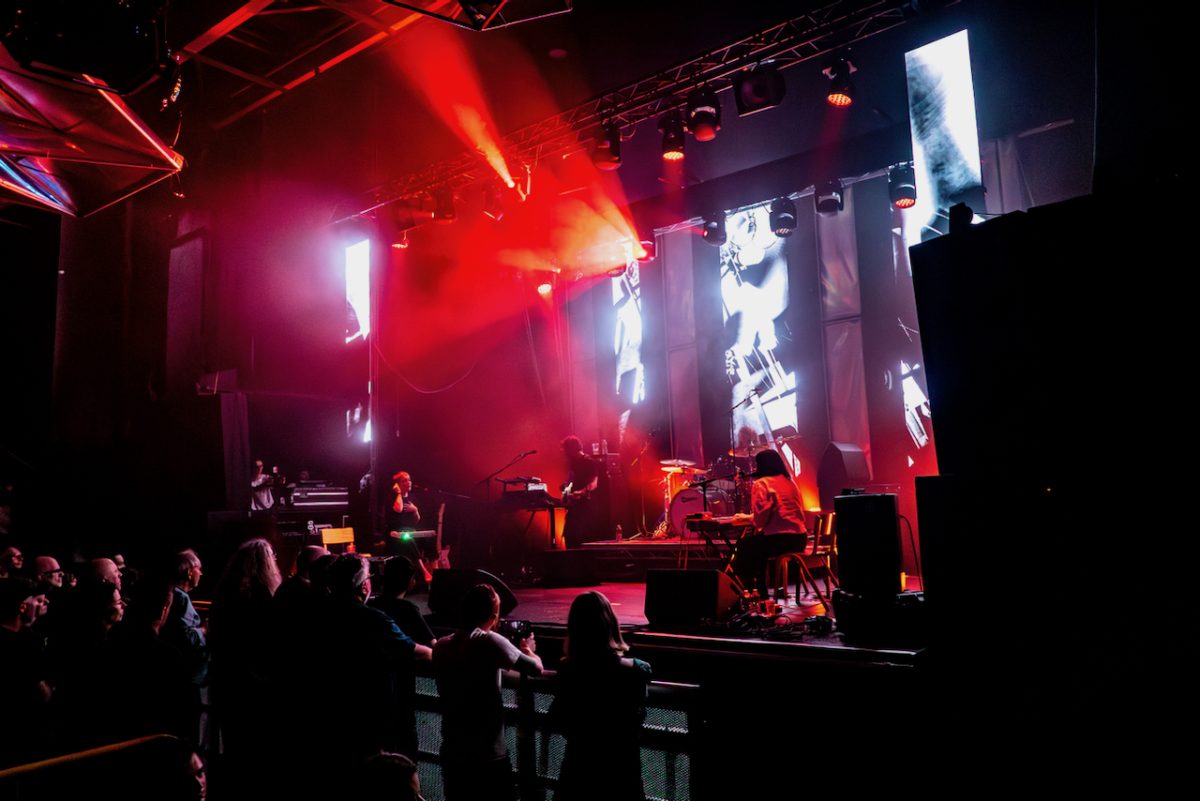

Outer Waves Festival
Liverpool, Invisible Wind Factory and Make
23rd & 24th May 2026
Although the acclaimed headliners, Mohammed Syfkhan and Lankum associates OXN, may suggest an austere and moving opening to Outer Waves, what instead began the festival showed off the even more diverse and absurd areas of experimental music it offered.
Germanager has a perplexing fusion of a mysterious online presence, choppy beats, and catchy electronica. In person, his music and style was befitting of this whimsical approach. Aside from the same section’s aviary field recordings, the most distinctive part of Germanager’s set came when he introduced its ‘salad making’ finale. This mic’d up tossing, box-opening and displaying was accompanied by breakbeat backing, melodic drum ‘n’ bass and jungle beats, then suddenly consumed by sleazy moaning. While his dress of bucket hat, tank top, and shirt matched his confession of not even knowing what was going on himself, the musician’s presentation ability, showing each stage of the unusual salad, and offering comedic bites at each turn, fully represented his declaration that it wasn’t ‘meant to be all TV chef’. Before this, however, he went through – at an even slower, melancholic stroll than the original – an oddly moving rendition of Pale Blue Eyes, accompanied by piano and an eerie melodica.
A little over twenty minutes into the first day, the festival’s curatorial excellence put to the foreground its recurring themes: a rapturous mix of the highbrow, the absurd, and totally original from the UK’s underground greats – and beyond. The phrase ‘what a day’ had already been uttered.
An excellent choice from Outer Waves with a foot more firmly in traditional music, Ultan O’Brien followed, ancient, evocative fiddle playing by melding his discordant and beautifully haunting blend to a sample. Both of O’Brien’s worlds, the primal unaccompanied strings and more modern touches, were just as mesmeric and moving.
Rongorongo were an unknown, however – using their everyman charm, charismatic hysterics, and siphoning of Joy Division’s Closer – they quickly had the Make crowd firmly invested in their wrought-iron, gothic, swinging immersion. While these mildly gothic sequences were a captivating strength, there was so much more in their wheelhouse: whereas Negative Vibes conjured Adam Ant and New Order, the new single sounds like Bauhaus on a newer post-punk road trip. With their wry, wily, wandering frontman full of pure and authentic banter, telling the audience to write down the name of their studio head honcho and lambasting their new single with faux irritation, the Liverpool lads provided live bonuses far beyond the booming quality of their combined instruments. He also had a build-up to the song Negative Vibes Only which was as brilliantly sardonic as the song itself, a dark-humoured, tragi-comic doomer ensconced in subtle guitars and misty layers of Bauhaus. They were also adept at rearing a big noise rock crescendo in the most crucial places, backed by an emphatic air punch from their vocalist, but plaintive power was incrementally gathered elsewhere. While the former was most evident on No Sympathy, with the cow bell hit and melancholic titular lyric, the latter was wondrously impactful on Wonderful Lie.

Playing tracks from his debut album of spectral pop, which landed on The Guardian’s albums of the year, Karl D’Silva’s live presence was captivating in a noir-ish way, the sparse neon lightning accentuating this to align him with personal loves such as Cabaret Voltaire. His live style also enhanced the album’s sound, with an extended intro to On The Outside using finger-tapping like a heavier Robert Fripp, which led to the track’s isolation becoming so much more potent, while his voice was a unique engine of primal emotion which heightened tracks like Wild Kiss. Entropy, on the other hand, was the set’s poppiest moment, but here it felt even more potent and urgent in its evocation of gothic pop landmarks like Bauhaus or Howard Devoto.
One of the through-lines of the assembled artists was their sleight of hand, taking drastic, equally tantalising detours. This was true of the set by Syrian folk artist Mohammed Syfkhan, but also Haress. The experimental folk trio primarily specialised in burgeoning, vaguely eerie, lilting jam-type songs which crept under the skin immediately. Later, however, in what was undoubtedly a first for many, they successfully cajoled the Make crowd into participation, joining the lead vocalist in a classically English folk mantra about skylarks and music. The band’s biggest surprise was their venture into heavy psych folk which conjured thoughts of Smote’s percussive drone majesty. This emerged from a calmer – yet mystical – torrent, fluidly flirting with genre and dynamics, from slow folk to relentless drone.
Keeley Forsyth was one of many minimalist greats to grace the Invisible Wind Factory, the venue’s huge space and subdued lighting providing extra gravitas for the electronic artist, this time accompanied by Matthew Bourne on piano and Polish musician Resina performing cello from her own interpretations of the original recordings of the Hand To Mouth EP. The trio were a macabre form of captivating for the whole show, whether Forsyth was the main contribution with deep and drawn-out vocals, kneeling below the cellist to enjoy the discordant bow strokes, or the striking glacial beauty of all three.
Jarboe was another legend to stun the venue’s swelling crowd into silent reverence. Using expressive yet understated lyrics, non-lyrical vocalisations ranging from gasps to an alien language that resembled the style of Damo Suzuki, as well as harrowing singing, the former Swans member laid out an emotionally stirring variety within her particular minimalist personality. The stripped-back music, simple piano and cavernous vocals, perfectly accompanied illustrative lyrics such as ‘transcendental satisfaction’, ‘breathe in the jealousy…the rage…the hate…’, and words about an open sea. This is without even mentioning Joy Von Spain, who added glassy and operatic vocals to Jarboe’s early spoken word narrative, aligning with harmonies and serene keys elsewhere. In a different way to Jarboe, Mohammed Syfkhan’s performance was also semi-religious. The Syrian-Irish musician’s backstory is as powerful as his non-Western melodies and rhythms; similarly, his music bore all the pain and catharsis of his life, rising in tempo and melody to match it. For Syfkhan, the aforementioned sleight of hand was the trance-inducing, club-type beats that joined his bouzouki melodies surreptitiously. While his folk was easily worth watching for an hour plus, this part of his music elevated the thrill of his playing speed, while also making it so much more vivid, becoming as beautiful and harrowing as his journey over recent years.

The first piece of under-the-radar sound came from the colourful jazz which laced Carmel Smickersgill’s fun atmosphere, the heavily percussion-based backing mingling with her modern classical composition style. Each track was built within her sphere of genre while spanning various sounds, such as afrobeat and folk, referencing her release which reworked Phillip Glass. A story of forgetting her tin whistle provided humour before the surprise of a ridiculously catchy contribution to her funk and world music extravagance, the tin whistle making the buoyant music seem even more like a modern offspring of heavyweight funk mavericks !!! and Liquid Liquid. Her lyrics boosted the Mediterranean euphoria and buoyant rhythms, with a refrain of ‘feel it’ coalescing a sunny mood. Smickersgill’s entrancing set had an equally vivid, repetitious ending, the track mimicking math rock’s addictive grooves while her classical background kept it fascinating and melodic.
Luce Mawdsley, akin to Carmel Smickersgill, inverted jazz and its tropes. From its burgeoning beginning to its gorgeous, technicolour middle, it felt like the genre’s traditional and modern greats combined. It began with patient plucks of guitar leading to a flood of Bitches Brew-esque genius, the two other musicians colliding in discordant harmony on saxophone and drums. The set then saw Still House Plants and Shabaka Hutchings mixed in a complimentary dervish.
The first thing that was witnessed upon getting into space-rock veterans Mugstar’s set was their hirsute guitarist wielding his instrument for sizzling whammy bar excursions, the robust bass a perfect partner, sitting halfway between pure drone and thrumming percussion. The next track inverts their template, the bass becoming the melodic centre and the guitar still hammering away at drone fuelled fuzz while riffing madly. Mugstar became even more percussive with the finale, each instrument usng the J Mascis approach of drumming at a guitar (and bass), hammering a mantric rhythm while putting dynamic dervishes at intervals, scratching the distortion-meted strings and pumping big power chords as the noise rock megaladon comes to a Swedish psych end.
Alongside Jarboe, Elspeth Anne used aquatic metaphors, “ocean princess” balancing the lyrics’ abstraction and realism to the transfixed watchers; another source of sonic depth within the already rich harmonium and vocal power. Her variety of folk tales included a folk travelogue featunig Tipperary and cork city, a guitar-led paean, and a fully acapella song that entranced the audience with its natural majesty.
Lord Spikeheart was a member of acclaimed Nairobi-based noise duo Duma and, while the solo venture had a slight club influence, the bracing harshness was still there – in his vocals and the techno backing’s lo-fi style, and its pummelling volume. While his onstage persona is easy to describe, being as barnstorming as the music, it was also uncertain as to being classifiable as ‘onstage’, as he spent so little time there. Before you could even say his name, the short and scream-heavy performer darted between the crowd and had formed an intense circle pit, which he went between but was far from the leader of, several audience members stomping and scurrying across the floor.
Bedecked in white and tight but sprawling musicality, a.p.a.t.t were both fun and overwhelming – as many Outer Waves alumni are. They began by crossing widescreen King Crimson prog and Cardiacs’ neurotically joyous psych-punk, with poise yet carefree abandon, the drums careening, the off-kilter saxophone blaring, and vocals powering through with danger-induced tones. The rest of the set alternated between this bewildering skill and an accessible stage where nursery rhyme melodies platformed their zanier beats and guitar noise.

Around three years old, OXN – featuring members of Lankum and Percolator – have become an all-encompassing live entity at the very top tier of powerful doom folk. Cruel Mother, beginning the set with its haunting refrain of ‘all alone and lonely’, was the best display of their elegant transitions from slow to heavy flood of emotion, with the rest of the band gradually joining Radie Peat’s solo vocals. It then became a cantering dirge, before going back again to its serene state. The band’s second track saw a slow, sludgy, almost trip-hop build – Katie Kim and Eleanor Myler harmonising seamlessly – become gothic, orchestral majesty. Their vocals soared while John ‘Spud’ Murphy’s bass was percussively prominent. This performance emboldened the doom in their folk, the electronics and drums rising in eerie minimalism. The Trees They Do Grow High had the crowd again feeling utter serenity, albeit a mournful type. Here, Katie Kim’s solo singing – the huge and swelling, exquisite highlight of the band’s live appeal – then saw Radie Peat joining to add rich sonic hues, while the drums veered with macabre gentleness from brush strokes to sharp pistons, trudging in a gruelling stretch alongside the equally foreboding lyrics.
A palpable buzz was felt throughout, in the range of activities alongside the Sunn O))) area of loudness, intriguing points of interest occurring with each walk between venues; whether this was the noticeably eclectic – the mainstream, remixed, or the utterly obscure – DJ sets, live painting and poster collections, a spotlight on various fanzines, or a stall dedicated to trans support and inclusive apparel, the non-musical parts of the festival drew equal fascination. In tandem with the show-stoppers, broad array of venues, and unknown entities to eagerly share on your social media, Outer Waves is becoming a must for experimental music fans and those with open ears.
Find more information about Outer Waves on their website.
Follow them on Instagram.
~
Words by James Kilkenny. See his Louder Than War archive here.
Photos by Richie Yates.
A Plea From Louder Than War
Louder Than War is run by a small but dedicated independent team, and we rely on the small amount of money we generate to keep the site running smoothly. Any money we do get is not lining the pockets of oligarchs or mad-cap billionaires dictating what our journalists are allowed to think and write, or hungry shareholders. We know times are tough, and we want to continue bringing you news on the most interesting releases, the latest gigs and anything else that tickles our fancy. We are not driven by profit, just pure enthusiasm for a scene that each and every one of us is passionate about.
To us, music and culture are eveything, without them, our very souls shrivel and die. We do not charge artists for the exposure we give them and to many, what we do is absolutely vital. Subscribing to one of our paid tiers takes just a minute, and each sign-up makes a huge impact, helping to keep the flame of independent music burning! Please click the button below to help.
John Robb – Editor in Chief
PLEASE SUBSCRIBE TO LTW


Leave a comment